Trees as shamans: in the Sila, amongst therapeutic woods and talking forests
A study by the CNR demonstrates the beneficial effects of silver firs, beech trees and Swiss pines in Fago del Soldato. Meanwhile, a sound designer captures the voice of the Giants of Fallistro

Key points
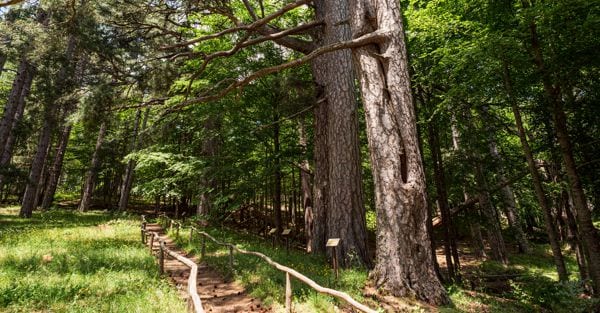
The forests of the Sila have healing properties, just like shamans. There is scientific evidence and certification to back this up: the silver firs, beech trees and Swiss pines of the ‘Enchanted Forest’ at Fago del Soldato emit high levels of volatile organic compounds – substances with beneficial antioxidant, anti-inflammatory, soothing and relaxing effects that help alleviate anxiety and mood disorders.
The CNR study on the Enchanted Forest
This was documented in a study carried out on Italian Alpine Club trail number 421 in Montescuro (Celico, Cs), in collaboration with the Institute for Bioeconomy and the Institute for Mediterranean Agricultural and Forestry Systems of the National Research Council. A total sensory immersion within the largest UNESCO-designated Man and the Biosphere (MAB) area, the Sila Biosphere Reserve, where the air is the cleanest in Europe.
The Voice of the Giants of Fallistro
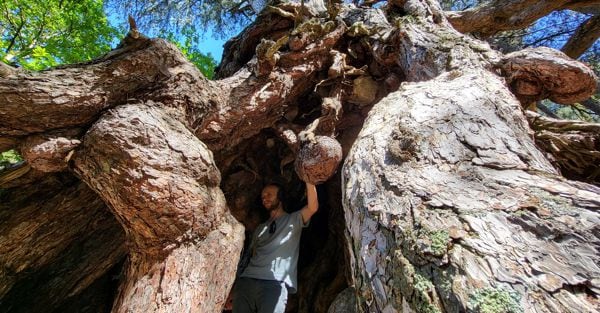
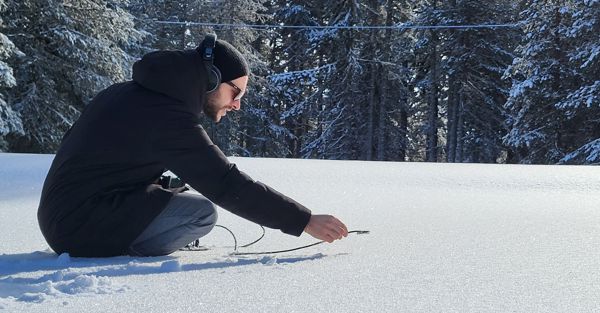
Not far away, in the centuries-old forest of Croce di Magara – home to the ‘giants of Fallistro’ – it has been proven that trees do indeed speak: every branch is a voice, a whisper, a heartbeat, a breath. Sound designer Domenico Palopoli, known professionally as Dasp, originally from Longobucco and trained in Milan, attached special microphones to the bark, linked to a digital recorder. And he waited for hours, even days, to capture the sounds of centuries-old pines, larch trees and maples: the wind, the sap, the dampness of the ground and the moss created a world of sound, at times noisy, at others harmonious. At times, like a deep sleep.
Forest closure and dendrological analyses
With trunks 45 metres tall, 2 metres wide and over 350 years old, the native trees of the reserve – now managed by the FAI – represent a historical and natural heritage of immense value to the Sila National Park and the whole of Calabria. Their health is currently being assessed: the woodland – which attracts over 50,000 visitors a year, with a high proportion of foreign tourists, particularly from northern Europe – is temporarily closed to the public following the collapse of two larch trees. The results of the analyses already carried out are awaited in order to draw up an action plan. The investigations were commissioned from Francesco Iovino, former lecturer in Ecology and Forest Systems Management at the University of Calabria and vice-president of the Italian Academy of Forest Sciences, and to Gianluca Piovesan, a lecturer in Ecology and Dendrology at the Department of Agricultural and Forestry Sciences at the University of Tuscia.
The restoration of the Casino Mollo
Simona Lo Bianco is the FAI’s representative for the Giants of Fallistro and the nearby Casino Mollo, a historic residence donated to the FAI by the Mollo barons, a family from Cosenza, in 2016: a beautiful country house which, once restoration is complete, will become a hub for the local area. It will tell the story and evolution of the Calabrian rural landscape. But in the meantime, deep in the woods, these uncertain months are being lived through with trepidation: ‘The Fallistro Giants are an important asset – in terms of tourism, culture and the economy. We are the gateway to the Sila National Park; we create jobs and run projects with local communities. The closure to the public, decided upon to ensure visitors’ safety – explains Simona Lo Bianco – is inevitably affecting our activities. But the analyses will enable us to redesign the visitor routes and define new strategies for the protection, conservation, management and enjoyment of the reserve’.