The collaboration

Tremonti: ‘Italia-China Commission launched – make way for parliamentary diplomacy’

The revival of the organisation is the result of a mission undertaken by a delegation of MEPs to Beijing last March. Europe must once again serve as a bridge between the West and the East. The challenge? To prevent war

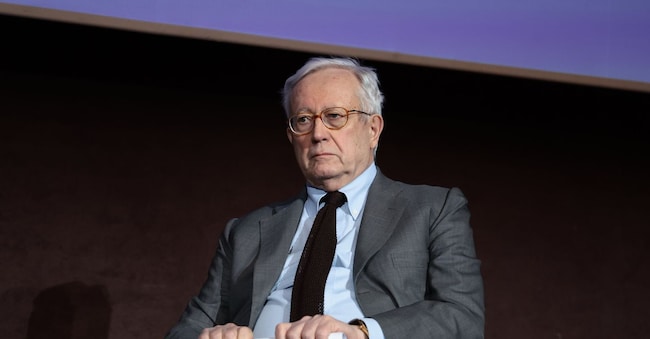
Giulio Tremonti Imagoeconomica

4' min read

Translated by AI
Versione italiana

4' min read

Translated by AI
Versione italiana

‘To rebuild a rules-based international order, without denying differences and points of contention’. An order in which Europe can reclaim its role as a ‘bridge between the West and the East’, with an ultimate objective that is as strategic as ever: ‘Avoiding war’. Giulio Tremonti summarises the crux of the discussions to be held by the “Parliamentary Commission for Italian-Chinese Cooperation” in *Il Sole 24 Ore*, which has just been re-established after a five-year hiatus following a visit to Beijing from 22 to 25 March by a delegation from the Chamber of Deputies’ Foreign Affairs Committee led by the former minister, who co-chairs the body alongside Wang Donming, vice-chairman of the Standing Committee of the National People’s Congress. A meeting is already scheduled: it will take place this autumn in Rome, at Montecitorio.

Could parliamentary diplomacy work where conventional diplomacy fails?

Loading...

 In conventional diplomacy, relations between states are hampered by the rigidity inherent in the origins and backgrounds of governments. With parliamentary diplomacy, representation is broader, as it includes the opposition. The dialogue was wide-ranging. During the mission, we met not only with fellow parliamentarians, but also with representatives of the Chinese Communist Party, the International Department and the Central Party School of the CPC Central Committee.

The university where she had given a lecture in 2009 on the crisis of globalisation.

 Yes. In March, I deliberately wore the School’s tie – a very austere one. None of our counterparts were wearing one. By then, everyone was wearing ‘Western’ ties. It’s a sign: compared to back then, China has retained its colossal economic stature but has now also developed an equally colossal political presence, comparable to that of the United States. The Italian proposal, seventeen years ago, during Italy’s G8 presidency, was to establish shared rules to move from free trade to fair trade. The point was clear: we cannot live in a world where the only rule is that there are no rules; instead, we need a global legal standard . Things turned out differently. It was thought that it would be enough to print money and draw up prudential rules for finance, and the Financial Stability Board’s approach prevailed. Today, there is very little sign of stability!

 Did China agree?

 The day after my lecture, we were invited to Tiananmen Square for a discussion with the head of the School. He was the Vice-President of the People’s Republic of China and his name was Xi Jinping. We discussed the structure of the world after the crisis whilst sitting round a table. Xi said that, to be stable, a table must have at least three legs. He was alluding to America, Europe and China – the same triangle outlined in the Ventotene Manifesto: America, Europe and Asia.

 Isn’t Europe too weak in this tripolar world?

 I see encouraging signs. Europe has handled the dispute over tariffs with the United States well. It has adopted a geopolitical strategy with Mercosur, which alters the BRICS framework. It has approved Eurobonds for the defence of Ukraine, a historic turning point. When they were proposed for common defence in 2003, during Italy’s six-month presidency of the European Council, the British Prime Minister Gordon Brown said he was voting against them because it was nation building. A line of reasoning that anticipated future geopolitics, brought to the fore by the war in Kyiv.

 Re-armament, however, is a divisive issue. Even in Italia.

Loading...

 Military spending must be at a European level. And this point goes beyond the current debate. Moreover, calculations must be made with the ‘new’ form of warfare in mind. In 1940, French generals were focused on the Maginot Line but ignored the internal combustion engine – that is, tanks. Similarly, today military strategists all too often ignore the modern realities highlighted by the war in Ukraine.

 Drones?

 Exactly. Back in 2000, together with General Carlo Jean, I wrote *Star Wars: Society and Economy in Cyberspace*. We must not make the mistake of investing in old weapons when a war is being fought with new ones. And we must not talk in terms of national spending, but think on a European level.

Is this Europe capable of overcoming parochialism, even in the industrial sector?

 Yes. At the end of the day, the best aeroplane out there is still the Airbus. But certainly, the Europe I’m referring to is not the narrow-minded one characterised by regulatory and bureaucratic interventionism. It is not, to be clear, the Europe that imposed individual sugar sachets in cafés some twenty years ago – which, from 12 August, will have to be replaced with refillable dispensers.

With all this talk of war, are we in danger of forgetting that peace is the ultimate goal of European integration?

 It is true that Napoleon’s prophecy on Saint Helena came true: ‘When China awakens, the world will tremble’. But I do not believe that war lies on the horizon. China has a mercantile mindset; the Great Wall was defensive. In 1989, in my essay “The Civil War”, I described the replacement of traditional warfare aimed at conquering territories – Thucydides’ war – with another type of conflict aimed at conquering markets and trade routes. Yesterday, China was fighting for the Silk Road; today, it is fighting for the Arctic route, which will turn Russia into Beijing’s Belarus. There are already Chinese workers in Siberia.

Behind the actual conflicts, from Ukraine to Iran, there seems, however, to be the shadow of the fierce rivalry between Washington and Beijing, with Moscow caught in the middle. 

 In 2005, I highlighted the ‘fatal risks’ facing Europe in the wake of 9/11, including the reaction of the orthodox Arab world against blasphemous Western civilisation. In many ways, we are still there, at the Gordian knot of the clash between East and West, a juncture in history where we Europeans stand guard. History is by no means over. It has returned, bringing with it long-standing grievances and geographical realities. The great challenge is to avoid war, confining it to its ‘civil’ dimension. I remain confident.

Copyright reserved ©

Brand connect

Loading...

Newsletter

Notizie e approfondimenti sugli avvenimenti politici, economici e finanziari.

Iscriviti