
Trentino invests in bike lanes, safety beyond bike lanes
Without narrowing the carriageway, marked lanes on the road invite motorists and cyclists to respect each other

3' min read
Key points
3' min read
Not ordinary cycle paths, but a formula aimed at promoting safer and more sustainable mobility, encouraging coexistence between motorists and cyclists.
The formula
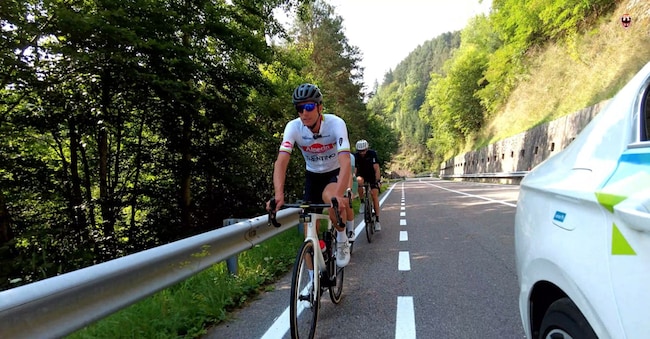
.The bike lane is not a narrowing of the carriageway: instead, it is a marked lane on the road, which acts as a deterrent and invites motorists and cyclists to pay more attention to each other. Cars can therefore travel it freely when there are no cyclists, while maintaining caution and respect for cyclists.
The Autonomous Province of Trento has just presented a new awareness-raising campaign dedicated to the bike lane, the urban cycle lanes also introduced in Trentino: the President of the Autonomous Province of Trento Maurizio Fugatti, world champion Maurizio Fondriest, the general manager of the Infrastructure and Transport Department Luciano Martorano and the manager of the Road Management Service Sergio Deromedis were present.
"This campaign was born with a clear objective: to make our roads safer and the coexistence between cyclists and motorists more serene - explained Fugatti - the bike lanes are not a cycle lane, but a sign of mutual respect. And for a land like Trentino, which has made sport and sustainable mobility an identity value, it means investing in the quality of life of citizens and the safety of our young people'.
The rules
.The bike lanes are cycle lanes drawn on the right-hand side of the carriageway, in the direction of travel of vehicles, with widths between 80 and 100 cm and are supplemented by symbolic road markings. They are delimited by discontinuous white lines and can be crossed by vehicles, bearing in mind that on many roads in Trentino, particularly in the mountains, there is not enough space to create lanes reserved exclusively for cyclists. However, the horizontal marking serves as a constant visual signal, to remind motorists of the possible presence of bicycles on the carriageway and to maintain a high level of attention to the safety of cyclists, who must always be treated with the utmost respect. The aim, therefore, is to make the space reserved for cycling visible and recognisable and to increase motorists' awareness, also through a continuous visual signal along the route.

