
Trento capital of economics: five ministers and two Nobel Prize winners on the first day
Academics and institutional and business leaders from three continents animate the city with high-profile debates from 22 to 25 May

3' min read
3' min read
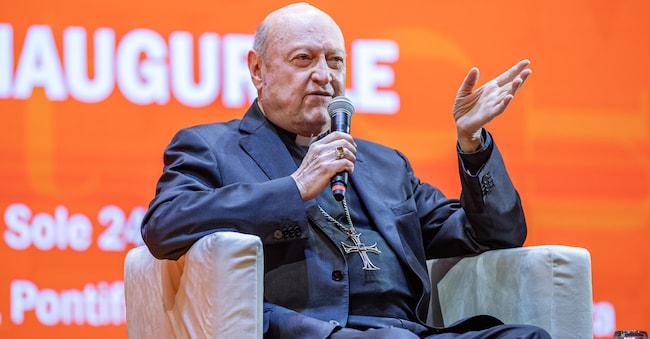
Over 300 events in four days in the schedules of the Festival dell'Economia, Fuori Festival, Economie dei territori, and Incontri con l'autore, with 650 speakers, popularisers and artists from all over the world in Trento from 22 to 25 May for the Festival dell'Economia 2025. The theme of this edition of the Festival, celebrating its 20th birthday, is "Risks and Fatal Choices. Europe at the crossroads". Internationally renowned academics (107), economists (45), Nobel Prize winners (6), representatives of institutions (66) and the economic and financial business community (61) will discuss this highly topical theme, chosen by the Festival's Advisory Board. The opening ceremony was entrusted to Cardinal Gianfranco Ravasi, President Emeritus of the Pontifical Council for Culture, with a lecture on the theme "Between the bulimia of means and the anorexia of ends". This will be followed, on stage, by speeches from the Festival organisers: Maria Carmela Colaiacovo, president of the 24 ORE Group, Flavio Deflorian, rector of the University of Trento, Maurizio Fugatti, president of the Autonomous Province of Trento, Franco Ianeselli, mayor of Trento, Maurizio Rossini, managing director of Trentino Marketing, Federico Silvestri, managing director of the 24 ORE Group, and Fabio Tamburini, editor of Sole 24 Ore, Radio 24 and Radiocor (as well as of the Advisory board and the Scientific Committee). The event has been renewed and enriched over the years with the new formula devised by the 24 ORE Group together with Trentino Marketing in the role of organisers on behalf of the local authorities. During the event, the first initiative designed to celebrate the 160th anniversary of Il Sole 24 Ore is also celebrated.
The first day featured speeches by two Nobel laureates: Michael Spence (Economics 2001) and Tawakkol Karman (Peace 2011) in dialogue with Father Enzo Fortunato. The American economist Spence was optimistic about the possibility for Germany and Europe to find the right solutions to overcome the economic stalemate they find themselves in. Provided, however, that the locomotive country of Europe and the entire continent begin to invest heavily in artificial intelligence, in order to close the current gap with the United States and China. The generative digital revolution, in fact, is the strongest lever to restart growth, because it allows a recovery of efficiency, competitiveness and productivity that can compensate for the slowdown in exports due to international tensions and the war of duties initiated by the Trump administration (but also by Europe in its dealings with China). A trade war that has generated great alarm on an international scale and ominous predictions of a global economic slowdown. Spence on the one hand believes that from Trump "we can only expect uncertainty", however he invites not to exaggerate on the "catastrophic impact" of his policies: "there will be a global slowdown but not a catastrophic one: the American economy represents 25% of the world economy, but the rest of the economy, from emerging countries to Europe, is resilient".
On the first day of the Festival, the 'squirrel people' were also able to listen to the views of five ministers (Alessandra Locatelli, Disability; Daniela Santanché, Tourism; Giancarlo Giorgetti, Economy and Finance; Antonio Tajani, Foreign Affairs; and Guido Crosetto, Defence, the latter three in connection) and a large representation of entrepreneurs and great managers (such as Marco Tronchetti Provera, Francesco Gaetano Caltagirone, Diana Bracco, Lavinia Biagiotti Cigna).
A broad overview was offered on various strategic areas of the world. Three panels were dedicated to China. The first was organised in collaboration with Ispi (also with Paolo Magri and Alberto Forchielli), then there was the meeting on the internationalisation of the renminbi (with two distinguished Chinese academics and Giovanni Tria), and finally there was the round table on the Asian bet with Roberta Casali, vice president Asia Development Bank. The meeting on the future of Gaza with Gad Lerner, Ugo Tramballi and Mohammed Abu Mughaisib of Médecins sans frontières, the debate on international corruption with Francesco Greco, the one on the regenerative economy with Andrea Illy, the one on training and work in and out of prison with Renato Brunetta (president of Cnel), and the one on monetary policy with Donato Masciandaro, were all very important.


