
Trento Festival of Economics opens its doors to the ideas of the new generations
Applications until 8 April for under-30s who would like to participate as speakers at events together with prominent national and international speakers

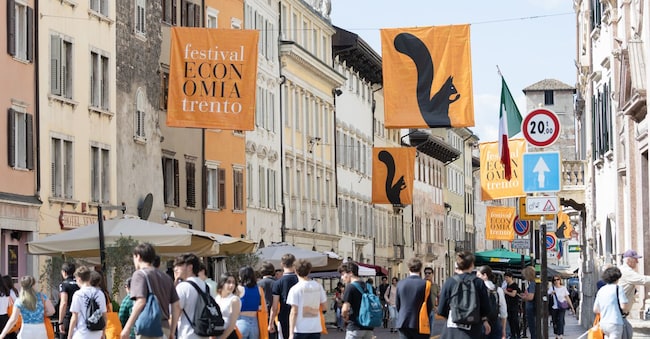
There is a thin line separating those who analyse change from those who live it every day. The Trento Festival of Economics chose to start from there, trying to bridge that distance and bring to the stage the point of view of a generation that moves within unstable markets, changing jobs and redefining powers.
With the call for ideas "The Voices of Tomorrow", the Trento Festival of Economics - organised for the fifth consecutive year by the Il Sole 24 Ore Group and Trentino Marketing on behalf of the Autonomous Province of Trento and with the collaboration of the Municipality and the University of Trento, to be held from Wednesday 20 May to Sunday 24 May - opens its official programme to the under-30s, inviting them to take to the stage not as spectators, but as speakers.
A passage that says a lot about the times we are living through: the economy is changing, transforming, redefining hierarchies and powers. And so it becomes natural to ask those who are now entering work, business, research, to tell us what they see and imagine.
The objectives
It is no coincidence, moreover, that the 21st edition of the Trento Festival of Economics bears a significant title that sounds like a declaration of intent: 'From markets to new powers. The hopes of young people'. It is a formula that brings together two levels. On the one hand, there are the markets, which are increasingly global and interconnected, and which have never been traversed as in this phase by geopolitical tensions, technological transitions and new value chains. On the other there are the powers that are being redesigned: the financial, the political, the platform and data powers. In between, a generation looking for space and perspective.
Trento tries to build a bridge. It does so with a five-day event in which the intention is to open up the historic centre even more to meetings, debates and comparisons. And all this by putting those who usually remain in the audience at the centre.


