Geopolitics

Tronchetti: the West does not split, negotiate with Trump

Tariffs absorbed because declarations have 'landed in sustainable territory'. Same expected outcome on Hormuz: war costs too much
by Chiara Di Michele

4' min read

Translated by AI
Versione italiana

4' min read

Translated by AI
Versione italiana

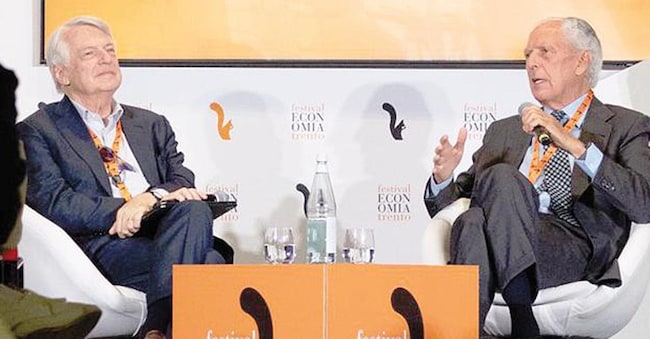
An all-round discussion on the world's intertwined destinies between war and peace in times when every forecast is permeated by great uncertainty and Europe needs to evolve in order to grow and be a protagonist among the great powers. It will be animated by Marco Tronchetti Provera, Pirelli's executive vice-chairman, together with Ferruccio de Bortoli, during the Trento Festival of Economics.

Starting from the observation that from 2022 - with Russia's invasion of Ukraine to continue with the conflicts in the Middle East - the term war is repeated daily, 'to make predictions today is an act of presumption without any real content,' Tronchetti observes. The war is in fact on the borders of Europe and the Middle East is where the main sources of fossil energy are located. So, it is another element that clearly destabilises future predictions.

Loading...

A scenario that was preceded by another crucial issue: tariffs. Which, however, have now almost faded into the background. 'We absorbed the tariffs because US President Trump's initial statements landed in generally sustainable territory. We have all managed to accelerate the reorganisation and cost-cutting processes,' explains the tyre group's number one.

Even today, with the crisis in the Middle East, 'the markets are betting on a normalised landing', i.e., on the reopening of the Strait of Hormuz. Because this war between the United States and Iran is 'too costly for everyone'. The manager and entrepreneur hopes for 'a path not to split the West, which President Trump tries to split every day'.

This means that Europe must 'find a way, however much we may not like it, to stay in a negotiating phase with the United States, to keep them engaged'. It means 'having the strength to stay together', because 'we Europeans are a happy island and we must fight to stay that way'. Tronchetti cites as an example the focus on social protection, which 'does not exist anywhere else'. But to defend all this, 'we have to defend our borders, in the technical sense of the term, but also by sitting at the tables. We must strengthen our market and find a long path of autonomy and defence, which means first of all governance, which is not there'. The problem is that 'we are not able to give ourselves governance', but this 'can be done', also because 'Europe must be our future, there is no alternative'. But this Europe 'must evolve', because the current model 'is at social risk if the economic perspective is not changed and if governance is not changed'.

Moreover, we live in a time in which 'China also has serious problems with internal growth, consumption growth, and export needs'. Therefore, 'a Europe in recession, in a phase of China's expansion in European markets, would certainly be a serious loss for Beijing as well,' Tronchetti goes on to explain. Even on the defence front, 'it is unimaginable to date for European defence to be able, in the next 15-20 years, to match China, the United States, and Russia,' Tronchetti Provera argues, adding that 'Europe could not afford to go to war without the US, which has a frightening investment' in this sector. Then there is the unknown of Russia, since 'alone I do not think there is a chance of defending Europe's borders', just as 'you cannot develop artificial intelligence in Europe without a connection with the American clouds'.

On the business side, continued Pirelli's executive vice president on the opening day of the Trento Festival, 'we must continue to focus on efficiency, accelerate innovation, technologies, and focus on risk reduction'. However, 'a major issue' remains open, which is that of raw materials and which involves Europe above all, given that the sources are not close to our geographies.

On this, the Old Continent 'is risking a lot', warns Tronchetti, who then turns a glance towards the future. For a global company like Pirelli, it remains fundamental to 'produce local for local, to have regional suppliers, whether in the United States, China or Europe'. It is a strategy that Pirelli has been pursuing for many years now and that has led it over time to a manufacturing presence in 12 countries around the world with 18 plants, all of which share a strong focus on technology.

This is also confirmed by the recent announcement of the future production of its flagship technology, Cyber Tyre, in the plant the group has in the US, in Georgia, to preside over one of the world's most important markets for the high value segment. 'It will be one of the most important capacity growth projects in the coming years,' Tronchetti said.

This announcement came after the overcoming of the impasse over US regulations on connected vehicles, which prohibit the use of software and hardware made by companies with a significant presence in the capital of a Chinese shareholder such as Sinochem in Pirelli. This was made possible by government intervention with the application of Golden Power, which 'guarantees Pirelli full compliance with US regulations and connected vehicles'.

Copyright reserved ©
Loading...

Brand connect

Loading...

Newsletter

Notizie e approfondimenti sugli avvenimenti politici, economici e finanziari.

Iscriviti