
Trump to Nato allies: 'Cowards'. London grants bases for Iran raids
US president: 'I don't want a cease-fire, we are annihilating them', sent three more military ships and 2,500 more marines to the area

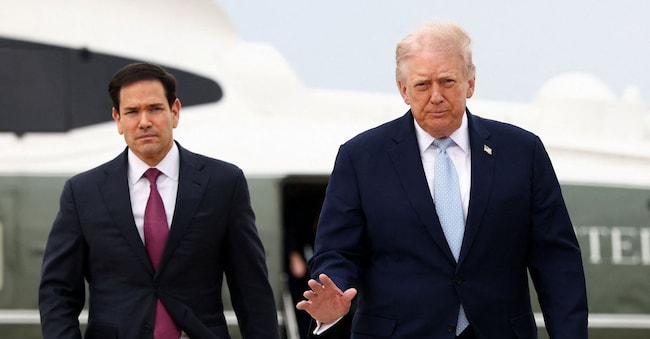
Donald Trump lashes out and insults Nato allies again: "They are cowards! They complain about oil prices, but they don't want to help us in Hormuz. They are cowards and we will not forget that,' the US president declared on social media. Three weeks away from the start of the bombing of Iran, while the United Kingdom gives the green light to the US to use the bases also 'in attack missions', three more American warships and thousands more marines are about to arrive in the Middle East: a sign of strength, in the intentions of the Republican administration, which may however become weakness, revealing that, beyond the continuous reassurances, the American army risks being dragged into a conflict that is much longer than the 'five or six weeks' announced by the White House.
And after all, the Pentagon's request to Congress on Thursday for approval of a 200 billion package to finance the conflict suggests a prolonged intervention. "I don't want a ceasefire. You don't do a ceasefire when you are literally annihilating the enemy,' Trump explained yesterday. And again: 'We could withdraw from Iran even immediately and Tehran could not rebuild its military capabilities for at least ten years. But this is not an acceptable situation, the goal is not regime change, what we are interested in,' he said, 'is that Iran never has nuclear weapons again'.
Washington's pressure on its allies is very strong and yesterday brought a first result, although 'too late' according to Trump. The UK government authorised the US to use British bases to launch operations against Iranian targets controlling and attacking the Strait of Hormuz. While continental Europe attempts diplomatic mediation to avoid becoming involved in the war, British Prime Minister Keir Starmer - according to Downing Street sources telling the BBC - has decided to widen the green light granted to the US, hitherto limited to 'operations to prevent direct threats to British interests or lives'. The new authorisation granted by London now also includes US 'defensive operations' to neutralise Iranian positions and reopen Hormuz. The Starmer government has made it clear that there will be no direct involvement and that 'the principles underpinning the British approach to the conflict remain unchanged'. But it has had to endure threats from Iran: 'Starmer is putting British lives at risk by allowing UK bases to be used for aggression against Iran,' said Iranian Foreign Minister Abbas Araghchi, stressing that Tehran will 'exercise its right to self-defence'.
Meanwhile, the Pentagon continues to step up military intervention against the regime in Tehran. According to reports by US officials to the Reuters news agency and the Wall Street Journal, another 2,500 marines are about to go into action in the Middle East, adding to the 50,000 US troops already in the region: these are assault troops that can also be used in a ground operation.
For the US, at this stage, it is necessary to secure the Strait of Hormuz, if need be by deploying US forces to the Iranian coast, or by sending ground troops to the Iranian island of Kharg, a crucial hub for 90% of Iran's oil exports. "I have no intention of deploying troops anywhere, but if I do, I certainly won't say so in advance," Trump said, well aware that any deployment of military personnel on the ground, even for short missions, carries significant political risks: a Reuters-Ipsos poll, concluded on Thursday, shows that about 65% of Americans believe Trump will order large-scale ground troops to be sent to Iran, while only 7% support this decision.


