
Duties, Trump backtracks: 90-day truce. But those to China rise to 125%.
The announcement came in the face of growing nervousness among businesspeople and the public. Beijing had raised tariffs on imports from the US to 84%.

3' min read
3' min read
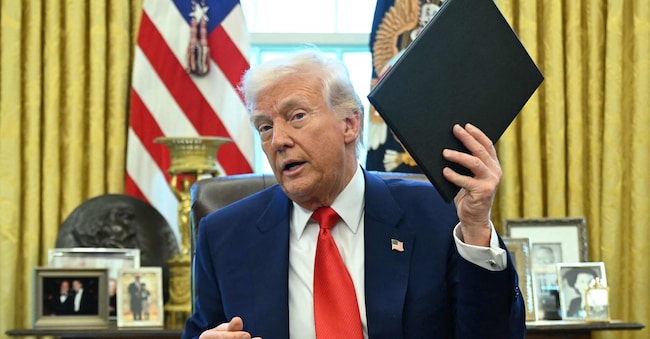
Donald Trump declares a 90-day truce in his tariff war. Citing the desire of dozens of nations to negotiate, he backtracked, ordering the suspension of much of the reciprocal tariff trade offensive against allies and partners - the exception being China - from the Truth Social megaphone.
The transition to the universal 10%
."I have authorised a 90-day pause," he announced, mentioning that 75 foreign capitals would come forward to negotiate over the imbalances in trade reported by his administration. The President specified that the pause 'is effective immediately'. And that during the armistice a 'substantially lowered reciprocal duty, at 10 per cent' would be applied. Spokeswoman Karoline Leavitt went on to explain that that tariff corresponds to the universal, minimum 10% triggered against all imports since Saturday. The president closed his message with: 'Thank you for your attention'.
In a subsequent press conference, Trump emphasised that he had granted the break first 'to those who did not decide on reprisals' and admitted that he had acted because 'people were getting a little scared'. He evoked possible 'fair deals' with many nations, including the European Union, and also did not rule out understandings with China: 'They don't know how to do it, but they want a deal'.
No peace with Beijing
No peace is on the agenda, however, with Beijing at the moment. On the contrary, Trump has intensified the conflict with his strategic rival: he raised tariffs to 125% after China had responded to his initial tariffs of up to 104% with its own 84% levies. An action 'based on China's lack of respect for the world's markets'. Beijing, even before the latest escalation, had made it known that it had the 'firm will and means for the necessary countermeasures and to fight to the end'.
And that 'if the US really wants to resolve differences through dialogue and negotiation, it should adopt an attitude inspired by equality, respect and mutual benefit'. Beijing has also launched new complaints against Washington at the WTO and decided on further limits against US companies. Eleven companies, in particular, have been added to a blacklist banning them from purchasing and transacting with Chinese groups, including some Pentagon suppliers.


