Trade wars

Trump downplays exemptions on electronics and announces new duties on tech. China blocks exports of rare earths

The exemptions are 'temporary' and 'no one will be spared from our tariffs', says the President. Confusion over White House moves. Beijing freezes rare earths, critical minerals and magnets.

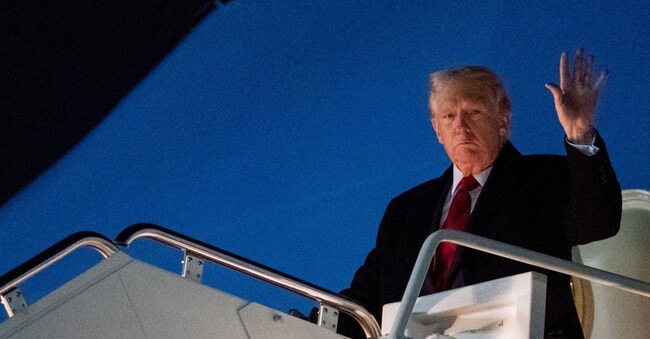
U.S. President Donald Trump exits Air Force One as he arrives at Joint Base Andrews in Maryland, U.S. April 13, 2025. REUTERS/Nathan Howard

3' min read

3' min read

Donald Trump's tariff saga, were there still any doubt, continues under the banner of great uncertainty and chaos. In the last few hours, the US President has threatened new tariffs on tech, from semiconductors to FMCG electronics, dampening optimism about a possible de-escalation of his economic wars. An optimism that had instead been fuelled by significant exemptions on electronics, first and foremost from China, decreed not two days earlier.

To add to the concerns, Beijing is responding harshly to the White House trade war: it has effectively suspended exports of a range of rare earths and critical minerals, including powerful magnets essential to industries from auto to aerospace, from chip giants to defence companies. The magnets are crucial for assembling vehicles and robots such as drones and missiles. Beijing created a system earlier this month that requires special licences for such exports, and the New York Times revealed that such permits are currently at a standstill and that the complete halt threatens to bring paralysis to many industries.

Loading...

Trump again raised the tariffs after attending a mixed martial arts championship in Miami, together with Elon Musk and other trusted associates. The tournament has become almost a symbol of his aggressive policies. Stepping into the trade ring again, the President downplayed as temporary the reprieve granted Friday night to smartphones, PCs and other products by his so-called reciprocal tariffs to declare peremptorily: 'No one will escape our tariffs.

What's more: he promised that new barriers will soon be erected on microchips and the entire supply chain of technology and electronics, stating that he is in the crosshairs of investigations and national security measures to reindustrialise America.

"We will examine semiconductors and the entire electronics supply chain in our tariff investigations for national security reasons," he said on his Truth Social media outlet.

'Those products,' he added, referring to smartphones such as Apple's iPhones, computers and chip machines currently spared from the reciprocal duty category, 'simply ended up in another tariff bracket.

Commerce Secretary Howard Lutnick in turn described the exemption on electronics as temporary and indicated that duties on chips and tech are expected within sixty days. Products exempted today, he indicated, "are included in duties on semiconductors, probably coming within a month or two. Duties on iPhones, he pointed out, may also come into play here, without clarifying whether directly or indirectly because of the chips used: 'We have to take our medicine and we have to make semiconductors and electronics in America. Apple now produces 80 per cent of its iPhones in China.

It is a medicine, the one proposed by Lutnick, that for many economists is not only bitter but ineffective and counterproductive. Hardly any analysts believe that complex global manufacturing chains such as the tech industry can be reinvented by tariff shocks. Rather, the more likely scenario is one of spiralling downturns, inflation and investment uncertainties, which can damage competitiveness and innovation.

The exemption on electronics currently in place, however, offers at least a measure of immediate relief to brands from Apple to Nvidia and Google, as well as Taiwan Semconductor and Samsung. The many tech products pardoned for the time being account for 23% of US imports from China and bring down the overall average US effective tariffs to 22% from 27% previously. Those average duties, however, remain up dramatically from 2.3% last year. Compared to imports from China as a whole they are now 106% instead of 145%.

There are still separate 20% tariffs in force against China on fentanyl, which also affect electronics. The exemption for smartphones and PCs, as well as accessories, chip-making machinery, solar cells and flat screens, however, concerns 125% barriers raised against Beijing under the label of reciprocal duties. Also suspended for such products is a universal 10% duty against all countries, thus for Asian nations that are themselves crucial to the technology supply chain, from Taiwan to Vietnam and India. Exempted in this way for now are two thirds of imports from Taiwan, 44% from Malaysia and 30% from Vietnam and Thailand.

Faced with the heavy unknowns that remain over Trump's trade policy, hedge fund guru Ray Dalio, founder of Bridgewater Associates, said he feared something "deeper" than just a recession. "We are witnessing a breakdown of the monetary, political and geopolitical order," he said. 'We are at a decisive moment, very close to a recession,' he continued, 'and I fear something worse if the situation is not handled well.

Copyright reserved ©
Loading...

Brand connect

Loading...

Newsletter

Notizie e approfondimenti sugli avvenimenti politici, economici e finanziari.

Iscriviti