Asia

Trump hears Xi then asks Japan to tone down on Taiwan

The US president picked up on China's outburst and called the Japanese premier Takaichi suggesting restraint

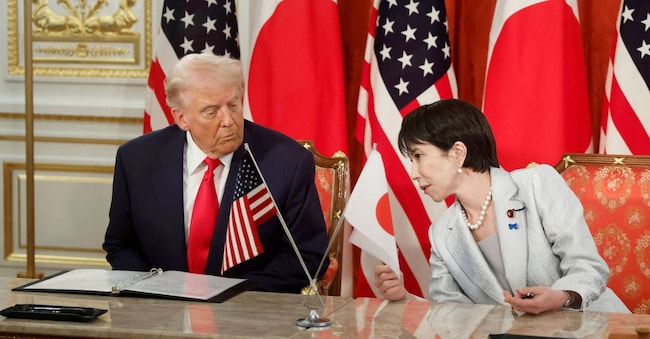
Trump avrebbe raccomandato a Takaichi cautela nelle sue dichiarazioni sulla questione di Taiwan, così da non irritare la Cina

4' min read

Translated by AI
Versione italiana

4' min read

Translated by AI
Versione italiana

Chinese leader Xi Jinping was angry and US President Donald Trump listened to him. Days after Japanese Premier Sanae Takaichi outraged China by suggesting that a Chinese attack on Taiwan could mobilise a military response from Tokyo, Xi spent half an hour on the phone with Trump, according to people briefed on the matter, reiterating China's historic claim to the democratically self-governing island and the joint responsibility of Washington and Beijing in managing the world order.

Later the same day, Trump scheduled a phone call with Takaichi and advised her not to provoke Beijing on the Taiwan sovereignty issue, Japanese officials and an American briefed on the call said. Trump's advice was subtle and did not pressure Takaichi to retract his comments, the informants said.

Loading...

Japanese officials said the message was worrying: the president did not want friction over Taiwan to jeopardise the détente reached last month with Xi, which includes a promise to buy more agricultural products from US farmers hit hard by the trade war.

Asked about the exchange with Takaichi, the White House released a statement from Trump to the Wall Street Journal: 'US relations with China are very good, and this is also very good for Japan, which is a close and dear ally of ours. Getting along with China is a very good thing for China and for the United States. In my opinion, President Xi will greatly increase the purchase of soya and other agricultural products, and anything that is good for our farmers is good for me.

And then a message addressed to Tokyo: "We have signed wonderful trade agreements with Japan, China, South Korea and many other nations, and the world is at peace," Trump added. "Let's keep it that way!"

The Japanese prime minister's office declined to comment. The episode highlights a new reality in US-China relations. The trade truce with China and the Taiwan issue have become inextricably linked as the President and Xi prepare for several meetings next year. Although official US policy recognises without endorsing Beijing's claim to the island, Washington has provided Taiwan with defensive weapons, ensuring that its fate is not determined by China's strength.

Trump praised Takaichi for his hard stance on defence and held an event with her aboard a US aircraft carrier in the Japanese city of Yokosuka, in a strong demonstration of the alliance between the two countries.

But Takaichi infuriated Xi, at a difficult time for Trump, who is cultivating a relationship with the Chinese leader. Speaking to lawmakers on 7 November, Takaichi warned that Japan could deploy its armed forces along with other nations if China were to attack Taiwan. The remarks prompted Beijing to take economic and diplomatic retaliatory measures against Japan. One Chinese diplomat wrote on social media that they should slit her throat.

Trump's phone call to Takaichi reflected the intense focus on Taiwan in the official Chinese account of their discussion on Monday, people briefed on the matter said. Xi told Trump that "Taiwan's return to China is an important component of the post-war international order," the Chinese account read.

During the phone conversation, Trump suggested to Takaichi that he moderate the tone of his comments on Taiwan, said the American briefed on the matter, adding that Trump had been informed of his domestic political constraints and knew that he probably could not fully retract his comments that had irritated Beijing.

Tokyo's position was that Takaichi was speaking hypothetically and articulating long-standing Japanese policy, although it was unusual for a sitting prime minister to be so explicit.

Trump told reporters on Tuesday night that he had a 'very good conversation' with Takaichi. "We have a very good relationship," he said. "He's very smart, he's very strong. And he will be a great leader."

During a debate in Japan's parliament, Takaichi said on Wednesday that she had not planned to go into the specifics of the Taiwan contingency, comments that some analysts see as a sign of softening. "I had no intention of mentioning any details," Takaichi said, when asked by a lawmaker about remarks that irked Beijing.

According to analysts, the sequence of the phone calls - first China, then Japan - may reflect Trump's willingness to curb an ally's controversial stance on a central geopolitical issue in the service of US trade relations with Beijing.

"It's not at all surprising that an American president would talk to both Chinese and Japanese leaders," said Matthew Goodman, a former Obama administration Asia specialist who works on geo-economic studies at the Council on Foreign Relations. "But the order of the phone calls is interesting and probably raised a few eyebrows in Tokyo."

The phone call between Trump and Xi highlighted what matters most to the two leaders. A person close to the White House said the call was about trade, adding that Washington is concerned about China's delay in implementing promised soybean purchases.

Trump said on Tuesday night that he had told Xi: 'I wish you would buy a little faster'. The reference was to China's promised purchases of US agricultural products. "He more or less agreed to do that," he said.

After the late October meeting between Trump and Xi in South Korea, Washington stated that China had agreed to purchase 12 million tonnes of soya by the end of the year and 25 million tonnes per year for the next three years. Beijing has not issued an official statement confirming these figures.

Xi's main focus was on Taiwan. Although Xi did not mention Japan or ask Trump to put direct pressure on Tokyo, his discussion of the post-World War II order was an implicit reference to Japan as a losing party, showing the depth of his concern over recent tensions.

The Wall Street Journal reported that Xi is seeking the ultimate concession from Trump, a pledge to 'oppose' Taiwan's independence. The State Department stated at the time that the US opposes 'any unilateral change to the status quo on either side' and that 'China poses the greatest threat to peace and stability in the Taiwan Strait'.

Copyright reserved ©

Brand connect

Loading...

Newsletter

Notizie e approfondimenti sugli avvenimenti politici, economici e finanziari.

Iscriviti