
Live
Iran, EU against the crisis: 'Smart working mandatory and discounts on public transport'
In Paris meeting of 'volunteers' for the security of the Strait of Hormuz. At the Elysée Palace also Giorgia Meloni
For feedback, please contact
english@ilsole24ore.com
Summary by points
Meloni arrives at Paris summit
Italian Prime Minister Giorgia Meloni arrived at the Elysée Palace for the meeting hosted by France and the UK aimed at organising a multinational mission to guarantee freedom of navigation in the Strait of Hormuz once the war is over. The Italian leader joins French President Emmanuel Macron, British Prime Minister Keir Starmer and German Chancellor Friedrich Merz, who will discuss the issue with several dozen global leaders connected via video conference.
Hormuz and naval blockades, Paris proposes a 'third way'
At the Elysée Palace, there is talk of a 'third way' between the blockade of the strait decided by Iran and the blockade imposed by the US on ships arriving in and departing from Iranian ports: 'A third way is needed between the maximum pressure previously exerted by the United States on Iran and the resumption of the war, including the Iranian destruction of the Gulf States'. An operation that would be carried out 'in close contact with the United States even though there will be no coalition with them because we are not a party to the conflict'. The idea is to involve 'non-belligerent' countries.
Some have emphasised the difference in the approach to the topic between the German Chancellor and the French President. Yesterday, Merz indicated that Germany is ready to contribute to the security of sea routes under certain conditions and that he also wants to discuss 'the participation of American military forces'. The French side denies that it is possible to form a coalition with the US. The White House also reiterated yesterday that the US Navy has all the means to guarantee security in the straits, however Trump has repeatedly indicated that security is the business of the Europeans. In any case, neither Americans nor Israelis will, of course, attend today's meeting.
The German government has indicated readiness to deploy minesweepers on condition that there is a stable agreement to stop bombing on both sides, that there is an international (UN) mandate. However, it will have to pass a parliamentary decision.
The military security mission should be purely defensive and aimed at guaranteeing the passage of ships. The plan would involve three stages: definition of the means to allow freedom of transport through the strait; logistical support for the currently blocked ships; and military aspects to guarantee freedom of movement. It is expected to be clearly stated today that there is to be no toll for passage through the strait (as Iran wants).
Paris meeting of 'volunteers' for Strait of Hormuz security
While the European stock markets remain cautious but positive, awaiting precise signals on the negotiations between the United States and Iran, and even oil prices have resumed their descent in Asia, the highest political decision-makers of some thirty countries will meet in Paris in the early afternoon to take stock of the 'initiative for maritime navigation in the Strait of Hormuz'. In essence, this is the mission of the 'volunteers' to guarantee the safety of maritime traffic in the strait through which a significant share of the trade in oil, gnl, fertilisers, sulphur and helium passes, the blockade of which due to the war waged by the USA and Israel against Iran is causing what the International Energy Agency has described as 'the greatest threat to energy security in history'.
At today's meeting the bulk of the participants will connect remotely in their respective capitals, at the Elysée Palace there will be Macron's guests the British Prime Minister Starmer, the German Chancellor Merz and the Italian Prime Minister Meloni, who at this stage has decided to appear more 'voluntary' than ever, after her recent distancing from the latest moves of US President Trump. For the PM to participate in person and not remotely in today's meeting is a precise political signal that certainly has domestic political implications (after the defeat in the referendum on justice reform) as well as political positioning in Europe.
French sources indicate that a press statement by the four European leaders is expected at the end of the meeting. Not only that: the list of participants will be circulated at the end of the meeting and the participation of Australia, Canada, Latin America, Japan and South Korea is indicated
There are rumours that China might eventually participate in some form, too, and this would be a first. On the other hand, before the war on Iran, China imported 1.3-1.4 million barrels of Iranian oil per day, or about 13% of total imports. The import of LNG that passed through the strait amounted to a quarter of China's total import of natural gas, most of which came from Qatar. Although China's energy mix has changed structurally, crude oil imports from Russia have increased, and China has large strategic reserves that are estimated to cover 80 days, the Hormuz blockade is considered an extremely dangerous bottleneck if protracted.
Macro and Starmer's goal is to guarantee the so-called 'coalition of the willing' a decisive role in the security of navigation in the strait on the precondition that the ceasefire between the US/Israel and Iran be consolidated because it is considered fragile. After Trump's tugs and threats against Europe, both European and Asian sides realised that the wait-and-see strategy becomes a boomerang. On the other hand, however, there is a line that the 'willing ones' do not want to cross both in order not to bow to Trump's increasingly dangerously indecipherable and contradictory manoeuvres, and in order not to get directly embroiled in the armed conflict: to participate in the cross-strait security operation yes, but only if the bombing stop is consolidated. Better if with an international mandate.
'Freedom of navigation in the Strait of Hormuz is an immediate priority, especially given the global economic consequences of this conflict,' they indicated at the Elysée. In some areas, the time of the real emergency is approaching. The International Energy Agency has indicated that aircraft fuel supplies in Europe are only enough for about a month and a half and that announcements of further flight cancellations will soon multiply if the Strait of Hormuz remains blocked. The Middle East supplies about one fifth of the world's aviation fuel, with prices even exceeding two hundred dollars per barrel.
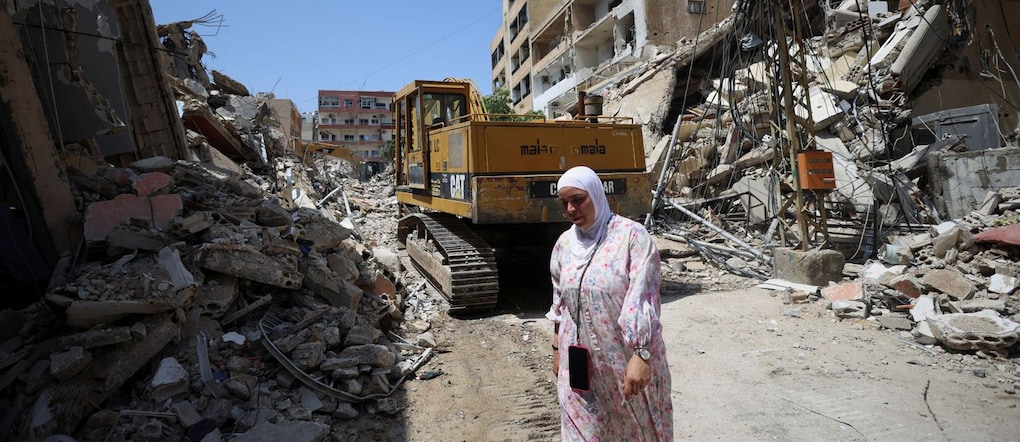
Una donna cammina sul luogo di un attacco israeliano avvenuto prima dell’entrata in vigore del cessate il fuoco di 10 giorni tra Libano e Israele, a Tiro, in Libano, il 17 aprile 2026. REUTERS/Louisa Gouliamaki REUTERS
Ask the editorial team
Have questions or feedback about this article? Contact our editorial team.
'Grande Torino' still stranded in the Persian Gulf, 21 seafarers on board
Stranded in the middle of the Persian Gulf along with hundreds of other ships:almost two months after the start of the war in Iran, the situation of the Grande Torino is not unblocked. The Grimaldi Lines car carrier continues to remain at anchor, not too far from the Iranian island of Kish, and with a crew of 21 seafarers on board, including 3 Italian officers and 18 sailors of Filipino nationality. The situation of the Grande Torino seemed to be unblocked with the truce announced a few days ago but today it still remains very uncertain; the fate of the Italian-flagged ship is being closely monitored by both the Neapolitan shipping company and the Farnesina. In addition to the crew on board the ship, launched in 2018 and just under 200 metres long, there are several new cars loaded in Japan and China; the Grande Torino had unloaded part of them in some Persian Gulf ports it was leaving to continue its itinerary and disembark the rest of the vehicles still on board (ANSA).
Most popular stories

Three Iranian oil tankers left the Gulf through Hormuz
Three Iranian oil tankers on Wednesday left the Gulf through the Strait of Hormuz with five million barrels of crude oil, the first since the US blockade of Iranian ports began. Maritime data company Kpler told AFP today.
According to Kpler's data, the Deep Sea, the Sonia I and the Diona, all three subject to US sanctions, passed through this strategic passage. All came from the island of Kharg, home to Iran's largest oil terminal, through which about 90 per cent of the country's crude oil exports pass, according to a note by the US bank JP Morgan.
The tankers loaded their cargoes on 2, 8 and 9 April respectively. The Deep Sea and the Diona each carry two million barrels, while the Sonia I carries one million, according to Kpler. Since Monday, Washington has imposed a blockade on Iranian ports with the aim of preventing Tehran from exporting its oil, although these exports had not been interrupted since the beginning of the war on 28 February.
India, we were invited by France and Gb to the mission for Hormuz
India says it has been invited by the United Kingdom and France to join the Volunteers' mission to restore safe navigation through the Strait of Hormuz. The announcement by India's Foreign Ministry spokesman, picked up by Al Jazeera and Reuters, comes as international efforts to restore safe navigation through the strait intensify.
Tajani: 'In Lebanon turn truce into peace, ready to do our part'
The signals coming from Lebanon "are positive", yesterday's step "was important" and "now we have to transform the truce into peace": "Now we will do our part so that we can move forward and peace is the priority for everyone". This was said by Italy's Deputy Prime Minister and Foreign Minister Antonio Tajani, speaking in Shanghai at a meeting with representatives of the Italia system and the Italian business community in China, stressing that Hezbollah "must end its attack against Israel".
EU: Egypt, Lebanon, Jordan, Syria and the Gulf also at Cyprus summit
The leaders of Egypt, Lebanon, Jordan, Syria and the Secretary General of the Gulf Cooperation Council Jasem Mohamed al Budaiwi have been invited to attend an extended session of the informal European Council to be held in Cyprus next week. This was announced today by Cypriot Deputy Minister of European Affairs Marilena Raouna during a press conference.
EU draft, against the crisis mandatory teleworking and discounts on public transport
At least one compulsory telework day per week, cheaper public transport, heating cuts and energy vouchers for vulnerable households. These are some of the measures the European Commission recommends to member states in the draft 'Accelerate Eu' plan, due on 22 April, to tackle the war-related energy crisis in the Middle East. The package aims at the voluntary reduction of consumption, especially in heating and transport. Among the indications: limiting energy use at home, avoiding waste and shifting consumption away from peak hours, along with incentives for sustainable mobility. Administrations are asked to set an example with regard to consumption and lighting, while businesses and buildings are asked to be more efficient.
17 April 2026
Iran: no to temporary ceasefire, stop war in the whole region
Iran rejects any temporary ceasefire and hopes for a final solution to the conflict throughout the region. This was stated by Iranian Deputy Foreign Minister, Saeed Khatibzadeh, speaking to the press on the sidelines of the Antalya Diplomatic Forum.
According to Turkish news agency Anadolu, Khatibzadeh said that any ceasefire must include all conflict zones, "from Lebanon to the Red Sea", calling it a "red line" for Iran.
17 April 2026
Lebanon, Hezbollah deputy: 'Government not authorised for talks with Israel'
A Lebanese MP from Hezbollah's parliamentary bloc, Hassan Fadlallah, stated that "the Lebanese government is not able, not capable, and not constitutionally or nationally authorised" to conduct direct negotiations with Israel. According to the MP, direct talks constitute "a concession" to Israel "so dangerous that it threatens the future of Lebanon", since the Israeli army (IDF) remains on Lebanese soil. "In these ten days, we want Iran to continue its efforts to force Israel to follow the line imposed by the Islamabad talks," Fadlallah added, speaking to the press in the Haret Hreik neighbourhood on the southern outskirts of Beirut, which has been hard hit by the bombings. Fadlallah also warned that Hezbollah will not remain silent if Israel continues its attacks in southern Lebanon.
17 April 2026
Katz 'Idf maintains control of positions won in Lebanon'
Israeli Defence Minister Israel Katz stated that the IDF "maintains and will continue to maintain" all the positions it has "reclaimed and conquered" in Lebanon, saying that Israel is still in the middle of a war against Hezbollah and that its goals have not yet been achieved. In a statement released by his office, Katz said that the goal of disarming Hezbollah "by military or diplomatic means" remains the central objective.
17 April 2026
Lebanon: US, ceasefire with Hezbollah is the beginning of a path
The 'brilliance' of the ceasefire between Israel and Hezbollah in Lebanon lies in putting an end to 'senseless killings' and 'this is only the beginning of a journey'. This was said by Tom Barrack, US special envoy to Syria and ambassador to Turkey, speaking at the Antalya Diplomacy Forum, a conference hosted by Turkey. "The brilliance of what happened yesterday lies in the fact that it put an end to the senseless killings and that President Trump and Secretary Rubio intervened forcefully stating that we need a truce," Barrack said. "This is just the beginning of a journey and ceasefires are very delicate because everyone has proven to be equally unreliable," he added. "Everyone is exhausted because of this absurd war. So will the ceasefire hold? What are we going to do? These are small steps," he concluded.
17 April 2026
Lebanon: IDF raid on Tyre just before truce, 13 dead and 35 injured
At least 13 people were killed and 35 injured in Tyre, Lebanon, by an Israeli IDF raid just minutes after the truce came into effect at midnight last night, local sources told Afp. Rescuers are still searching for survivors - 15 people are still missing -- in the rubble. Six residential buildings were destroyed in the shelling.
17 April 2026
Iran: if truce continues, possible resumption of internal flights
Some 50 aircraft were damaged by US and Israeli attacks, including 10 destroyed by direct missile strikes, said Mohammad Reza Rezaei Kouchi, chairman of the Iranian parliament's construction committee, who said that some of the damaged aircraft could return to service and domestic and international flights could resume if an agreement was reached or if the ceasefire was extended. "There are no serious infrastructure problems," he concluded. Iran International writes.
17 April 2026
Lebanon, Hezbollah deputy thanks Iran for ceasefire
Hezbollah deputy Hassan Fadlallah thanked Iran for 'allowing this ceasefire and standing up to the Israeli enemy', meeting with the population in southern Beirut in the aftermath of US President Donald Trump's announcement of the ceasefire between Lebanon and Israel.
'To the displaced we say: you will return home, to your villages in the south,' the MP added, according to L'Orient Le Jour newspaper. 'Despite the destruction, your return this morning and last night was a source of pride. We want a ceasefire, the withdrawal of the enemy from our land, the return of the displaced and the release of prisoners'.
"I call on Lebanese officials to go to the field, to listen to the suffering of the population and to see with their own eyes the crimes of the Israeli enemy," Fadlallah added.
17 April 2026
Pasdaran: 'Ready to respond to any act of aggression'
The Iranian Armed Forces remain in a state of 'maximum combat readiness, with their finger on the trigger' in the event of 'any act of aggression' by the US and Israel. This was stated in a communiqué issued today by the Guardians of the Revolution on the occasion of 'Iranian Army Day'.
In the note reported in the Iranian media, the Pasdaran say that any 'reckless act by the enemy will be countered with lethal blows by the fighters of Islam, and will achieve nothing but humiliation, strategic defeat, and dishonour'.
17 April 2026
Ministers from Ankara, Riyadh, Islamabad and Cairo will discuss the war in Iran
The foreign ministers of Turkey, Pakistan, Egypt and Saudi Arabia will meet today to discuss regional issues, including how to end the war in Iran, on the sidelines of the diplomatic forum in Antalya, a location on Turkey's Mediterranean coast, which starts today and ends on 19 April. "The meeting will focus on assessing regional solutions to regional problems, including the conflict between the US, Israel and Iran, within the framework of regional responsibility," sources in Ankara's Foreign Ministry said, while in March the foreign ministers of the same countries had already met twice as part of diplomatic efforts to end the conflict.
17 April 2026
Hezbollah: 'We have finger on trigger if Israel violates ceasefire'
Hezbollah warned that its fighters 'will keep their finger on the trigger' if Israel violates the ceasefire in Lebanon. "The mujahideen will keep their hands on the trigger, ready to defend themselves against the treachery and treachery of the enemy," it stressed in a brief statement released by al-Manar TV, a Hezbollah-owned broadcaster, quoted by the Guardian.
17 April 2026
Media, 'Lebanon truce could remove an obstacle to US-Iran talks'
The ceasefire removes a major obstacle to peace talks between the US and Iran. This was reported by several international media, including the New York Times. Tehran had initially refused to continue direct talks with Washington and to reopen the Strait of Hormuz until Israel stopped its attacks in Lebanon.
17 April 2026
Iran, Trump: 'Pope must understand that this is the real world'
US President Donald Trump has stepped up his criticism of Pope Leo XIV, accusing him of an overly naive view of geopolitical dynamics. Trump, leaving Washington yesterday, declared that he was "sure that the Pope is a good person", while hinting that the Pontiff would lack realism in matters of international politics.
17 April 2026
Hormuz: first South Korean tanker bypasses strait and crosses Red Sea
A South Korean tanker has crossed the Red Sea: it is the first such transit since the Strait of Hormuz was blocked due to the ongoing conflict in the Middle East. This was announced by Seoul. Today the South Korean Ministry of Maritime Affairs reported the 'first case of crude oil transportation in the country (South Korea) through the Red Sea, an alternative route, since the blockade of the Strait of Hormuz'.
South Korea, which is heavily dependent on hydrocarbon imports, has been trying to secure its supplies since the Israeli-US attacks on Iran in late February led Tehran to close off access to the Strait of Hormuz, which is also subject to a US naval blockade for ships arriving in or departing from Iranian ports.
17 April 2026
Hormuz, second Chinese tanker crosses the strait
A Hong Kong-flagged oil tanker has crossed the Strait of Hormuz and entered the Gulf of Oman in what appears to be a second 'test' of the US blockade against ships entering or leaving Iranian ports. This was reported by the South China Morning Post.
The oil tanker Ava 6 left a port in the United Arab Emirates on Wednesday, according to Beijing time, and crossed the strait between 4am and 2pm on Thursday, according to data from Mingkun Technology, a Chinese maritime information provider based in Chongqing. The ship's transit was also recorded by the tracking site MarineTraffic, which indicated the chemical and oil tanker Ava 6 in the Gulf of Oman earlier today. The registered owner of the ship is the Hong Kong company Standwill Shipping Ltd, according to MagicPortù's data. The Chinese tracking company pointed out that it remains uncertain, however, whether the Ava 6 actually breached or challenged the US blockade, despite its successful passage through the strait. "The area of the blockade is approximately in the Gulf of Oman, so it cannot be said that the ship crossed the blockade," the Chongqing-based company said
17 April 2026
Iran: South Korean tanker crosses Red Sea route
A South Korean-flagged tanker carrying crude oil from the Saudi port of Yanbu has safely left the Red Sea. This was reported by South Korean officials. The passage marks the country's first such shipment since it began looking for alternative energy routes following the blockade of the Strait of Hormuz. South Korean President Lee Jae Myung today called the passage a 'valuable achievement' as part of the government's efforts to overcome the challenges posed by the war. The Ministry of Oceans and Fisheries did not immediately specify how many oil tankers will attempt to use the Red Sea route or when the ship that crossed the strait will arrive in South Korea. According to the authorities, 26 South Korean ships remain stranded in the Strait of Hormuz.
17 April 2026
Iran, Tajani: with China we did not discuss the 5-point plan
Of the five-point China-Pakistan proposal for peace in Iran 'we did not discuss it. We talked in general about the dialogue, I reiterated for them to engage who have pushed and are pushing with Pakistan. Let's see what the parties will be able to do'. This was stated by Foreign Minister Antonio Tajani speaking at a press point last night at the Italian Cultural Institute in Beijing about the meeting he had had with Chinese counterpart Wang Yi shortly before.
17 April 2026
Trump: Iran ready to hand over enriched uranium
Iran has agreed to hand over its enriched uranium. Donald Trump said this, according to reports in the Wall Street Journal. The president also said he was ready to fly to Islamabad in the event of an agreement between the two countries.'It's very likely that we will reach an agreement with Iran. It will be a good deal,' the president noted.
17 April 2026
Lebanon, ten-day truce, Trump: close to agreement with Iran
A ten-day ceasefire between Lebanon and Israel came into force on the night of Thursday to Friday. In Beirut, celebratory gunfire rang out in the southern suburbs of the city at the stroke of midnight. Until the last moment, the conflict was intense: the last attack claimed by Hezbollah against Israeli troops - Al Jazeera reports - came ten minutes before midnight, and Israel continued to launch air raids until one or two minutes before the ceasefire came into effect. The ceasefire declared as a primary condition by Tehran seems to pave the way for more decisive talks between the US and Iran. US President Donald Trump said he was optimistic about a possible agreement: 'I think we are very close to making a deal with Iran,' he told reporters outside the White House, adding yesterday evening that the war 'should end fairly soon'.
However, the truce remains fragile and already contested. Hezbollah appears to have ceased fire, but the Lebanese army has confirmed Israeli violations, with artillery strikes targeting several villages in the south. Whether this is a technical violation of the ceasefire remains to be clarified: the US State Department has pointed out that the agreement allows Israel to strike Hezbollah at its own discretion - an interpretation that is not shared in Lebanon, including by the Lebanese army.
Trump called on Hezbollah to respect the truce with a post on social media: 'I hope Hezbollah behaves during this important period. No more killing. There must finally be peace."
On the negotiating front with Iran, the Pakistani mediator, army chief Asim Munir, arrived in Tehran on Wednesday and reportedly made progress on some thorny issues. According to diplomatic sources quoted by Reuters, signs of compromise are emerging on the nuclear dossier: Tehran is reportedly considering transferring part - but not all - of its stockpile of highly enriched uranium abroad, a position it had so far ruled out. At the last talks in Islamabad, Washington had proposed a 20-year suspension of all Iranian nuclear activities, while Tehran had countered with a three- to five-year pause. Trump argued, again via social media, that Iran has pledged not to acquire nuclear weapons for over twenty years, and pointed to the potential positive spin-offs: "If this happens, oil goes down, prices go down, inflation goes down - and, more importantly, there won't be a nuclear holocaust."
Trump used unusually relaxed tones: "We have a very good relationship with Iran right now, as hard as it is to believe. And I think it's a combination of about four weeks of bombing and a very powerful blockade."


