
Trump causes a stir in Ireland: ‘I’d like to see it united’
The US President has reignited the debate on a sensitive and controversial issue. Unionist Protestants have issued a flat ‘no’. British Prime Minister Burnham: a referendum is not on the agenda

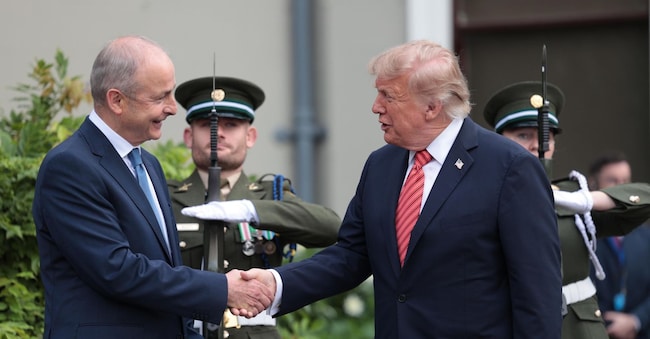
“I’d like to see a united Ireland.” Donald Trump’s weekend on the Emerald Isle gets off to a flying start: the US President, speaking to journalists after meeting Prime Minister Micheal Martin, touched on an extremely sensitive and still controversial issue, which immediately put him on a collision course not only with the unionists in Northern Ireland, but also with the British Prime Minister. A few weeks ago, Andy Burnham had in fact stated that a referendum on Belfast’s secession from the United Kingdom was not on the agenda, a position which – as Downing Street reiterated yesterday – has not changed.
Under the 1998 Good Friday Agreement, a referendum could be held at the discretion of the British Government only if it became apparent that a majority of the population of Northern Ireland was in favour of reunification; however, opinion polls to date show that only a minority supports it.
The leader of Northern Ireland’s largest unionist party, the Democratic Unionist Party, has rejected Trump’s remarks, stating that reunification would lead to the ‘destruction of our country’. “The constitutional future of Northern Ireland will be decided by the people of Northern Ireland, not by comments coming from London, Dublin or Washington,” Gavin Robinson wrote on X.
US presidents, including those of Irish descent such as Joe Biden, have always sought to maintain a neutral stance on the issue of Irish reunification. The US government also played a key role in brokering the 1998 peace agreement.
On the first day of the visit – which was also marked by a protest march in Dublin as Trump left the capital to travel to his Doonbeg golf resort in County Clare – the US President made another statement on an issue that is sensitive for London: he said he could resolve the dispute between Argentina and Britain over the Falkland Islands, if asked to do so, and expressed doubts about the British government’s ability to deploy resources to defend such a distant territory should the need arise.

