Towards the elections

Trump: in Musk a commission on efficiency. And discounted rates for US-made companies

Former president refines his economic plan, including trade tariffs, push on oil and gas, deregulation even on construction, to counter Kamala Harris

by Marco Valsania

4' min read

4' min read

Donald Trump relaunches on the economy: he announces that he will form a special commission on the efficiency of the US government, entrusting it to Elon Musk who had submitted the idea to him. And he plans to cut corporate tax rates to 15% from 21% for companies that will champion US-made products by producing domestically. While plans to continuously reduce the tax burden were already circulating, the characterisation in the sense of America First is new. Then there are the controversial recipes that have already been announced and defended to the hilt as necessary to make the country great again: trade tariffs, a big push for energy from fossil fuels, drastic deregulation.

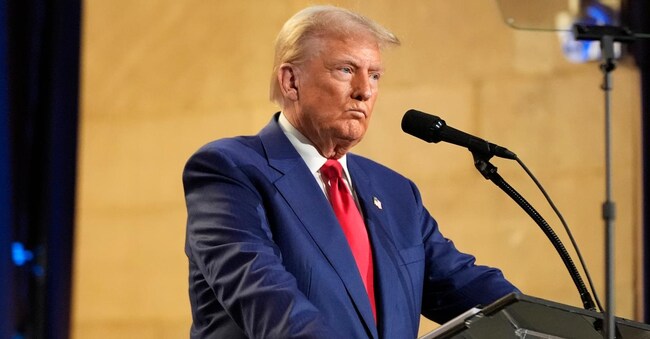
Trump focused on his economic plans during a speech at the Economic Club of New York. The economy, still grappling with inflation and growth uncertainties, is one of the hot topics of the campaign, perhaps the hottest, on which Trump maintains a lead in the polls. But Democratic rival Kamala Harris is pressing on. Trump currently trails Harris by eight points on economic management and by five on inflation, according to the Wall Street Journal, less than he trails Joe Biden.

Loading...

The 'Efficiency commission' is the latest trump card. It had been discussed by Musk during a his interview with Trump on X, the former Twitter. "I would be happy to offer my help to such a committee," Musk had said. In the official version now launched by the former - and would-be - president, it will be tasked with conducting a "comprehensive review of the performance and financial condition of the entire federal government", and then issue "recommendations in favour of drastic reforms" aimed at combating and eliminating fraud, waste, and payments deemed improper.

Musk, on X, immediately accepted the promised appointment. "I look forward to serving America if the opportunity arises. No compensation, no titles, no recognition are necessary." Fruit of his new, close friendship with Trump, whom he supports officially, politically and with contributions in campaign funds. Such a role for Musk would, however, bring with it a vast web of conflicts of interest: he controls the electric car king Tesla and the space group SpaceX, giants subject to federal regulation and with government contracts. Social media X, for its part, is under the supervision of the Federal Trade Commission and its Neuralink, in brain implants, of the Food and Drug Administration.

Fiscal rebates for enterprises

On the tax front, Trump offered a corporate tax rebate 'at 15 per cent only for companies that make their products in America. Our message is simple: manufacture here in America, only here in America'. Instead, he attacked rival Harris as a harbinger of 'economic calamity', asking voters to 'change direction' from the Biden-Harris years.

The former president has also promised to rescind any funding that has not yet been spent under Joe Biden's ambitious Inflation Reduction Act plan, dedicated to energy transition to healthcare and manufacturing, potentially wiping hundreds of billions of dollars from federal spending projects.

Rather, Trump has aggressively pledged on fossil fuels to remove 'every bureaucratic obstacle to the speedy approval of permits for new drilling, pipelines, refineries, power plants, and nuclear reactors'. He promised to halve energy prices in this way, even though in reality the US already produces record amounts of crude oil and gas.

Among Trump's other ideas, already surfaced and now reiterated: drastic deregulation everywhere, including on building and land to lower costs and stimulate the construction of large structures. Facilitations will come to digital currencies, which have become a passion of his. And there will be generalised trade duties, on all imports, perhaps 10% or 20%, and higher against China, perhaps 60%. The outcome of his 'doctrine', he insisted, will ultimately be positive.

'Smart tariffs do not cause inflation,' he argued, 'they fight it. A response to the many economists who claim that his plans would, on the contrary, exacerbate the cost of living and wipe out any gains from tax cuts for the middle classes. 'A combination of fair trade, tax cuts, energy abundance, will allow for better and cheaper production in the US,' he said,

Harris's economic recipe

Harris, however, by no means cedes arms to Trump on the economy. He is fresh from a proposal to tax capital gains more, but without taxing them. She has thus opened up to business by showing a more moderate face, and plan, than Joe Biden on the sensitive tax front. She has distanced herself from 'her' president and downwardly adjusted proposals that in fact call for a doubling of taxes on capital gains. Harris lifted the curtain on a more modest plan to raise the overall rate to 33% from the current 23.8%, halfway to the 44.6% assumed by Biden. The tax includes a surcharge from 3.8% today and would rise to 5% in Biden and Harris' formulas.

Tax plans, even when wanted by the White House, have to go through Congress, and the road to both increases, now and in the future, appears uphill. But the message is beyond doubt: Harris is extending his hand to business. The move on capital gains represents a significant turning point for Harris herself: until now, the Democratic nominee had fully supported Biden's budget plans. In response, the business community has stepped up its pressure for flexibility from Harris on fiscal strategies.

Harris's advisors believe that the change in his position now reflects a commitment to make businesses and wealthy groups pay more, but without the risk of unduly penalising investment. The game is not over. At stake is still a levy, currently on the Democratic drawing board, that targets the wealth of Americans with large fortunes: it prescribes the taxation of unrealised gains over five million at the time of death and over one hundred million during life.

Calls from major party backers to rethink the measure have recently intensified. However, Harris has also kept the spotlight on measures with a more popular and progressive appeal. He has offered relief to small start-ups in the form of increases in tax deductions for expenses incurred, increased tenfold to $50,000 from $5,000.

'My plan will make the tax system fairer while prioritising investment and innovation,' he told a rally that mobilised three thousand people under the slogan 'The Opportunity Economy'. Harris, on the other hand, accuses Trump of only benefiting the wealthiest and big corporations.

Copyright reserved ©
Loading...

Brand connect

Loading...

Newsletter

Notizie e approfondimenti sugli avvenimenti politici, economici e finanziari.

Iscriviti