
Trump raises: '15% global tariffs, many countries have robbed us'
The US president raises the import tariffs announced after the Supreme Court's rejection. And he insists: 'The administration will introduce further law-abiding measures in the coming months'

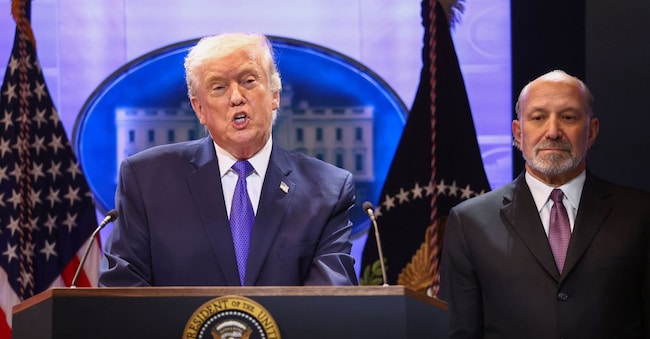
Donald Trump raises the bar in his response to the rejection of his ambitious reciprocal tariffs at the hands of the US Supreme Court: on Truth Social he announced that new global levies replacing the reciprocal tariffs will be 15%, after having signed a decree only a few hours earlier setting them at 10% from 24 February. The new import tariffs, intended to neutralise the ruling, are identical to those negotiated or discussed with Washington by major partners to avert more serious shocks and penalties, from the European Union to Japan, from South Korea to Taiwan.
Trump's new escalation now resorts to Section 221 of the Trade Act of 1974, which allows the president to raise barriers of up to 15% for 150 days in the face of severe imbalances in trade. And he is also harsh in tone: 'I, as president of the United States, will, effective immediately, raise the global 10% tariff on countries, many of which have been robbing the United States for years without retaliation (until I came along), to the maximum and legally permissible level of 15%'. He added that he does not intend to stop: "In the coming months, the Trump administration will determine and issue new and legally permissible tariffs that will continue our extraordinary success in making America great again." The president also renewed his attacks on the judiciary, saying that the new 15 per cent would be the result of a 'thorough, detailed analysis of the Court's ridiculous, misguided, and extraordinarily un-American' decision.
The courts have ticked off Trump's trade claws as an easy weapon for all occasions. However, the political and legal defeat has not altered his plans, which threaten to leave the framework of trade as well as international relations profoundly transformed and increasingly tense. A climate that could convince many of the nations that have struggled to reach agreements with Washington, even accepting disadvantageous tariff regimes, to preserve them.
The administration's promise to stay the course is made up of other figures derived from the new 15% across-the-board tariffs: this tariff, which is intended to take the place of the invalidated levies, because they were based on a misuse of the Ieepa Economic Emergencies Act, is expected to generate the same revenue this year, calculated Treasury Secretary Scott Bessent. And analysts also predict that the average actual US tariffs in 2026 will not be far off the 2025 values.
Yale's Budget Lab, even before the latest moves, had summed up the pinwheel of announcements this way: average effective tariffs were at 16.9 per cent, a record since 1932, fell to 9.1 per cent with the Supreme Court decision, but would rise to 13 per cent already with a new global duty limited to 10 per cent. They would rake in between 1.3 trillion and 2.5 trillion and more by 2035, depending on whether the new tariffs expire after 150 days or become somewhat permanent.


