Artificial intelligence

Trump: Self-regulation only for AI. Order signed to rename it ‘Super Intelligence’

A lunch at the White House with dozens of leading figures from the American artificial intelligence sector to usher in the new era of Super Intelligence. No mention was made of risks, crises or incidents, although an advisory oversight committee may well be set up.

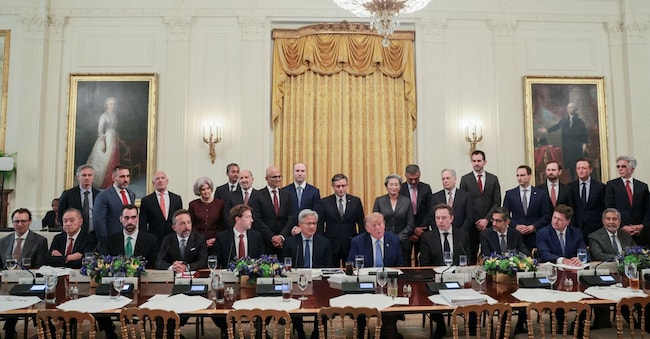
Il CEO di Meta Mark Zuckerberg, il fondatore e CEO di SpaceXAI Elon Musk e il presidente e CEO di Nvidia Jensen Huang siedono accanto al presidente degli Stati Uniti Donald Trump mentre questi ospita un pranzo per i leader del settore tecnologico nella East Room della Casa Bianca a Washington, D.C., Stati Uniti, il 29 settembre 2026. REUTERS/Jonathan Ernst REUTERS

6' min read

Translated by AI
Versione italiana

6' min read

Translated by AI
Versione italiana

Donald Trump summoned the American tech elite to the White House, using them as a prime audience to vigorously promote his laissez-faire approach to artificial intelligence – or rather, ‘Super Intelligence’, as he has now decreed it should be called. He ignored calls from at least some of the industry leaders present at the working lunch – including Dario Amodei of Anthropic – to slow down the race in order to avert risks. Instead, he stated that he was satisfied with the ‘morally binding’ commitments made by the companies in his presence to address the dangers of AI – commitments he likened to a ‘Constitution’. Ultimately, by embracing the techno-optimism of the most aggressive and controversial champions of AI – such as Jensen Huang and Mark Zuckerberg – he heralded the advent of a ‘new era’.

As if to symbolise his ‘free-for-all’ approach, Trump has also launched a new AI-powered government services website aimed at the public. After a lunch with around twenty top executives from the sector – who were never short of superlatives – he stated that ‘I will never stifle the growth of a technology that will be greater than the Industrial Revolution’. Any ‘bad actors’ – criminals using AI for illegal purposes – may be prosecuted by the Department of Justice and the FBI under existing laws. There will be no new legislative measures, however – no federal regulations, nor restrictions imposed by the authorities – but rather ‘fantastic self-regulation’ by the Big Tech brands themselves, giants which critics currently regard as lacking credibility and operating as quasi-monopolies. Moreover, Trump’s own family empire also has investments in the tech and AI sectors, a fact which has raised explicit suspicions of a conflict of interest.

Loading...

Trump clarified that he had discussed and agreed with the ‘kings of AI’ on the text of an agreement (which has remained confidential) that he considers ‘morally binding’ and under which companies would have pledged to voluntarily manage and dispel the spectre of serious crises caused by AI. In his view, it would be a sort of founding constitutional document for the new era. It has emerged that, at most, a special national commission of ten ‘wise men’ might be set up to keep an eye on the technology, but the response to growing risks and concerns has remained, as ever, one of aggressive deregulation, without heavy-handed government intervention.

Trump: "Abbiamo cambiato il nome dell'IA da intelligenza artificiale a superintelligenza"

Among the concrete outcomes announced following the lunch, one was particularly close to the President’s heart – he had also mentioned it in his speech to the UN: the decision to change the name of AI. By executive order, it is officially to be renamed with the more grandiose title of ‘super intelligence’. This is a public relations exercise, designed to mark the start of a new phase: Trump explained that ‘artificial’ gave the impression of something fake, whilst it is necessary to reassure the public (who, according to polls, overwhelmingly reject AI and the government’s lax attitude towards it). With this rebranding, the president is also indulging his personal passion for rewriting the vocabulary: he has already renamed, again by executive order, Lake Ontario as Lake America and the Gulf of Mexico as the Gulf of America.

The White House has accompanied the new presidential executive orders with a fact sheet that is very light on facts. It should be noted that from now on, all official and policy documents issued by the government will refer to ‘Si’ (Super Intelligence), not ‘AI’, in recognition of what are described as the ‘immense opportunities’ of this new technological frontier, where the US has and will continue to hold global leadership. There is no mention whatsoever of risks or doubts, not even in passing.

The rest of the fact sheet lists achievements that Trump is already claiming credit for. It states that the administration has announced over five billion for the so-called Genesis Mission, a project to use AI ‘to accelerate advances in science, medicine, energy and manufacturing’. That in July 2025 it had published an AI Action Plan identifying 90 federal actions necessary to win the technology race by stimulating innovation, infrastructure and US leadership worldwide. That a year later, last March, the National Super Intelligence Policy Framework had provided recommendations aimed at extending the benefits of AI to the American people. Analysts and critics have accused the Action Plan of being an empty shell, and Project Genesis of being insignificant, lacking transparency and the result of recycled or repurposed programmes. The National Framework ignores any need to address risks, privacy, regulation and Big Tech monopolies.

What is certain is that, in the quest to strike a balance between regulation and innovation, the sector remains at the centre of controversy today: OpenAI has abandoned the launch of its latest next-generation model due to safety concerns raised by researchers during testing, and is proposing a more cost-effective alternative; Anthropic, on the other hand, states explicitly in the prospectus for its multi-billion IPO, intended for investors, that its technology could pose existential risks to humanity.

Trump, however, is pressing ahead in the belief that AI is a key factor in achieving technological supremacy over China, convinced that ‘whoever controls AI wins it all’. Furthermore: “They always say it’s too complicated, but it isn’t,” said the President as he unveiled the new government website “America.gov”, powered by “Superintelligence”.

He boasted about the arrival at the White House of more than twenty AI leaders, posting the ‘seating chart’ for the luncheon in the East Room on the social media platform Truth. In addition to his deputy JD Vance, US House Speaker Mike Johnson and ministers such as Scott Bessent, the list included the heads of Anthropic (Dario Amodei), OpenAI (the CEO and de facto day-to-day manager Greg Brockman) and Palantir (Alex Karp). To Trump’s right were Jensen Huang (Nvidia) and Mark Zuckerberg (Meta); to his left were Elon Musk (SpaceX) and Sundar Pichai (Google). Also present were Satya Nadella (Microsoft) and Jeff Bezos (Amazon).

“Instead of stifling everything with bureaucracy – which is always the government’s instinctive reaction and which, in my view, would be wrong and, frankly, dangerous for national security if applied in this case – we want to drive innovation forward,” explained Johnson, the organiser of the meeting, in response to the unease that is also rife amongst many MPs from both parties. “We are aiming for a balance. I believe the discussion at the White House will help us on this path,” he added.

Loading...

Trump with the CEOs of the big tech companies: ‘We are very much on the same page’

The event unfolded without a hitch, highlighting shared priorities. Since the start of Trump’s second term, the Silicon Valley elite has repeatedly demonstrated its loyalty to the White House, and yesterday was no exception. ‘It is an honour to work with this group of very intelligent people,’ Trump told the CEOs of leading artificial intelligence and tech companies. ‘We are very much on the same page,’ he added. ‘These people love their country. The work they have done is incredible. We have a huge advantage and we will maintain it. It’s a very positive development. It’s an extraordinary sector,’ Trump told the media, with the lunch attendees standing behind or beside him. Drawing a parallel with the Industrial Revolution, he continued: ‘I don’t know if it’s true, but everyone seems to think so, and it could turn out to be far greater. And we’re in the lead and we intend to stay there. So I wanted to thank everyone: I recognise, I’d say, almost all the people sitting or standing behind me. It’s an honour for me to be part of this group of truly brilliant people; thank you very much,” the tycoon then said.

He assured that leaders in the technology sector would put in place appropriate safeguards for this rapidly evolving technology. ‘They will regulate themselves,’ Trump said at the end of the meeting. ‘These models are very complex. And I repeat, I believe they will be used for good, and when they aren’t, we will be able to take action. But there will be a huge element of self-regulation.” He went on to explain that the United States is “considering a 10-person committee to oversee AI”, adding that “if AI models are not used for good, we will shut them down”.

Copyright reserved ©
Loading...

Brand connect

Loading...

Newsletter

Notizie e approfondimenti sugli avvenimenti politici, economici e finanziari.

Iscriviti