
Trump exempts Big Oil that supported him from duties. Beijing: duties at 34% on US goods


Key points
Kennedy Jr admits: 'Wrong 20% of Musk's healthcare cuts'
About one-fifth of the 10,000 jobs cut by the Department of Health were made by mistake by Musk's Doge and will have to be corrected, sector minister Robert F Kennedy Jr admitted. 'Staff who should not have been cut, were cut,' Kennedy said, announcing the reinstatement. The health secretary explained that some of the people who lost their jobs were not in the administrative roles targeted by the Doge, but in research work.
Trump postpones deadline for TikTok sale by 75 days
Donald Trump postponed the deadline for the sale of TikTok and the separation of the app from its Chinese ownership by 75 days, under penalty of a ban in the US. "My administration worked hard on a deal to save TikTok and we made tremendous progress. The agreement requires more work to ensure that all necessary approvals are signed, which is why I am signing an executive order to keep TikTok up and running for another 75 days," the US president wrote on Truth. "We hope to continue to work in good faith with China, which I understand is not very happy with our reciprocal tariffs (necessary for fair and balanced trade between China and the US!). This shows that tariffs are the most powerful and very important economic tool for our national security! We do not want TikTok to 'go dark'. We look forward to working with TikTok and China to close the deal,' Trump added.
To read more: US Senate passes bill to ban Tik Tok
Duties, Starmer: 'Total trade war would be very damaging'
British Prime Minister Keir Starmer spoke with his Australian and Italian counterparts, Anthony Albanese and Giorgia Meloni, about how to respond to Trump's tariffs, saying they agreed that an "all-out trade war would be extremely damaging". Reuters reports that in separate calls, Starmer said it has been "clear for some time that like-minded countries must maintain strong relationships and dialogues to ensure our mutual security and maintain economic stability," a spokesperson for his office said in a note. "They all agreed that an all-out trade war would be extremely damaging and is in no one's interest, while agreeing to remain in close contact in the coming days," he added.
Duties, White House: 'Americans are already seeing first results'
The White House insists: 'Americans are already seeing the first results' after 'President Donald Trump's bold statement' on tariffs announced two days ago. And in a note it lists these results: 'Nissan announced it will maintain two shifts at its Tennessee manufacturing plant, a reversal of its previous plan to eliminate one of the shifts'. Again, 'General Motors announced that it will increase truck production at its Indiana assembly plant', while 'Ford Motor Company and Stellantis announced that they will offer US consumers employee-reserved pricing on their vehicles'.
Trump exempts Big Oil that supported him from duties
The flurry of tariffs announced by Donald Trump includes an exemption for the energy sector, one of the sectors that contributed most to his campaign in return for pledging to deregulate and lift environmental regulations. The new universal 10 per cent tariffs, which are higher for many of the world's major economies, will not apply to many fossil fuel products, including imports of liquefied natural gas, crude oil from Canada and materials needed for the production of petrochemicals.
Big Oil rejoices: 'We welcome President Trump's decision to exclude oil and natural gas from the new tariffs, underscoring the complexity of integrated global energy markets and the importance of America's role as a net exporter of energy,' Mike Sommers, head of the leading US fossil fuel lobby group, the American Petroleum Institute, wrote in a social media post. "We will continue to work with the Trump administration on trade policies that support US energy dominance," he added. During the presidential campaign, the fossil fuel industry donated $96 million to the tycoon.
USA, Trump plays golf while markets plummet
President Donald Trump is spending the day at his golf club in Palm Beach, Florida, as markets continue to lose ground after the announcement of new tariffs. Wearing a red cap and white polo shirt, he greeted supporters along the street before entering the club. In the evening he is expected at a dinner organised by MAGA Inc, a political group close to him. Yesterday, he was in Miami, at another of his golf courses, where he participated in a tournament financed by Saudi Arabia. He arrived aboard Marine One and was greeted by a golf cart driven by his son Eric.
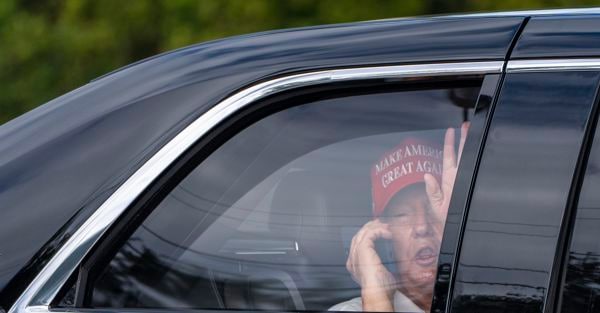
Il presidente Donald Trump saluta all’arrivo al Trump International Golf Club, venerdì 4 aprile 2025, a West Palm Beach, in Florida. (AP Photo/Alex Brandon)
Usual routine for the presidential weekend, although his protectionist measures have shaken markets and the global scenario. Meanwhile, after asking Jerome Powell in a post to cut rates, the Fed governor announced today that the cut is postponed, warning that tariffs could fuel inflation and slow growth.
Duties, Ft: EU studies measures against low-cost products from China
As a side effect of US tariffs, Europe risks a flood of cheap Chinese imports that would worsen its already weak growth prospects. Analysts quoted in the 'Financial Times' noted that Brussels could prepare measures to protect itself from the flood of cheap Asian products, electrical products and household appliances in particular. "The trade shock suffered by Asia is likely to affect Europe," points out Robin Winkler, Deutsche Bank's chief economist for Germany quoted by Ft. Chinese manufacturers will try to sell more products in Europe and elsewhere, facing "an impressive tariff wall". 'We will have to take safeguard measures for a large number of industries,' says a senior EU diplomat. "We are very concerned that this is another point of tension with China. I don't think they will change their model of export overcapacity." he adds, speculating on duties on other Chinese products above the 35 per cent already imposed on the entry of electric vehicles. The duties on China were 'far higher than many expected' says Andrzej Szczepaniak, economist at Nomura, explaining that as a result the risk of 'dumping of Chinese goods in Europe' would increase because due to the prohibitive barriers erected by the US Chinese manufacturers to increase market share would resort to discounts.
The EU faced similar pressures during Trump's first term. In 2018, Brussels imposed 'safeguard' tariffs of 25% on steel imports above a set ceiling in response to similar measures by the tycoon to prevent products from exporters such as China being diverted to the European market. And the Commission may be ready to act again. "We can close our markets because of a sudden and unexpected influx of imports," says a senior Commission official. "We did it for steel for a while," he adds, "and we will see if we need it for other sectors. In the case of Germany, notes Ifo think tank director Clemens Fuest, the combination of Chinese pressure to increase exports to Germany but in turn reduce imports, US tariffs and the stagnating German economy could push the country into a new contraction. "Europe's worst economic nightmare has just come true," Carsten Brzeski, global head of macro at Ing, writes lapidarily in a note to clients.
Madrid calls for EU fund 'to help sectors affected' by US duties
Spanish Economy Minister Carlos Cuerpo said that on Monday at the EU Trade Council he would demand that the Union set up a "fund to help with subsidies, with direct aid, the sectors affected" by US duties. Cuerpo, speaking to the media at the end of meetings with all the Spanish political groups, with the exception of Vox, defended the proposal, saying that it is the Commission that has the competence in trade matters, that if duties are imposed on the US, the proceeds will go to the European budget, and then remarked that "citizens and businesses must see that Europe protects them". The minister said that he had received the support of the political groups on this proposal.
Duties, Tajani: EU reaction will be less than US action
"Nobody wants a trade war, should there be a reaction it will rather be a political signal to the US to say: enough is enough. So an absolutely inferior reaction to the action taken by the United States, that is, there will be absolutely inferior economic damage to what American duties could do'. This was stated by Deputy Prime Minister and Foreign Minister Antonio Tajani during the episode of 'Cinque minuti' to be aired this evening on Rai 1.
EU Trade Commissioner Maros Sefkovic, explains further, 'is still negotiating with the US to see what they intend to do and what reaction we can give. On Monday there will be the Trade Council, i.e. the EU trade ministers, who will decide whether it will be necessary to impose duties on certain American products". 'We,' concluded the Farnesina titular, 'ask that no duties be imposed on American products that may provoke a more damaging reaction for our products,' he added. I give the example of whisky: we import little of it but the American reaction would be to impose duties on wines'.
Trump to Powell (Fed): "Stop playing politics and cut rates!"
"Jerome, cut interest rates and stop playing politics!" This was Donald Trump's intimation to Fed Chairman Jerome Powell in a post on Truth in which he stated that this would be the 'perfect time' to cut rates. Powell 'is always late, but now he could quickly change his image', the US president writes.
Duties, Cambodia first to give in: 'Down with tariffs on US-made goods'
Cambodia, hit by tariffs at 49%, has announced that it will substantially lower its current tariffs on goods arriving from the US. Phnom Pehn's Minister of Commerce, Cham Nimul, in a letter to US Trade Representative Jamieson Greer, explained that the measure will affect 19 categories of goods - including motorbikes, cars, and agricultural products - to which a rate of 5% instead of 35% will be applied. Nimul, reports CNN, has therefore asked the US to open negotiations with the South-East Asian country and extend the deadline for applying the duties. It is unclear, according to the broadcaster, whether the move will lead to changes on the part of the Trump administration. Yesterday, Cambodia's Ministry of Commerce spokesman Penn Sovicheat had called the duties 'not reasonable'. Last year, Cambodia exported about USD 10 billion worth of goods to the US, mainly clothing, while US imports came to about USD 264 million, taxed at an average of 29.4 per cent.
Trump, Vietnam want to reduce their tariffs to zero
"I had a constructive phone call with the general secretary of the Vietnamese Communist Party, To Lam. He told me that Vietnam wants to reduce its tariffs to zero if there is an agreement with the US. I thanked him on behalf of our country and told him I will see him in the not-too-distant future." This was stated by Donald Trump on his social Truth.
Duty effect, buying and stockpiling in the US
From televisions to soy sauce, from clothing to Irish beer, Americans rushed to the shops to make 'pre-emptive purchases' after Donald Trump's announcement of new tariffs on most imported goods. As the Wall Street Journal reports, millions of people in the US reacted in the same way: stocking up, amid anxiety about inflation and fear of an imminent price hike. The widespread feeling is that the hit will come to everyone this time: from small business owners to consumers, and so many are playing it safe. Cedar Roach told the newspaper that while Trump was speaking from the White House, she rushed to buy a sportswear outfit from Lululemon (a Canadian brand) and a jumper from House of Sunny (a British brand), while her boyfriend, Sean MacKenzie rushed to buy three eight-packs of Guinness. "I knew the risky items and what I wanted, so I didn't put it off," said Roach, a 22-year-old student at Southern Methodist University. While Mark Cuban, billionaire entrepreneur and TV personality, suggested his followers start stocking up. "From toothpaste to soap, anything you can find room for in your house, buy it before they have to restock the inventory," he said in a post on the Bluesky social media platform, "Even if they are made in the US, they will raise the price and blame it on tariffs. On the other hand, 50-year-old Noel Peguero said that from Wednesday night to Thursday morning, he spent about $3,000 on electronics, car parts, gardening tools and other household items. "Now is the time to buy," he said.
Duties, sources, 'fines on Apple and Meta expected, unanimous support from 27'
The European Commission is preparing fines against Apple and Meta for breaking the Digital Marketplace Act (DMA), which are expected to be announced next week. This was reported by sources within the Commission. The member states, they explain, were consulted last week on the decision, which is to be finalised by the Berlaymont Palace in a written procedure. Reportedly, the closure of the investigation, the first under the Dma, and the decision to fine the two tech giants received 'unanimous support' from the Twenty-Seven. In the EU's crosshairs are, on the one hand, Apple's App Store management policy and, on the other, Meta's 'pay or consent' advertising model for paying and avoiding advertising or not paying and allowing the use of one's own data, neither of which comply with the DMA.
Under the Digital Markets Act, the Commission can impose fines of up to 10% of the global turnover of the companies concerned, but the Berlaymont Palace is more inclined to impose penalties far below this threshold. "The ultimate aim of the Dma, like the Dsa (Digital Services Act, ed.) is not to fine a company, but to bring it into compliance," the sources explain. Although the investigations under the Dma are independent, the timing of the publication of the fines could be delayed due to the ongoing negotiations between the US and the EU on the 'reciprocal' duties announced by US President Donald Trump. The Commission's fear is that the fines could be seen 'as an immediate sanction' against the newly announced tariffs, undermining the ongoing negotiations.
Jp Morgan Chase increases US recession probability to 60% in 2025
Jp Morgan Chase, the largest US bank by assets, increased the probability of a recession in the US this year to 60% due to the tariffs announced by President Donald Trump, an increase of 20 percentage points since March. According to a report published today by Marketwatch, the cumulative 22% increase in tariffs over the year would result in the largest tax increase since 1968. "The impact of this tax increase is likely to be amplified through retaliation, leading to a decline in US business confidence and supply chain disruptions. This impact could only be moderated by further fiscal policy easing,' explained Bruce Kasman, chief economist at Jp Morgan. The analyst described the White House measures as a 'severe macroeconomic shock' that, although the US agency has not yet incorporated them into its forecasts, will 'likely' cause a recession in both the US and the rest of the world in 2025. In the case of the US, the recession could be 'mild', but restrictive trade policy and reduced migration flows could put pressure on supply costs. This would reduce the country's GDP growth in the long term.
Turkey, 'we will negotiate with the US on tariffs'
Turkey wants to negotiate with the US regarding the tariffs imposed by President Donald Trump's administration. This was stated by Turkish Trade Minister Omer Bolat, explaining that Ankara is not on the list of states subject to specific additional duties and is subject to the basic 10 per cent tax, which he called "the best of the worst", as reported by Daily Sabah. "We want to discuss the issue (of tariffs) during negotiations with the US Department of Commerce and the Trade Representative... as there is a $2.4 billion surplus in favour of the US in trade between the two countries for 2024," Bolat said. "The relatively low tariffs for our country could offer a comparative advantage in some sectors," Economy Minister Mehmet Simsek said instead, HaberTurk reports.
Duties, Trump: China panics, can't afford it
"The Chinese played it badly. They panicked. The one thing they can't afford to do." This can be read in a post on Donald Trump's Truth account. Yesterday, the US president announced reciprocal duties of 34% on Chinese products, to which Beijing responded today with duties at the same rate.
see also: China announces 34% tariffs on US goods
EU: 'We invite companies to invest here'
"We do not comment on the statements" of others, "but we are very confident that we have a very attractive offer here in Europe for companies wishing to invest. We can guarantee stability, an attractive single market and a reliable rules-based system." European Commission spokesman Olof Gill said this, responding to a question on whether the EU would open up to Emmanuel Macron's proposal to suspend investment in the US in retaliation to Donald Trump's tariffs. "We invite all companies to invest in the EU as a viable option," added Ursula von der Leyen's spokeswoman Paula Pinho.
Trump: 'My policies will never change'
US President Donald Trump's assertive social post, written all in caps: "To the many investors who come to the US and invest huge amounts of money, my policies will never change. This is a great time to get rich, richer than before!"
Duties, Trump: 'Tariffs for drugs coming as never seen before'
The pharmaceutical sector may not escape Trump's tariffs. Responding to reporters on board Air Force One, the US president said that tariffs on drugs and microchips would be announced soon. Those on 'chips will begin very soon'. And the tariffs on 'pharma will also begin, I believe, at a level we've never seen before', is the statement also reported by the 'Wall Street Journal'. "We're looking at pharma right now. They are a separate category,' he added, speaking of a 'review phase'. The announcement 'in the near future', he predicted.
Duties: Rubio, markets are collapsing but will adjust
US Secretary of State Marco Rubio acknowledged today that "markets are crashing" as a result of the Trump administration's enactment of tariffs, but said they will recalibrate. "Companies around the world, including those in global trade and commerce, just need to know what the rules are. Once they know what the rules are, they will adjust to those rules," Rubio told reporters during the Nato foreign ministers' meeting in Brussels, as reported by CNN. "So, I don't think it's fair to say that economies are collapsing. Markets are collapsing because markets are based on the value of the shares of companies that are now embedded in modes of production that are bad for the United States," he added.
"We have to restore the global order of trade," Rubio said. "The worst thing is to leave it as it is forever. I mean, this cannot continue. We cannot continue to be a country that does not produce things." As for China he points out that 'it's scandalous', 'they don't consume anything. All they do is export, flood and distort markets, on top of all the tariffs and barriers they put in place'. And again: 'The president has rightly concluded that the current state of global trade is bad for America and good for a lot of other people. And he will restore it, and he is absolutely right to do so."
Media: Trump to German companies, stop supporting minorities
After French companies, German companies have also received a message from the US administration asking them to suspend their minority support programmes, in line with President Trump's directives. This was reported in a long article by the German business daily Handelsblatt, which had the opportunity to view the communication sent by the US embassy to companies. It is a request forwarded to companies that have contracts with the US government; the German newspaper informs that it certainly does not have a legally binding value but could pose a problem for companies, for example by denying access to government funds, not to comply with the fight against the 'Woke culture' undertaken by Trump. The aim is to eliminate all measures in support of Die, which stands for 'Diversity, Equity, Inclusion'.
The Handelsblatt also reports that, unlike French companies, German companies did not receive a questionnaire to fill out: 'this shows that the embassies interpret Washington's instructions differently'. In the Handelsblatt, the Deutsche Industrie- und Handelskammer (Dihk) also stated that, after the duties, this latest measure only adds to the irritation. The trade association Bdi advised German companies not to respond to the US request to limit their diversity programmes. The German newspaper also reports that similar requests have also come to non-governmental organisations that, in particular, have to answer a detailed questionnaire to, 'among other things, exclude terrorist activities, as well as the promotion of transgender ideologies and discrimination in line with Trump's anti-Woke rules'.
White House invites Netanyahu to talk tariffs
Israeli Prime Minister Benjamin Netanyahu received an invitation to the White House following his telephone conversation with US President Donald Trump on the duties imposed on Israel. The visit will most likely take place after Passover.
Rutte, US duties do not violate the NATO treaty
The imposition of duties by the US on most NATO allies does not violate the Alliance's founding treaty. This was stated by Nato Secretary General Mark Rutte. "I don't think this is contrary to Article 2 of the Washington Treaty, we have seen this before among allies," he said in response to questions from reporters. "My role is focused on the defence of Nato territory, that's why I don't comment on the subject of tariffs," he added following reporters' insistence.
Von der Leyen: 'Mutual trust more important than ever'
"We have entered into a new strategic partnership. This means that we can rely on each other. Trusting each other today is more important than ever. When our partners grow and prosper, the EU grows too. This is how a partnership should be, this is our vision'. This was said by EU Commission President Ursula von der Leyen at the press point after the EU-Central Asia summit. Von der Leyen listed four priorities in the partnership with Central Asia: transport, climate and water resilience, digital, critical materials. The partnership envisages investments of 12 billion from the EU.
Tajani: on duties Italy 'does not negotiate with the US, it is an EU competence'
Italy 'cannot negotiate' on duties directly with Washington, because trade policy is the competence of the European Commission. This was pointed out by Foreign Minister Antonio Tajani, responding on the sidelines of the NATO ministerial in Brussels to the League's position that Italy should be the one to negotiate directly with Donald Trump. 'You cannot negotiate with the United States,' replied the former European commissioner and former president of the Eurochamber, 'because the competence of international trade lies with the European Commission, so it is Commissioner Maros Sefcovic who deals with it, listening and confronting us. Then, we can do other things,' he adds.
China announces 34% tariffs on US goods
China will impose additional duties of 34 per cent on all goods imported from the US, starting on 10 April. This was announced by the Customs Tariff Commission of the State Council in a statement reported by local media. The decision comes two days after the Trump administration announced 34 per cent duties on Chinese imports.
China puts 16 US companies under observation
China announced today that it has placed 16 US companies 'endangering its national security and interests' on its export control list. According to the Ministry of Commerce, as of today, the export of dual-use items by these companies, including High Point Aerotechnologies, Universal Logistics Holdings, Inc. and Source Intelligence Inc. will be banned, and all current export activities will have to be halted immediately.
According to Chinese media reports, Beijing has also suspended the eligibility of six US companies to export to China, 'to safeguard public health and protect the country's livestock industry'.
Russia: 'Emotional reaction to duties'
"The global economy is reacting to these decisions in a very, very emotional way. We see a fairly high level of turbulence in international markets and now, of course, the global economy is in turmoil." This is according to Kremlin spokesman Dmitry Peskov, commenting on the duties imposed by Donald Trump on products exported to the US. "We are hearing very unfavourable forecasts from various economists, including world-renowned ones," Peskov added, "with such a storm, we have to be very careful to minimise the negative consequences for our economy." This was reported by the Tass news agency.
Duties: Urso, 'Create a Euro-Atlantic free trade area'
"My wish is for a Euro-Atlantic free trade area to unite the largest trade basin of Western democracies, rather than divide it". These are the words of the Minister of Enterprise and Made in Italy Adolfo Urso, on the sidelines of the signing of a strategic agreement between the Italian space companies D-Orbit and Planetek, today at Palazzo Piacentini, speaking about the EU-US confrontation on duties that is kicking off today. The minister called for "caution in the response to the duties announced by the US administration. It is right that the confrontation and dialogue that begin today should seize every opportunity for an agreement that aims to reduce duties, with the hope that this may also be a push to finally realise that bilateral agreement, between the United States and Europe, on free trade that would create the largest economic trade basin between the two sides of the Atlantic and completely reunify the West'.
S&P, significant short-term impact of tariffs on US inflation
The relatively small share of imported products in US consumer spending should limit the impact of the new tariffs on consumer prices in the US, but in the short term the impact will still be substantial. This is stated in a report by the rating agency that provides an initial assessment of the impact of the US customs offensive. 'The impact on inflation in the short term will be significant,' the report reads, 'probably averaging closer to 4 per cent by the fourth quarter (compared to 3 per cent in our March baseline forecast). Given that 11% of consumer spending is accounted for by imported goods, the additional cost of imports is expected to add 0.7%-1% to the Cpi price index level compared to our previous forecast (assuming 50%-75% pass-through to consumers). Assuming no major second-round effects, inflation numbers should return to the 2% target by mid-2026." The impact on US GDP will depend on any trade retaliation by partners and how the duty revenue will be used. "Tariffs," S&P points out, "work as a regressive tax, hitting low-income households proportionately more. Reduced purchasing power, possible declines in the stock markets and uncertainty in investments could further weaken growth. The future of GDP will also be influenced by how revenues are redistributed: whether in the form of tax cuts or other transfers, the negative impact could be mitigated. Even in a moderate scenario with limited retaliation, quarterly real GDP growth on an annual basis is expected to fall by 0.3-0.4 percentage points compared to the March forecast (1.6 %).
Although the duties may generate theoretical revenues of 2.3%-2.7% of GDP in the first year (USD 700-800 billion), actual revenues are likely to be lower due to falling imports and the general economic slowdown. As for recession risk, an official recession as defined by the Nber is not yet expected, but the estimated probability has risen to 30%-35%, up from 25% in March'. Finally, the Federal Reserve is likely to keep rates unchanged for most of the year, despite some model analyses suggesting hikes.
Dombrovskis: 'EU withstands shocks, we expect growth'
"The European economy is proving resilient in the face of consecutive economic shocks" such as the Covid and Russia's war in Ukraine and "we expect EU economic growth to continue: last year we had an overall growth of 1%" and "this year we expect slightly faster growth". This was said by EU Economy Commissioner Valdis Dombrovskis during a conference in Riga, responding to a question on the resilience of the Old Continent's economy in the face of the current geopolitical uncertainty. Dombrovskis indicated that the new EU economic estimates will be published on 16 May.
Trump offers support to Le Pen and attacks the French judiciary
US President Donald Trump has offered his support for French far-right leader Marine Le Pen through a post on Truth. In the post Trump writes: 'The witch hunt against Marine Le Pen is another example of how the European left uses the judiciary to silence free speech and censor its political opponent, this time even going so far as to put him in prison. I do not know Marine Le Pen, but I appreciate the hard work she has done for so many years. She suffered defeats, but kept going, and now, just before what would have been a Great Victory, the courts convict her on a minor charge she probably knew nothing about. It seems to me an error in 'accounting'. It's all so bad for France and the Great French People, no matter which side they are on. Marine Le Pen free!" the tycoon wrote. (
EU source, working on a scenario where duties remain
"I'm not sure that we are working on the scenario" in which Trump can remove the tariffs, "or at least we are preparing for a scenario in which these remain, and that's how we should prepare." This was stated by an EU diplomatic source ahead of Monday's Foreign Trade Council in Luxembourg.
Does the US want action on the legislative level, such as lowering phytosanitary standards, abolishing VAT and digital constraints? "I'm not sure if anyone has gone into such detail. The US considers VAT to be a barrier, but I don't know if they are asking for it to be removed. Between what they see as a problem and what they are asking for there is probably a difference. But it is the Commission that is negotiating with the US,' he concludes.
Ambrosetti Workshop: up to 104 billion in the EU at risk from US duties
The tightening of trade policies by the United States could cost the European Union up to EUR 104.4 billion in customs costs. This is what emerges from the position paper presented today by The European House Ambrosetti (Teha) at the workshop 'The Economy and Finance Scenario', organised by the Ceo Community of the Teha Club and now in its tenth edition, taking place at Villa d'Este, Cernobbio. The most severe scenario envisaged by the study assumes that the figures presented this week by Donald Trump's administration will not budge: 20% duties on all exports and 25% on steel, aluminium and vehicles. In this context, the hardest hit sectors would be machinery (-€3.43bn), automotive (-€2.55bn), pharmaceuticals (-€1.58bn), agribusiness (-€1.34bn) and fashion (-€1.16bn). Germany and Italy would suffer the greatest impacts, with cost increases of EUR 34 billion and EUR 14 billion respectively. To respond to this scenario, Teha proposes a series of guidelines for action, starting with coordinated EU action to maintain competitiveness and international weight. There is also a need to strengthen strategic alliances with emerging markets such as Turkey (EUR 17.6 billion in trade), Japan (EUR 8.2 billion), the United Arab Emirates (EUR 8 billion) and Saudi Arabia (EUR 6.2 billion), all major trading partners to which exports have recorded growth rates of over 50% in the last five years.
Third, Teha suggests adopting and a deterrence strategy "highlighting the real threat the US fears: an attack on Wall Street and the dollar. The EU holds over $1.7 trillion of US public debt and European savers hold $9 trillion in US equities. Our estimates show that possible takings associated with the imposition of 10% tariffs on shares by the EU would lead to an increase of 900 billion, in addition to 1.7 trillion linked to the return of investments in T-Bonds". The document also emphasises the need to involve US multinationals active in the EU, which employ 3.6 million people and generate 16.8 per cent of European exports to the US, in a joint EU-US working table aimed at opposing protectionist policies and promoting a rebalancing of trade relations.
Macron: 'Together as Europe we will be able to protect ourselves against tariffs'
''450 million consumers: this is our strength'', wrote French President Emmanuel Macron in a message posted on X, returning to call for European unity in the face of US President Donald Trump's tariffs. ''Together, with all our supply chains, we will be able to protect ourselves and accelerate the reindustrialisation of Europe,'' Macron added.
Turkey wants to negotiate the elimination of 10% US duties
Turkish Trade Minister Ömer Bolat will be visiting Washington next May to discuss the elimination of the 10% tariffs imposed by the Trump Administration on imports from Turkey. "Taking into account the US $2.4 billion surplus in bilateral trade in 2024, we would like to address this issue in negotiations with the US Department of Commerce and the US Trade Representative in order to eliminate the additional 10 per cent customs duties imposed on products Turkey exports to the US," he said. The US President already stated yesterday that he was open to negotiations on these duties,' Bolat explained in a statement released by his Ministry.
According to data released by the Turkish ministry, trade between the US and Turkey increased by 4.7 per cent in 2024 to over USD 32 billion; the US is Turkey's second largest export market, with a 6.2 per cent share.
EU-US negotiators' first videocall on tariffs today
On the tariffs, 'we will not answer in vain: we want to give the negotiations every chance of success to find a fair agreement, to the benefit of both sides. That is why, at the mandate of President von der Leyen, I agreed with my US counterparts to hold a video call to explore the best way out of this unnecessary and painful phase, addressing the legitimate concerns of both sides". This was stated by EU Trade Commissioner Maros Sefcovic. The video call meeting is scheduled for today. "However, the EU will not remain inactive if we are unable to reach a fair agreement with our US partners," he added.
See also: Duties, EU retaliation to the US will take place in 'comitology': this is what it is
Australia responds to tariffs with protective measures for businesses and by proposing an agreement with the EU
The Australian Labor government, in response to the tariffs imposed by the Trump administration, has chosen not to impose counter-tariffs and has instead initiated protective measures to assist companies active in exports, mainly beef, and is committed to promoting trade with countries such as India and the United Arab Emirates and signing a free trade agreement with the European Union, in a diversification strategy that will be accelerated.
Anthony Albanese's government is now offering AUD$1 billion (about €565,000) in interest-free loans to assist exporting companies as Australia loosens trade ties with the US in response to new tariffs. While the US collectively receives only about five per cent of Australia's exports, it is the top destination for beef exports, with 400 thousand tonnes in 2024, worth A$3.4 billion. According to National Farmers Federation president David Jochinke, while the industry is 'deeply disappointed' with the US decision, 'the Australian agricultural industry supports a prudent and measured approach to negotiations with the US and will work closely with the government and all political forces to seek a solution,' he said.
USA, Trump torpedoes the director of the National Security Agency
The director of the National Security Agency (NSA) and head of Cyber Command has been removed from his post. American media report this, citing sources in the House and Senate Intelligence Committees. The reasons why Air Force General Timothy Haugh was fired are not known, however, according to an official with knowledge of the matter quoted by the New York Times, it was Laura Loomer, an extreme right-wing activist, who called for General Haugh's removal during a meeting with President Donald Trump in the Oval Office. According to the same source, Trump then ordered Defence Secretary Pete Hegseth to fire him. General Haugh's deputy at the National Security Agency, Wendy Noble, was also removed from her post and potentially reassigned to another position at the Pentagon. Three former officials told The Nyt that General Haugh was reportedly informed of the decision while he was travelling. One of the officials said that neither General Haugh nor his deputy was told the reason for their dismissal, only that 'your services are no longer needed'.
Measure by US senators to limit president's authority on tariffs
A bipartisan bill was introduced in the US Senate that gives Congress the final green light on tariffs imposed by a president. The measure bears the signature of Republican Chuck Grassley and Democrat Maria Cantwell. The measure has little chance of being passed, but it shows the discomfort of some GOP members with Donald Trump's tariffs.
Japan, US duties are a 'national crisis'
US President Donald Trump's tariffs on Japanese products are a 'national crisis', Japanese Prime Minister Shigeru Ishiba said today ahead of planned talks between Japan's parties to mitigate the impact of the US tariffs. (
Trump, soon duties on pharmaceuticals and chips
Tariffs on pharmaceuticals and chips will begin soon. This was said by Donald Trump, according to reports from reporters in tow. 'On chips we will start very soon. We're looking at pharmaceuticals now, we'll announce something in the future soon," Trump noted
White House, 'Trump revolutionises trade, duties strengthen US'
The White House is advising Republicans in the US Congress to focus on the long-term impact of Donald Trump's tariffs, pointing out that the president is 'revolutionising world trade' and that the tariffs will trigger the return of companies to the US, expanding the manufacturing base and 'creating good-paying jobs'. The trade practices, the White House explained, have 'created a national emergency: the president's executive order imposes tariffs to strengthen the US economic position and protect American workers'.
US duties, government of Japan considers restraint measures
Japanese Premier Shigeru Ishiba will hold talks today with leaders of other political parties following US President Donald Trump's announcement of reciprocal tariffs, to discuss possible responses. This was announced by the secretariat of the Liberal Democratic Party (Ldp), to which Ishiba belongs, explaining that the premier will meet with the head of the Ldp's coalition partner, the Clean Government Party (Pgp), and the leaders of the Democratic Constitutional Party, the Japan Innovation Party, the People's Democratic Party, the Communist Party of Japan and the Reiwa Shinsengumi. The reciprocal tariffs announced by the US on Wednesday include a 24% levy on Japan, and Tokyo has asked the allied country to be exempted from the measure. Ishiba emphasised the investments that Rising Sun companies have made in the US economy, stressing that the Asian country has been a promoter of free trade, with the rescue of negotiations for a Trans-Pacific Agreement after the US withdrew during Trump's first term. The US is the main destination for Japanese exports and, according to a Nomura Research Institute study cited in the Yomiuri Shimbun newspaper, reciprocal tariffs would reduce Japanese GDP by 0.59% in one year
"Trump contradicts his advisers and opens up negotiations on tariffs"
Donald Trump contradicted his aides on tariffs. After US Commerce Secretary Howard Lutnick and advisor Peter Navarro repeatedly reiterated that there was no room to negotiate on tariffs, the US president called the tariffs a tool to negotiate and opened up for negotiations. This was highlighted in the US media. "All countries are calling us. We took the lead: if we had asked these countries to do us a favour, they would have said no. Now, instead, they would do anything for us. The tariffs give us great power to negotiate,' Trump explained.
IMF, significant risks to global outlook from US tariffs
The International Monetary Fund is still assessing the macroeconomic implications of Donald Trump's tariffs but the tariffs "clearly pose a significant risk to the global outlook at a time of sluggish growth". This was said by IMF Director Kristalina Georgieva urging the US and its trading partners to work constructively to resolve tensions and reduce uncertainty.
Brand connect

