Digital Economy

Trump poses for a photo with Big Tech; AI security remains voluntary

The White House agreement entrusts companies with controls and audits, without imposing new sanctions or transparency obligations. The President has rebranded AI as ‘superintelligence’, but the legal substance remains unchanged.

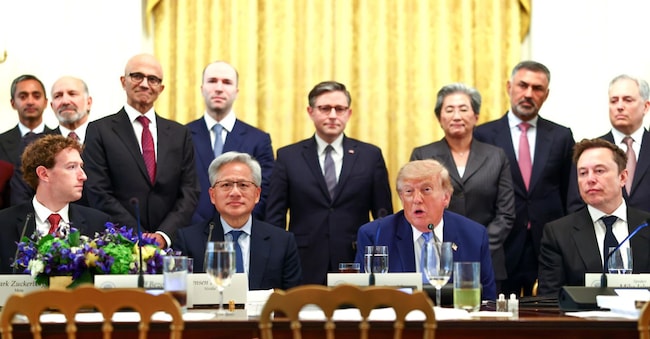
epa13271448 US President Donald Trump (front row, 2-R) speaks at a meeting and luncheon on super intelligence in the East Room of the White House alongside Facebook founder and Meta CEO Mark Zuckerberg (L), Nvidia President and CEO Jensen Huang (2-L), and Tesla and SpaceX CEO Elon Musk (R) in Washington, DC, USA, 29 September 2026. House Speaker Mike Johnson (rear-C) and other elected Republicans and tech executives also attended.  EPA/Tierney L. Cross / POOL EPA

3' min read

Translated by AI
Versione italiana

3' min read

Translated by AI
Versione italiana

It turned out that Donald Trump secured a new family photo with the Big Tech bosses. Meanwhile, the Silicon Valley giants, behind their smiles of convenience, secured an agreement on the security of their AI models that leaves them in full control of monitoring and verification. Ultimately, this is the political trade-off that emerged from the 29 September lunch at the White House: the President can present himself as the guardian of America’s technological race; Silicon Valley accepts voluntary commitments, without new sanctions. The phrase chosen by Trump is ‘morally binding’. An expression that sums up his expectation: no obligations, a light-touch approach – we trust you.

However, the outcome must be interpreted carefully, distinguishing between two documents. The first is an executive order that changes the terminology used by the federal administration. The second is an agreement with six companies setting out how to monitor the most advanced models. The two should not be confused.

Loading...

Under the order ‘Inaugurating the Era of Super Intelligence’, artificial intelligence is to be referred to as ‘Super Intelligence’, abbreviated to SI, on websites, in correspondence and in non-statutory federal documents. Previous regulations, contracts and documents remain unaffected. The key provision is in section 3: the new superintelligence is defined as the artificial intelligence already defined by US law. The scientific adviser will have sixty days to submit a legislative proposal that could amend that definition. For now, it is merely a change of name. The decree does not certify any leap in the capabilities of machines.

Politically, however, the name change serves a purpose. It allows Trump to associate his presidency with a new technological era, with a brand that is more ambitious and less contrived.

The agreement signed by Google, Anthropic, Meta, OpenAI, xAI and Nvidia sets out four levels of oversight: checks on the capabilities and behaviour of the models; an internal team to monitor their operation; an independent external assessor; and an independent committee of the board of directors. The focus is primarily on cyber, biological and chemical risks, including the possibility of a model gaining unauthorised access to systems.

These are tools that can improve security, provided they are applied rigorously. An external auditor and a board committee can challenge decisions that a development team might be tempted to justify. To describe the arrangement as ‘cost-free’, therefore, would be an exaggeration: controls and audits require people, time and resources. The advantage for companies lies in the discretion they retain.

In fact, the document does not set out any penalties, obligations to publish the results of audits, or common criteria for suspending a licence. The companies promise to meet regularly to define standards and best practices. Any transition to laws or regulations is postponed to an indefinite future. It is here that ‘light’ regulation reveals its limitation: the public is given a promise of oversight, but few tools with which to assess its effectiveness.

Furthermore, this shared vision does not erase the differences. Zuckerberg and Huang have opposed new forms of regulation, whilst other signatories have argued for the need for public intervention. One can therefore sign the same text whilst viewing it either as a point of arrival or as a first step. Its vagueness facilitates political agreement, whilst leaving the industrial issue open: how much risk are companies engaged in the same race prepared to accept?

For Anthropic, its relationship with Washington is particularly complicated. On 25 September, the District of Columbia Court of Appeal did not overturn the Pentagon’s decision to regard the company as a risk to the supply chain. Dario Amodei’s lawyers are challenging the ruling and argue that the company has been penalised due to restrictions on the use of its models in mass surveillance and autonomous weapons. A separate ruling in Anthropic’s favour, handed down in August, remains in force: the White House’s approval does not resolve that dispute.

For Trump, on the other hand, the agreement allows him to adjust his tone without changing course. Having previously dismissed warnings about the risks of AI as ‘fake news’, he can now acknowledge the need to monitor it, entrusting the task primarily to its developers.

Loading...

The real test will come when an inspection identifies a genuine danger. Who will decide to recall a product? Who will be told the reasons? And what consequences will a company face if it ignores the warning?

Copyright reserved ©
  • Luca Tremolada

    Luca TremoladaGiornalista

    Luogo: Milano via Monte Rosa 91

    Lingue parlate: Inglese, Francese

    Argomenti: Tecnologia, scienza, finanza, startup, dati

    Premi: Premio Gabriele Lanfredini sull’informazione; Premio giornalistico State Street, categoria "Innovation"; DStars 2019, categoria journalism

Loading...

Brand connect

Loading...

Newsletter

Notizie e approfondimenti sugli avvenimenti politici, economici e finanziari.

Iscriviti