Trento Festival of Economics

Trump's tariffs: much noise (almost) for nothing

Comparison of economists: limited impact on exports for now but risks of long-term knock-on effects on investment in Europe

by Luca Orlando

3' min read

Translated by AI
Versione italiana

3' min read

Translated by AI
Versione italiana

"The world has changed," explains Luigi Federico Signorini, "and I fear that tariffs now represent the new normal. "A process that has been going on for a long time since the 'first' Trump," adds Alessandro Fontana, "which calls into question the possibility for companies to produce anywhere in the world."

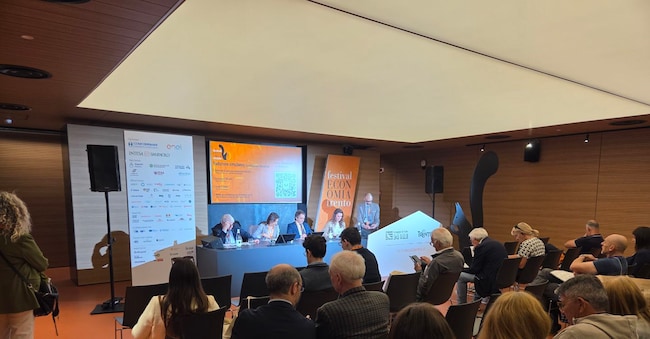
Assessments, those of the economist and former director general of the Bank of Italia and director of the Confindustria study centre, that give a sense of the pervasiveness of the changes taking place in terms of trade, a theme to which one of the first events of the Trento Festival of Economics is dedicated: 'Trump's tariffs, much ado about nothing'.

Loading...

While it is indeed true that in terms of exports, the direct effect on the volumes of Italian-made goods to the United States was apparently limited, breaking down the data in sectoral terms changes the matter.

'28% of trade with the US,' Fontana clarifies, 'is related to pharmaceuticals, which have grown a lot. Net of these, however, and some one-off ship sales, there was a reduction in sales in other important sectors. For example in metals, or in food, with an average slowdown in the order of 5%. Of course, nothing as much as one might have feared, but a reduction nonetheless, and this despite a first quarter of 2025 on course due to the preventive overstocking carried out by the companies'.

'In fact,' Signorini adds, 'if we take Liberation Day, that is, Trump's original announcement of tariffs towards the world, as a reference, today we see that the level reached is much lower. To this we must add Europe's wise decision not to go into a trade confrontation, avoiding retaliation. Depressive effects on growth certainly exist, but in reality the forecasts were already depressed even before 2 April 2025'.

'The use of tariffs has become purely political with Trump,' explains Alessia Amighini, professor at the University of Eastern Piedmont, 'distorting their original meaning, namely protection in the event of unfair competition. If the instrument adopted was aimed at reducing the US trade deficit, we see that this has not happened. US industry has largely migrated elsewhere and from this point of view 'protecting it' makes no sense. But even the one that has remained is naturally interconnected pr its purchases from other economies, and thus in turn damaged by this situation'.

However, the risks of this situation also lie elsewhere, for example in the diminishing appeal of investments towards Europe, as is happening, Fontana again points out, a shift in favour of the US and China that is indeed worrying.

The solution for Europe? "On the sales front, try to diversify the commercial outlets with new framework agreements," explains Cepii (French Centre for Research on the World Economy) economist Pauline Wibaux, "but in industrial terms we need to free ourselves as much as possible from dependencies, relaunching production and increasing production capacity in the most critical areas. As Brussels is trying to do, at least in part, with the Chips Act or the Critical Raw Materials Act'.

"Our companies," Fontana further adds, "are historically good at relocating, as demonstrated by the annual shift of 7-8% in geographical terms of our exports. What is certain is that this situation is not favourable, also because in perspective the risk is to see China's production overcapacity turn towards Europe, as is already happening in part. And we must remember that in production terms Beijing is now worth 35% of the total, more than Europe and the United States put together'.

"

Copyright reserved ©
Loading...

Brand connect

Loading...

Newsletter

Notizie e approfondimenti sugli avvenimenti politici, economici e finanziari.

Iscriviti