The clash

Trump threatens 100 per cent tariffs on Canada in case of trade deal with China

Canadian Prime Minister Mark Carney's visit to Beijing and the trade rapprochement between the two countries trigger new tension with Washington

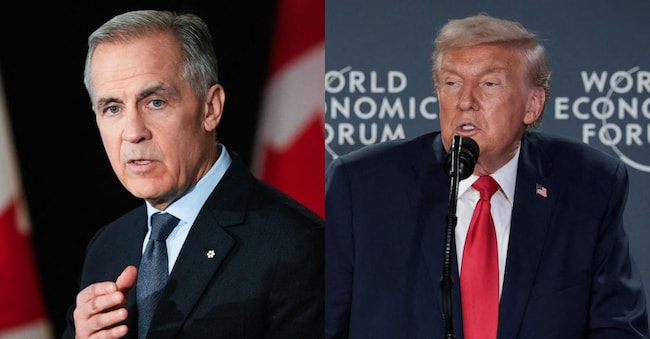
by Angelica Migliorisi

Da sinistra, il primo ministro canadese Mark Carney e il presidente degli Stati Uniti Donald Trump

3' min read

Translated by AI
Versione italiana

3' min read

Translated by AI
Versione italiana

"If Mark Carney thinks he is turning Canada into a warehouse for China to send its goods to the United States, he is sadly mistaken." Donald Trump posted his new attack on Canadian Prime Minister Mark Carney on Truth, the social media outlet he owns. The US president added: 'China will completely devour Canada, destroying its businesses, its social fabric, and generally its way of life.

Since the beginning of its second term in 2025, the Trump administration has adopted protectionist measures and additional tariffs on Canadian and Mexican products, with suspensions, counter-duties and disputes related to the United States-Mexico-Canada Agreement (Usmca), the trade agreement that regulates the extensive exchange of goods and services between the three countries.

Loading...
Davos, Trump accusa Carney: "Canada vive grazie agli Usa, ricordatelo"

A new agreement with the Chinese giant

The spark for the latest clash was a historic visit by Carney to Beijing, the first by a Canadian prime minister since 2017, during which the two countries reached an understanding to reduce mutual tariffs on certain categories of goods. "I am on my way to Beijing. China is our second largest trading partner and the world's second largest economy," Carney had written on X. "A pragmatic and constructive relationship between our countries will create greater stability, security and prosperity on both sides of the Pacific," he had added.

On the eve of the departure, according to the Canadian newspaper The Globe and Mail, Trump had dismissed the trade agreement between the US, Mexico and Canada as 'irrelevant'. A statement that, according to the newspaper, would have contributed to uncertainty and nervousness in Ottawa and Mexico City, just as a possible review of the treaty was approaching.

Under the announced agreements, China agreed to reduce tariffs on Canadian rapeseed and other agricultural products, whileCanada lowered some tariffs on Chinese electric vehicles from extremely high levels (up to 100 per cent) to reduced tariffs of around 6.1 per cent.

More in detail, in a first phase Ottawa will allow up to 49,000 electric vehicles manufactured in Beijing to enter its market by applying a 6.1% tariff, in line with the 'most favoured nation' regime (the cardinal rule of the World Trade Organisation whereby a state applies the same most favourable tariff conditions to one partner as to any other). A clear discontinuity from the 100% tariffs introduced in 2024 by the previous government led by Justin Trudeau, in the wake of restrictive measures adopted by the United States. For comparison, notes Reuters, in 2023 Chinese exports of electric vehicles to Canada had stopped at 41,678 units.

According to Carney, the agreement brings trade back to levels prior to the recent trade frictions, but within a broader framework that will grow over time: the quota, he pointed out, should gradually increase to around 70,000 vehicles over five years.

Cina-Canada, Carney da XI: "Costruiamo nuova partnership strategica"

The understanding reached with Beijing also envisages, according to the Canadian Prime Minister, thatby 1 March China will drastically reduce tariffs on rapeseed, bringing them down from levels around 84% to an overall threshold close to 15%. Carney also indicated that, as of the same date,tariff measures applied to several other Canadian products, including canola meal, lobsters, crabs, and peas, should be suspended, at least until the end of the year.

In the words of both countries, a "new strategic partnership". But above all, it is not an isolated episode, which is in fact part of a broader trend of diversification of trade relations on the part of Canada, driven precisely by the former governor of the Bank of Canada and the Bank of England, who has repeatedly emphasised the need to reduce trade dependence on the historically dominant US market, " by strengthening domestic capacity, working to double non-US exports and attracting substantial new investment".

This is also the background to Carney's speech at the World Economic Forum in Davos 2026. On that occasion, the prime minister openly criticised the use of tariffs as foreign policy leverage and called on middle-power countries to coordinate to defend their interests in the face of what he called the 'economic coercion' of the big powers. It was a message that turned up its nose at Washington and prompted a reaction from Donald Trump, who withdrew his invitation to Canada to participate in the US-sponsored peace council.

The possible impact on North American economies

Canada and the United States are linked by one of the most integrated trade relationships in the world, based on deeply interconnected production chains, in which components and semi-finished goods cross the border several times before becoming finished products, from automotive to agribusiness.The assumption of 100% tariffs on all Canadian imports would therefore risk producing disruptive effects for both Ottawa and the US economy, disrupting established value chains and translating into higher costs for businesses and consumers in the United States. At the moment, however, the Canadian government has not issued an official response to Trump's threat.

Copyright reserved ©
Loading...

Brand connect

Loading...

Newsletter

Notizie e approfondimenti sugli avvenimenti politici, economici e finanziari.

Iscriviti