United States

Ius soli: Trump to ask the Supreme Court to review the case

The president is making a fresh push following the rejection, confirming his intolerance of any limits on his power. But the last time the High Court reviewed a case was some sixty years ago

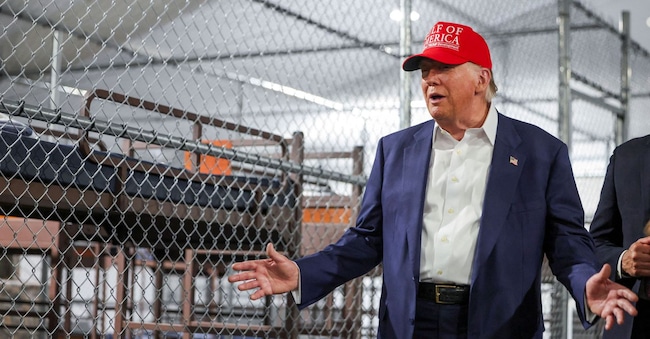
Il presidente degli Stati Uniti Donald Trump visita un centro di detenzione temporaneo per migranti, noto informalmente come "Alligator Alcatraz", a Ochopee, in Florida (Stati Uniti), il 1° luglio 2025.  REUTERS

3' min read

Translated by AI
Versione italiana

3' min read

Translated by AI
Versione italiana

Trump will ‘immediately’ ask the Supreme Court to review the ruling in which, a few days ago, the highest court in the judicial system – the guardian of the US Constitution – struck down the executive order that abolished ‘ius soli’, the right to citizenship acquired by those born in the United States, which has been in force since 1868.

The announcement came just a few hours after yet another killing during an anti-migrant raid by Immigration and Customs Enforcement on the streets of Houston, Texas: Lorenzo Salgado Araujo, aged 52, a site foreman, was stopped and killed by immigration officers whilst on his way to work, unarmed, in his white van, along with three other builders who were arrested. This is the tenth victim to have died during an ICE raid or during public protests since the start of Trump’s second term. ICE raids have resumed in recent weeks, without much fanfare, in many American cities.

Loading...

As you may recall, the most high-profile incidents took place in Minneapolis a few months ago, during a prolonged military siege that resulted in several deaths and over 4,000 arrests: on 7 January 2026, Renée Nicole Good, a 37-year-old mother of three, was killed whilst protesting unarmed in her car against the raids. On 24 January, Alex Pretti, aged 37, was shot dead with ten bullets to the chest by a police officer during another demonstration.

Human Rights Watch has calculated that, in the first 500 days of Trump’s second term, 52 people died in custody following arrests by ICE.

Following the High Court’s rejection of the ius soli, Trump initially called on Congress to resubmit a bill to reintroduce the measure as soon as possible. He then changed his mind, making use of a procedural mechanism provided for in the Supreme Court’s rules of procedure which allows for a request for reconsideration to be made.

The High Court very rarely grants a retrial, and it is highly unlikely to happen, despite the conservative leanings of the majority of the judges: the losing party has 25 days to lodge an appeal, but the approval of all nine judges is required to reopen a case. This is a very rare occurrence: the last time a case that had already been decided was reviewed was around 60 years ago.

“This miscarriage of justice will destroy America unless they reverse this utterly mad decision of theirs,” thundered The Donald on Truth, announcing his next move on immigration.

Trump decides everything, like an absolute monarch. He even asks for the rules of the sport to be changed at the World Cup. Because he refuses to accept defeat. At the start of the year, in a famous interview with the New York Times, he explained that ‘the only limit to his power is his morality’. According to him, only the courts – and not Congress – have the power to limit his actions, but ‘in certain circumstances’. His second term in office is characterised by an aggressive and rapid concentration of powers in the hands of the executive, at the expense of the legislative and judicial branches. In 2025, Trump signed 225 executive orders, whilst Congress, although controlled by the Republicans, passed only 49 new laws, all of minor importance. The current Congress has been the least productive in history since the end of the Second World War. In 2025, it abdicated its constitutional role in favour of the presidential executive, ceding significant powers in legislative and fiscal matters.

Even the Supreme Court has largely relinquished its power. And even when it overturns Trump’s executive orders (such as those on reciprocal tariffs or, most recently, on ‘ius soli’), he attempts, as in this case, to circumvent them and implicitly refuses to accept them.

It should be noted that, in US courts, there are currently over 600 legal proceedings underway challenging decisions taken by the Trump administration after just one year, including 200 cases brought before federal courts or courts of appeal.

Copyright reserved ©
Loading...

Brand connect

Loading...

Newsletter

Notizie e approfondimenti sugli avvenimenti politici, economici e finanziari.

Iscriviti