
Trump’s warning to Americans ahead of the mid-term elections: ‘If you don’t vote, you’ll go to hell’
With war and inflation taking their toll, the tycoon defends the attack on Iran, but reports from military commanders obtained by Vance are fuelling doubts

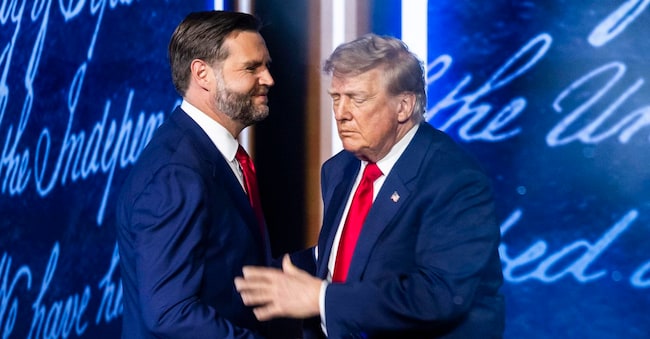
‘Do you know what happens if you don’t vote? You’ll go to hell, you go to hell!” Donald Trump concluded his lengthy appeal to voters at the Republican convention in Dallas, Texas, with these words. An audience of staunch supporters joined him in a pledge of loyalty and commitment ahead of the mid-term elections.
“Raise your right hand and repeat after me,” said Trump at the height of a long speech, amidst red, blue, white and gold balloons. And the MAGA crowd went along with him, repeating his words: ‘I promise the greatest president in the history of the United States, who loves us so much he can’t even breathe, that I will go with my family, my friends, I will do it –’ so continued the call-and-response chant – ‘in any way, I don’t care whether I’m being recorded or not, I’ll try to cheat like mad, just as they do. I’ll go out, I’ll get my friends and my family, and we’ll go and vote on 3 November.”
A referendum on the President’s actions
The mid-term elections will inevitably be a referendum on the President’s record. And despite the reservations of several Republican candidates, Trump, speaking in Dallas, put himself first and foremost, going so far as to ask voters to act ‘as if my name were on the ballot papers’. However, the president’s approval rating has fallen to its lowest level of his second term, just above 30 per cent. And the Republicans risk losing their majority in the House of Representatives and perhaps even in the Senate.
There is a lot at stake for Trump in the mid-term elections. That is why, as well as attacking ‘the communist Democrats who are a danger to the country’, he has reiterated his promise to give ‘$5,000 to every American’ if he wins the election and retains control of Congress.
The war in Iran (decided in conjunction with Israel) is complicating the President’s campaign. Rising prices for petrol and diesel, as well as for food and essential goods, are putting American families under strain, causing widespread discontent even in key swing states, and could lead to an increase in votes against the administration. But Trump insists on defending the decision to attack the regime in Tehran, triggering a conflict that was supposed to last a few days but has now dragged on for almost seven months. “I do not regret the war in Iran; I do not believe in the word ‘regret’. One can always reflect a little on one’s own actions. But if I had to decide now, I would act exactly as I did,” he said in an interview with Fox News.


