The interview

Trussardi, CEO Racca recounts the relaunch: 'We focus on premium luxury. Beyond fashion"

by Marta Casadei

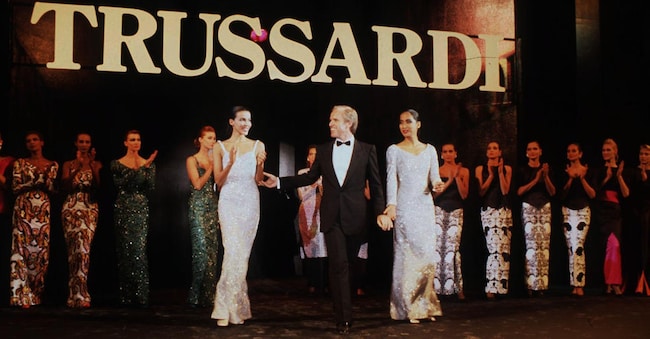
Italian fashion designer and entrepreneur Nicola Trussardi with fashion models at a fashion show, Milan, Italy, 25th March 1983. (Photo by Leonardo Cendamo/Getty Images)

4' min read

4' min read

A little over three months have passed since 12 March, the day the Miroglio group took over Trussardi from Fondo QuattroR. The Bergamo-based company, which was founded in 1911 as a glove manufacturer and has evolved into a lifestyle brand of so-called premium luxury, had been undergoing crisis resolution proceedings at the Court of Milan for about a year. The Piedmontese group heads 30 companies and four factories in 22 countries and, in addition to Trussardi, has nine brands: six for Miroglio Fashion (Elena Mirò, Oltre, Motivi and others) and three from the joint venture with the Turkish group Ipekyol. The decision to take over Trussardi is rooted not so much in the desire to establish itself as a 'white knight', but in that of developing the future of the greyhound brand according to a precise plan. Alberto Racca, ceo of Miroglio Group from 2019 and now ceo of Trussardi, explains.

Why did you choose to take over the greyhound brand?

Loading...

We saw a big space in the premium segment, which luxury has abandoned by raising prices by 70% since pre-Covid. Trussardi is an influential brand with a strong heritage and quality. The second reason is that it is a credible brand beyond fashion, thanks to a series of high-level partners.

What has not worked in the Trussardi parable?

Let me say at the outset that I come from the world of restructuring, but mine is not meant to be a judgement on the actions of others, but rather a focus on mistakes not to be repeated. In the Trussardi affair, a multiplicity of factors played a part, including the prevalence, at certain times, of very short-term visions. At other times, on the other hand, there was an excess of individualism on the part of some designers that obscured both the heritage and the customer's desires. And finally, the organisational structure was calibrated for times of growth, but became a burden when the market changed.

In addition to the brand, you took over 15 shops (outlets) and the archive. Have you managed to keep the staff? .

We made a union agreement that provided for the total preservation of employment.

Has production restarted?

Yes, it is now focused on the 15 shops that need a core product assortment - men's accessories, mainly - to continue operating. The biggest challenge will be the presentation of the full price collection for autumn-winter 2024-2025. That is the project we are focused on at the moment.

The luxury world is experiencing a major slowdown. How will you relaunch the brand after the years of crisis in this context? .

We tend to preserve its uniqueness and history, while working on a series of back office synergies. First of all, we have moved our headquarters above the Miroglio headquarters in Milan: in these offices our creative collective is working on the archive - which is enormous and occupies a space of 6,000 square metres in Alba - to create a men's and women's collection of clothing and accessories. It will be a quiet collection, aligned with Trussardi's heritage, inspired by timeless elegance and functionality. We hope it will be the basis for the restart of full-price wholesale and retail and then for distribution agreements abroad.

You don't bet, then, on a creative director?

No, as I said, we have stripped ourselves of the individualism that has been a negative factor for the brand in the past. We have a team made up of both people who already worked for Trussardi and newcomers. It is a collective that is working on the archive to read the history of the brand vertically, going to select what the customer might want. Without the collection having to make a fuss at all costs.

Will the greyhound brand's link to Milan remain strong? The iconic building in Piazza della Scala has remained in the family....

Milan is central and will remain so. We expect the launch of our full price collection to be accompanied by the reopening of a shop in Milan.

You also acquired licences. Have you kept them all? Which ones do you want to focus on?

Basically we have preserved the licence agreements. We see great potential in the world of serviced apartments and hotels: we recently launched Trussardi Residences in Dubai and they have had very positive feedback.

What are Trussardi's economic goals?

The idea is to arrive already this year at a situation close to breakeven. The turnover will be around twenty million.

The economic performance of the brand will fit into the broader performance of the Miroglio group. How have you archived 2023?

We ended 2023 at EUR 530 million, up from EUR 500 million in 2022, with ebitda at EUR 39.5 million, up from EUR 29 million in 2022. It was precisely having reached this level of profitability that allowed us to enter the market and take over Trussardi.

How is 2024 going?

The environment is difficult due to macroeconomic, geopolitical and climatic conditions. There is nosilver bullet but a mix of levers can be used: we are currently growing 5.5% on last year and should end the year between 550 and 570 million in revenues.

Is there a price increase among the levers? How do you manage high costs?

Increasing prices when purchasing power does not increase may work, but it is not our strategy. We have tried to recover surcharges by increasing production efficiency.

You have a dense network of single-brand shops which, including the Turkish joint venture, touches 1,100 shops in Italy and abroad. How are the different markets doing and what plans do you have in Europe?

Our network is very wide and basically stable. We are doing well in Romania, where, specifically, Oltre is doing very well; Elena Mirò is strong in
Spain and Benelux and with the joint venture we are growing in the Middle East and Central Asia. Also in relation to Trussardi, which is already very strong from the Middle East to Eastern Europe, we want to cultivate these geographical areas.

Copyright reserved ©
Loading...

Brand connect

Loading...

Newsletter

Notizie e approfondimenti sugli avvenimenti politici, economici e finanziari.

Iscriviti