
TSMC, the global chip factory match against Chinese risk
The group diversifies production in Germany, Japan and the US but ties to Taiwan remain high. Business driven by artificial intelligence

5' min read
5' min read
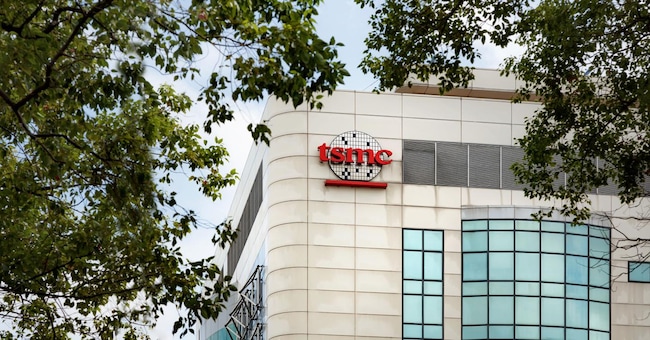
Taiwan Semiconductor Manufacturing Company (Tsmc). That is: one of the big companies in the world of semiconductors. It has recently hit the headlines. The reason? The surge of the company's stock on Wall Street (and on the Taiwan Stock Exchange), which propelled the entire sector and contributed to new records for the entire US market.
Stock Market Dynamics
.Specifically: Tsmc's shares gained some 13% from 18 January to the close of 30/1/2024. A dynamic which, over the past 12 months, implies an increase of 25.15% (27.5 the total return). On closer inspection, the most recent mini-rally has a precise cause: the indication, at the same time as the publication of the fourth quarter 2023 and full-year figures, of growth forecasts for the current financial year. The Taiwanese group estimates that its revenues will rise more than 20 per cent in 2024 compared to 2023. The figure, apart from the positivity in itself, has a strong signalling value because of Tsmc's corporate purpose. This is the world's largest semiconductor 'foundry'. In other words: it is the largest manufacturer of chips for third parties (on 30/9/2023 it had a 59% market share). Clearly, therefore, that - also considering the fact that customers include names such as Apple, Amd or Nvidia - the sales performance of Taiwan semiconductor manufacturing company is to be considered a thermometer of the health of the entire industry. True! It is still a single company whose business is affected by particular dynamics. And yet, its performance has always been taken into account (also) to grasp general industry trends.
The Profit and Loss Account
.Yes, the general trend. With respect, however, to Tsmc's more specific 2023 numbers, it should be mentioned that they are not so positive. Although last quarter turnover in dollars was up - on the third quarter - by 13.6%, the year-to-date figures show a drop of 8.7% (also in dollars). Gross margin (industrial margin) itself dropped to 54.4% (it was 59.6% a year earlier). Of course: the entire semiconductor industry - according to Deloitte - contracted by 9.4% in 2023. Hence: Tsmc outperformed the sector. And yet, the group's negative trend remains.
In contrast to last year's trend, the market rewarded Tsmc's 2024 forecast. That is: it interpreted CEO C.C.Wei's words as an indication that the industry's bearish cycle may be behind us. In the recent past, especially in 2023, the semiconductor world has suffered from excess inventory. Chip companies, in anticipation of rising demand, built up a lot of inventory. Too much! With the result that, partly due to the slowdown in sales of smartphones and personal computers, they had to dispose of excess 'inventory', reducing or withdrawing new orders and thus driving prices down. Hence the poor performance in 2023. Now, however, the situation seems to have changed, thanks in part to the volumes linked to artificial intelligence.
Technological Leadership
.All as easy as drinking a glass of water, then? The reality is more complicated. Some experts, it happened in the same conference call on the latest quarterly figures, point out on the one hand that, among Tsmc's strengths, there is technological leadership; but, on the other hand, that there are competitors who can challenge this very characteristic. Above all, in the race to miniaturise transistors, and thus, the chips themselves. "I don't see leadership at risk,' replies Carlo De Luca, head of AM at Gamma Capital Markets. 'Tsmc is currently one or two generations ahead of foundries such as Intel, for example. "The latter,' echoes Giacomo Calef, country manager of NS Partners, 'faced various problems in the launch of the 7-nanometre processor'. Tsmc, on the contrary, 'has successfully developed the production programme for this product, gaining a significant advantage'. Of course: 'Intel has repeatedly indicated its willingness to regain the lead in technology evolution by 2025 with new 1.8 nanometre chips'. But these, Tsmc itself has indicated, 'are roughly comparable', De Luca resumes, 'to the 3 nanometre technology that the Taiwanese group already has in production and which, at the end of 2023, will be worth around 6% of total wafer revenues'. In short: the experts' opinions seem clear. Nevertheless, these are frontier technologies. A situation where, beyond the experts' comments, it is always useful to point out how a solution that is now a winner can become a loser within a short time. That said, it is clear that Tsm invests heavily in R&D. It is one of its trademarks, also facilitated by its large size and global presence, which allows for high economies of scale and allows for large investments.


