
Turin, clashes at the Askatasuna social centre rally
Tear gas and clashes with police, a group of protesters deflects towards the headquarters of the evicted centre, 11 agents injured - 'What happened today in Turin is serious and unacceptable,' writes Giorgia Meloni on X

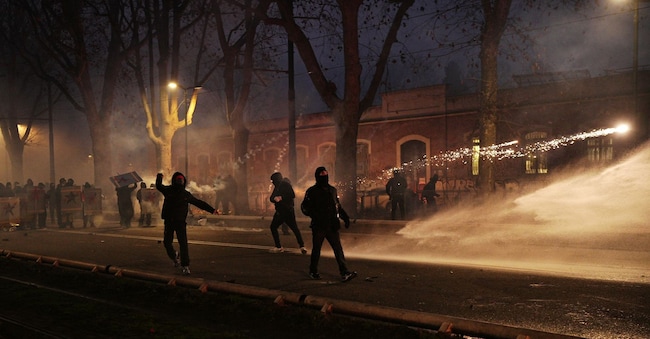
The day's demonstration in Turin began with 20,000 people in a procession, some of whom had come from half of Italy to protest against the eviction and closure of the Askatasuna social centre last December, and ended with an urban guerrilla war in the area of the city where the building is located. Eleven officers were injured, one in particular, as shown in a video, was surrounded and hit by a dozen or so masked protesters while a RAI crew was attacked and a journalist hit in the leg.
A part of the demonstrators, traceable to the anarchist and antagonist area, towards the end of the demonstration broke away from the procession to deviate towards Corso Regina Margherita 47, headquarters of Aska, from there on clashes with the police began. To the throwing of paper bombs, rockets and fireworks, the agents responded with water cannons and smoke bombs. A police truck was set on fire, as well as several rubbish bins in the area of the clashes.
The story of the closure of Turin's historic social centre, at the centre of a social recovery process shared with the administration led by the mayor Stefano Lo Russo - later interrupted by serious events such as the assault on the editorial office of La Stampa or the Ogr headquarters - became the pivot of a protest promoted by numerous associations - from the Pro Pal movement to the No Tav and student committees -, which brought demonstrators from all over Italy to Turin. Alongside them, there were also citizens' committees, calling for the resumption of dialogue and the return of Askatasuna to the community, many students and citizens protesting against the policies considered repressive with respect to dissent put in place by the government.
The images of u
n imposing procession, in a city that in recent years has also taken to the streets in support of the Tav, in 2018, or in defence of work, industry and the car, in 2024, were replaced by those of a violent urban guerrilla warfare, which went on until the evening, with an initial toll of 11 wounded among the officers, as well as a RAI crew attacked and a journalist shot in the leg.


