Made in Italy

Tuscany takes silver in exports thanks to Arezzo’s gold

The province saw a doubling of figures in the first quarter, with sales of bullion to Switzerland increasing tenfold; the jewellery sector, however, is struggling.

by Luca Orlando
3' min read

Translated by AI
Versione italiana

3' min read

Translated by AI
Versione italiana

From 485 million to over four billion. It is this surge in particular that is driving the national export figures: the exponential increase in sales of precious metals from the Arezzo district to Switzerland, with figures for the first quarter of 2026 having risen almost tenfold compared with the same period in 2025.

Arezzo, in fact, thanks precisely to this surge, was the top-performing Italian province in the January–March period, with figures almost doubling, placing it third amongst exporting provinces behind Milan and Florence: twelve months earlier, however, it had been only tenth. The district’s metal dealers and refiners have achieved an absolute record, exporting precious metals worth over six billion euros in total (to Switzerland and the rest of the world) during the quarter – triple the figure for the same period in 2025 – accounting for 60 per cent of the national total for this product category, which for Italia as a whole saw quarterly exports of 10.3 billion, double the figure for the January–March 2025 period.
Loading...

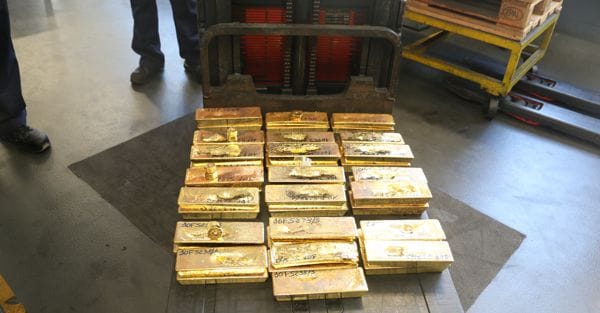
Lo scatto dei lingotti esportati

Per Arezzo i metalli preziosi esportati arrivano nel trimestre a oltre sei miliardi, da 1,8 di 12 mesi prima. E’ il miglior trimestre della storia, per effetto dell’aumento delle quotazioni ma soprattutto dei volumi.

Tuscany, as a result of this surge, is by far the best-performing region in the first quarter in terms of export growth, with an increase of over 30 per cent – a leap that allows it to edge ahead of Emilia-Romagna (and also Veneto), placing it just behind Lombardy for the first time.

This growth is certainly underpinned by the surge in the price of gold, which has soared by an average of over 50 per cent in 12 months, but this alone is not enough to explain the growth. The other factor is, in fact, the weakness of the other traditional market for Arezzo-based companies: domestic demand.

“The jewellery sector is currently struggling,” explains Maria Cristina Squarcialupi , president of Federorafi and managing director of the Chimet Group, “and the gold that is not returned to the domestic market is sold abroad, in this case in the form of ingots. Switzerland, in turn, uses it in many ways: there are the Swiss banks themselves, which hoard it; the watch market, which has never stopped; and then exports to other countries, such as India or China.”

“From 5.9 billion last year,” explains Ivana Ciabatti, Chair and CEO of Italpreziosi , “we now expect to reach ten billion – results that are also the fruit of our investments in technology and sustainability. Demand in Italia has fallen, whilst international demand for physical gold remains strong, coming from both central banks and private individuals. Switzerland, currently our largest market, serves as a key hub for expanding into other markets, such as the Chinese market, where we do, however, plan to establish a direct presence next year.”

Switzerland has also become the leading market for jewellery exports, with a 54 per cent surge in the first two months (Federorafi figures), against a backdrop of a general downturn in the sector.What is now happening with Bern is similar to what occurred with Turkey two years ago for contingent reasons; this time, it concerns semi-finished products from Arezzo, which are being imported in large quantities due to Ankara’s regulations penalising the import of pure metal. Turkish jewellers, who also had to pay tariffs on non-EU gold (previously purchased from Switzerland or the United Arab Emirates), therefore found it more cost-effective to buy products that were as raw as possible but still partially processed in Arezzo, before remelting and reworking them for domestic production. This trend has now subsided, with jewellery exports to Ankara returning to normal levels of just over 50 million per quarter, down from 1.5 billion at the end of 2024.

“If we look at exports to all markets as a whole,” explains Squarcialupi, “we see a rather bleak picture, with values already down by 19% in 2025 and the situation already struggling now, with double-digit declines continuing. Furthermore, from March onwards, we will need to assess the impact of the war in Iran on purchases from the Middle East, and it is easy to foresee that volumes will be even lower. The jewellery sector is also being held back by tariffs, which, in the case of the United States, affect not only the added value of the craftsmanship but also the metal itself.”

In the first quarter, in fact, jewellery exports from Arezzo plummeted, falling by more than half to 720 million euros. The Alessandria district bucked the trend (+56%), but nationally, the total value fell by 14.2% to €2.8 billion.

Copyright reserved ©
Loading...

Brand connect

Loading...

Newsletter

Notizie e approfondimenti sugli avvenimenti politici, economici e finanziari.

Iscriviti