Elections

Russia: pro-Putin party secures another landslide victory in the Duma

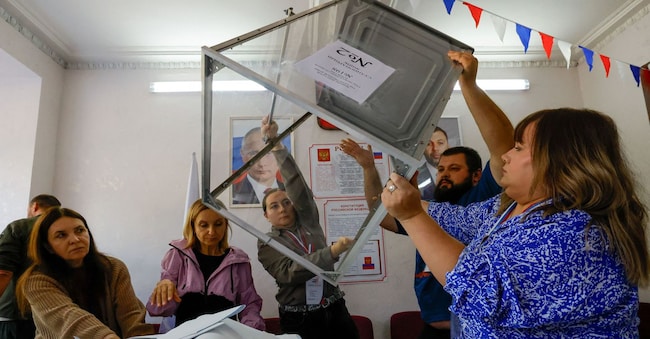
United Russia is leading the State Duma elections with 57.86 per cent of the vote, with 90.43 per cent of the ballots counted. This is according to figures from the Russian Central Electoral Commission

by Antonella Scott

Aggiornato il 21 settembre 2026 alle ore 09:06

Aggiungi Il Sole 24 Ore
ai preferiti su Google
REUTERS/Alexander Ermochenko REUTERS

3' min read

Translated by AI
Versione italiana

3' min read

Translated by AI
Versione italiana

Antonella Scott

After the polling stations had closed, as the first election results began to come in from across Russia, the leader of the Yabloko party, Nikolai Rybakov, addressed those who might have been his voters: shortly before, at the polling station, he had added his party’s name in second place on the ballot paper, then writing ‘for peace’ underneath.

Loading...

The number 2 spot on the list had been allocated to Yabloko (“apple” in Russian) before the party – the only one to speak out against the war in Ukraine – was excluded from the election, with the exception of around a hundred candidates admitted to single-member constituencies. However, according to a poll conducted by ExtremeScan in early September, had Yabloko been able to participate fully, it would have secured 24.6 per cent of the vote, coming second only to United Russia (31.8 per cent), Vladimir Putin’s party.

This is a figure that would appear to be borne out by the percentages achieved by Yabloko candidates where they were able to stand; furthermore, according to the official results, the party managed to secure a seat in the Novgorod regional parliament, with 6.2 per cent of the vote: the only region to have allowed a voice to be heard within the permitted limits, despite the fact that Yabloko was not spared from repression. In the months leading up to the election, two of its vice-presidents, Lev Shlosberg and Maxim Kruglov, were sentenced to 11 and seven years’ imprisonment respectively for spreading ‘false information’ about the Armed Forces.

“If we’d been on the ballot,” Rybakov told his supporters, “we would have come second in the Duma election. That is a fact: the main aim of the campaign has been achieved; millions of people have spoken out in support of Yabloko, for peace, freedom and a life without fear. Now no one can say that we are alone in this struggle for change. The whole world has seen it: in Russia, millions of people disagree with what is happening.”

The official results

But this is a reality that has no place in the official narrative, which – with the count almost complete (90.43 per cent of the votes) – naturally awarded United Russia 57.86 per cent and a constitutional majority, a better result than in previous elections (49.8 per cent in 2021) and of what had been described as the Kremlin’s targets, both for its own party and for voter turnout: the latter, at 57 per cent, also set a record, surpassing the 51.72 per cent recorded in the previous parliamentary elections.

Second place went to the Communists with 13.86 per cent: they will enter the Duma alongside the Liberal Democrats (who are, in reality, ultra-nationalists, 8.9 per cent) and “New People” (7.94 per cent), a party founded to provide an outlet for moderate protest on economic and social issues. ‘Fair Russia’, part of the systemic opposition – which is aligned with the Kremlin on the war – has been left out, having failed to clear the 5 per cent threshold and securing only 4.95 per cent of the vote. The picture is rounded off by the result achieved by Ramzan Kadyrov, Chechnya’s strongman, who is said to have secured 99.85 per cent of the vote.

A vote in wartime

To further emphasise the significance of United Russia’s success, the authorities highlighted the climate of unprecedented pressure in which the election took place: Ella Pamfilova, chair of the Electoral Commission, reported more than a thousand cyber-attacks on the electronic voting system, describing them as ‘signs of Ukrainian interference’ in what she called the most complex elections of her career. The final day of voting began in Moscow with a heavy attack by Ukrainian drones, leaving three people dead and a refinery on the outskirts of the capital ablaze: a “clear attempt by Ukraine to interfere in the vote”, said Mayor Sergei Sobyanin.

But in Ukraine too, following the weekend’s attacks, the authorities report at least eight deaths. On Monday night, a bombing left a university building in Zaporizhzhia ablaze. Putin is expected to declare electoral victory: having staked everything on continuing the war, and having asked every voter to contribute to the victory, the Russian president will undoubtedly claim the result as his own, presenting it as confirmation of his plans. Many fear the announcement of a mobilisation, or of further sacrifices in the name of the war: the future scenario, amongst other things, will feature a Duma filled with numerous veterans included on United Russia’s candidate lists. ‘It will be significantly bolstered by front-line soldiers,’ has already clarified Yevgeny Poddubny, a war correspondent who tops the party’s lists.

Copyright reserved ©
Loading...

Brand connect

Loading...

Newsletter

Notizie e approfondimenti sugli avvenimenti politici, economici e finanziari.

Iscriviti