
28th Regime and Integrated Supervision for the EU
A conference in Milan takes stock of the state of implementation of the Savings and Investments Union
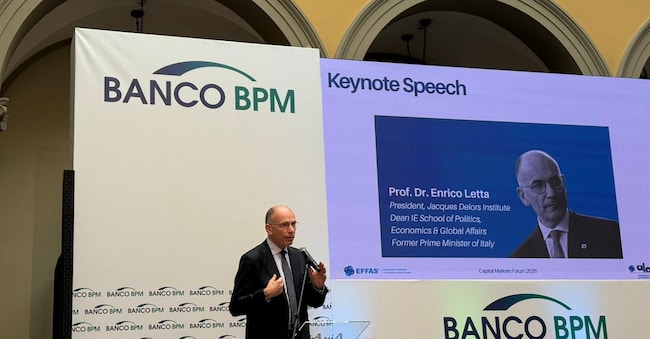
Europe urgently needs to catch up on a serious competitiveness and productivity gap that has accumulated over 30 years. This is what Enrico Letta recalled, in Milan during the conference of the Aiaf and Effas associations 'Savings and Investment Union Latest Developments' hosted by Banco Bpm.
The data that emerged from the speeches illustrate a clear distance from the United States: while overseas market capitalisation reaches 100% of GDP, in Europe it stops at 71%, with some areas, such as Italia, struggling to reach even 48%. There is an immense pool of savings, estimated at 30 trillion, which too often remains unproductive in the form of liquidity or flows massively, at the rate of hundreds of billions, to the US markets.
The theme is therefore integration at European level, and to implement it, Enrico Letta has indicated two major structural reforms as the way forward. The first is the implementation of the '28th regime', a sort of pan-European regulatory fast track that Letta considers politically crucial. And with respect to which he reports positively on the fact that the text proposed by the Commission eventually turned out to be broader than initially envisaged.
The second indispensable move is the creation of genuine European industrial and financial champions to acquire the 'scale' necessary to compete globally. Letta used the aerospace sector as a perfect comparison, highlighting the example of Airbus. The biggest obstacle to such cross-border aggregations, however, remains the politics of individual states; Letta said: 'The problem in Europe, compared to the United States, is the cost of our legacies that we want to keep alive,' referring to the national historical companies that governments tend to protect at all costs.
The central issue is always that of regulation, which was then addressed by Chiara Mosca, deputy chairman of Consob, who called for a real quality leap for European supervision. Mosca clarified that 'supervisory convergence is not just how we do supervision ... it is something that impacts market integration', lamenting the too many divergences in the application of rules between one state and another. He was very insistent on the concept of 'better regulation', saying that 'simplification means studying better regulation, on the quality of the rule, so that it can be understood, is correct, consistent and aligned with a single jurisdiction'.

