
Twenty years of Blue Ocean: winning without competing

2' min read
2' min read
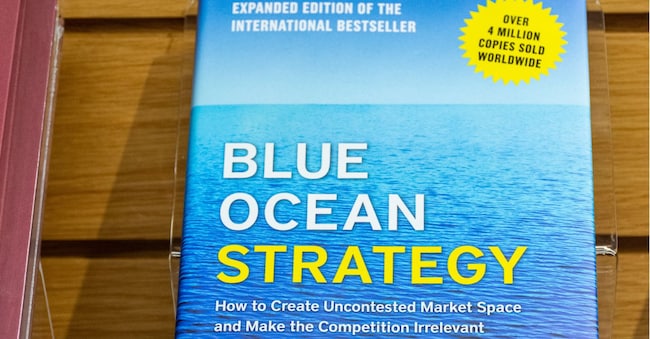
In 2005, the book Blue Ocean Strategy by W. Chan Kim and Renée Mauborgne came out, destined to become a milestone in the world of management and corporate strategy. Twenty years after its publication, the 'Blue Ocean Strategy' continues to influence the way companies think about innovation and competitiveness, proposing a radical alternative to the logic of direct competition. This revolutionary approach has transformed the way companies and entrepreneurs (but also non-profit organisations and governments) think about innovation, competition and value creation.
The key concept behind the Blue Ocean Strategy is simple but powerful: instead of competing in saturated markets (the so-called 'red oceans'), where companies compete for the same spaces to the tune of prices and imitations, it is possible to create new and uncontested market spaces, the 'blue oceans'. In these new perimeters, competition becomes irrelevant, because one innovates in such a way as to generate new demand, offering value to both the customer and the company: thus, the Schumpeterian vision emerges, according to which market boundaries and industry structure are not given, but can be reconstructed by the actions and convictions of the industry players. The Blue Ocean Strategy, as opposed to the 'red ocean' characterised by ruthless competition, therefore proposes to create these pristine market spaces where competition becomes irrelevant. Companies that want to stand out must have the courage to abandon the 'price war' and invest in strategic creativity, listening to latent customer needs and anticipating trends.
Unlike traditional strategies based on incremental improvement and competitive analysis, the Blue Ocean Strategy calls for 'breaking the mould' and rethinking market boundaries. Among its best-known tools are value innovation and the four-action framework (eliminate, reduce, increase, create), which are used to analyse and redesign the offer in order to make it unique. Famous examples are not lacking: Nintendo with the Wii or even Airbnb and Uber, are all cases of companies that have succeeded in creating blue oceans, reinventing entire sectors and attracting new customer segments. In each of these cases, the key element was a conscious move away from the traditional logics of the industry in favour of a new and engaging value proposition.
Twenty years on, the message of the Blue Ocean Strategy resonates more relevant than ever. In an increasingly dynamic and interconnected world, where competition becomes global and technologies evolve rapidly, focusing on value innovation can make the difference between surviving and thriving; by enabling peer-to-peer transactions without intermediaries, e.g. blockchains have evolved traditional financial systems and generated blue oceans with an unprecedented paradigm shift. Their disruptive potential underlines the need for strategic alignment between innovation and purpose, enabling stakeholders to unlock value, drive economic growth and shape a more connected and equitable future.
Filippo Monge - Professor of Economics of Innovation - University of Turin

