
Two Italian architects design the Ukrainian Paralympic Centre
The Milan-based Ifdesign studio presented the project with athletics tracks, swimming pools, rehabilitation areas - Estimated budget of 40 million euro

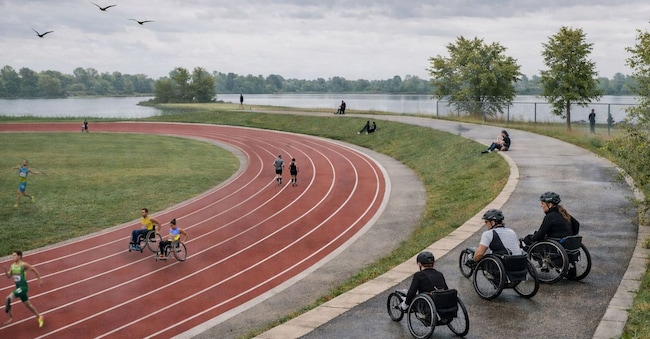
Under the bombs and drone attacks, Ukraine still manages to think about the future. As part of the "One hundred ideas for one hundred cities" initiative for the reconstruction of the country, the project for the new national Paralympic training centre, which will be built in Shatsk on the border with Belarus, has the signature of the Milan-based Ifdesign studio of architects Ida Origgi and Franco Tagliabue. Who recalls: 'We presented our proposal in the autumn of 2024 as part of an international consultation and we were rewarded: it is an initiative aimed at raising awareness of Ukraine's needs among public opinion and planners from all over the world'.
The country has thirty years of planning in the field of Paralympic sport, so much so that it has built training centres throughout the country since independence (1991), which have led Ukrainian athletes to excel in both summer and winter medals (sixth at Paris 2024; second at Beijing 2022, behind the unreachable China). All the more reason why, after four years of war, Ukraine knows that it will find itself with thousands of young people maimed by the conflict and, as experience teaches, sport is a vehicle for rebirth: "We have designed four tracks embraced by a raised green dune," explains the architect, "the rooms revolve around two patios so that there is osmosis between the areas and those who frequent them. There is a rehabilitation centre with two swimming pools, a physiotherapy area, and an indoor gym, which can be used in winter. Above all, we thought about beauty and imagined the centre open to the whole community, in an attempt to find a balance between privacy and sociality, without ghettoising either side. This is how we turn worlds upside down: people with disabilities need us and we need their experiences, their testimony'.
The attempt to blend worlds is the hallmark of the Ifdesign studio: there are sports facilities, but also the recreational part with cinemas and restaurants, and, after all, this is what happens in the latest generation of stadiums. In these terms, the architectural reference, for which Ifdesign received the Italian Architects of the Year 21-22 award, is the Noivoiloro socio-educational centre for differently abled people in Erba (Como): "We have overturned the concept of the fragile group. Fragility is not just a social burden, but an opportunity. The facility had no public funding, and thanks to the events organised by the Noivoiloro non-profit organisation, financial resources were recovered. Today, the day centre hosts thirty young people who carry out various activities, mature autonomy, in osmosis with the city around them". A concept that is also declined in the Ukrainian project.
Now the question of resources arises. The project will be placed in a context of European or, more likely, US funding and, of course, the figure does not change: the preliminary estimate hypothesises a budget of 40 million euros. An important sum, but derisory when compared with the one - never made public - that China has invested to build its immense Paralympic preparation centre, just outside Beijing. It wanted it in order not to disfigure itself at the Paralympics at home in 2022: 22 hectares (i.e. more than thirty football pitches) that earned 61 medals (only one medal, four years earlier in Pyeongchang 2018). Ukraine's numbers are not these, but great is the desire, after too much pain, to be together, to mix worlds. Finally at peace.


