
Two Italian F-35s intercept two Russian aircraft in Estonia: what you need to know about NATO's Baltic Air Policing mission
This is the third Italian participation in the mission to Estonia, after those of 2018 and 2021

2' min read
2' min read
While the gaze of international public opinion is turned to the Ukraine dossier, awaiting the face-to-face meeting between Donald Trump and Vladimir Putin in Alaska, NATO's surveillance activity along the Alliance's eastern flank continues. On Wednesday, 13 August, two F-35 fighters of the 32nd Wing of the Italian Air Force based in Estonia intercepted two Russian jets, a Sukhoi Su-24 Fencer and a Sukhoi Su-27 Flanker.
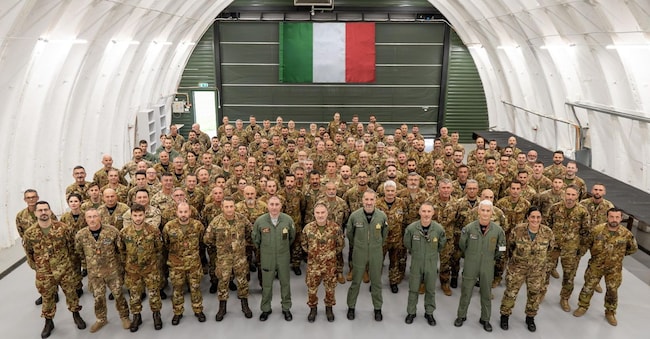
The two Italian F35 Lightning II fighters operate as part of the NATO Enhanced Air Policing mission. The 'Task Force Air 32nd Wing' detached at the Amari air base in Estonia is on 24/7 Quick Reaction Alert duty. Between Air Policing and Air Shielding, in 2025 Italy will participate with 15 air assets and 375 military personnel.
Air Policing is a capability that NATO has had since the mid-1950s and consists of the integration, in a single NATO air and missile defence system, of the respective and similar national systems provided by member countries. Air Policing consists of the continuous surveillance and identification of all violations of the integrity of the Atlantic Alliance airspace. It is carried out within the area of responsibility of NATO's Allied Command Operation in Mons and is coordinated by the Air Command in Ramstein.
The Air Shielding is a reorganisation of the air and missile defence posture along the Alliance's eastern flank, put in place by NATO in response to the Ukrainian crisis, and includes all surveillance (Air Policing), patrolling (Combat Air Patrols), vigilance (enhanced Vigilance Activities) and readiness (readiness) of air and missile assets.
The Mission
.The Enhanced Air Policing in particular is part of Nato's 'reassurance measures' introduced in 2014, following Russia's illegal and illegitimate annexation of the Crimean Peninsula. The Alliance implemented these reassurance measures with the aim of demonstrating the collective resolve of the Allies, the defensive nature of the Atlantic Alliance and deterring Russia from aggression or the threat of aggression against NATO Allies. These are flexible resignations in line with the changing security situation facing the Alliance.


