
Two new museums for Amsterdam
The Suriname Museum and the Art Zoo Museum expand the cultural offerings of this city

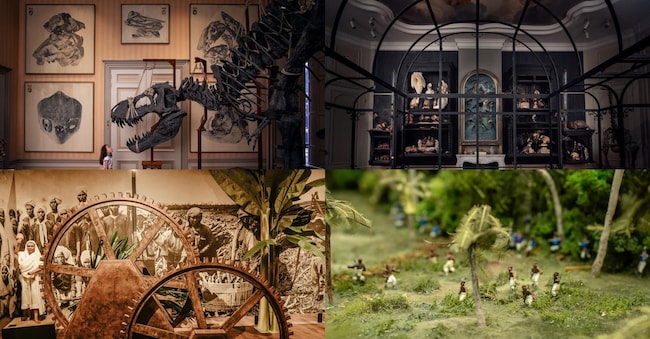
Amsterdam, like many of Europe's most beautiful cities, suffers from overtourism, but like few it tries to react to the problem. And what's more, it does so in a way you wouldn't expect, i.e. by expanding its tourist offer, while moving it away from the most popular centre in order to direct the flow of visitors towards less congested areas such as the 'Plantage'. And not only that. The Dutch city is also looking back and rethinking its colonial past, making, though perhaps only in part, mea culpa.
Suriname Museum
Thus was born the Suriname Museum, housed in a building in Zeeburgerdijk. Inaugurated by the sovereign at the end of November, the museum traces the history of the former colony that - from 1683 until independence in 1975 - gravitated under the Dutch crown.
Tassidermies
While the entrance is dominated by colourful taxidermies of the fauna of the former Dutch Guiana, along the three-storey itinerary, old maps, archive documents, videos and photographs, as well as wax dummies, huts, collections of various furnishings and family trees, recompose the varied and convulsive past of suffering, slavery and forced immigration that characterised the extremely harsh Dutch colonial experience. Individual slots of differently 'animated' narratives are dedicated to all the individual ethnic groups that the Dutch brought together with the intention of maximum exploitation in this verdant 'slice' of South America: Hindustan, Creole, Javanese, Chinese, Indians and slaves 'from all over' are recounted here in expressly dedicated sections. Other chapters feature slave colonists in uniform, underpaid and malnourished labourers, and finally, sigh of relief, on the third floor the images of the redemption of the freedom and independence fighters, with photos of the first president, Johan Henri Eliza Ferrier, jubilant as he raises the star-studded, green-and-white-and-red-striped flag of the new era.
Among the most successful representations are the filmed one of an elderly immigrant of Indian origin on his return to his home village and the reconstruction dedicated to the Jewish community that had moved there in large numbers, at the urging of first the British empire and then the Dutch empire. A separate chapter is represented by the basement where the 'galley' in the hold of one of the vessels used to transport the slaves that would be exploited in the local plantations and farms has been reconstructed: a cavern characterised by a claustrophobic and lugubrious interior that imitates, albeit distantly, the immense sufferings of those innocents whom the colonisers devoted to slave sacrifice, when not to death, in the name of a profit perpetrated in the search for all the seas of spices and exotic riches and which, would have enriched the motherland, indelibly staining the history of this country with the worst slavery - with the West India Company as its master -.
New Amsterdam
The exchange with the British Empire, with the cession of New Amsterdam, later to be New York, to the British, and the surrender of the Dutch colony to British troops, formalised by the Treaty of Westminster in 1674, and thus the massive arrival of the Dutch in what was to be their Guyana from then on, is the subject of another in-depth video and more.

