
Two written papers, oral on four subjects and no mute scene: this is the Maturità 2026
With less than three months to go before the State examination comes the ministerial order with all the news on interview, scores, conduct
by Eugenio Bruno and Claudio Tucci
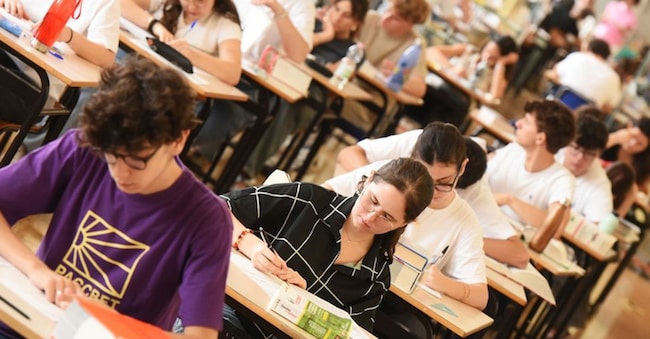
Everything is ready for the Maturità 2026. With less than three months to go before the first test, the Minister for Education and Merit, Giuseppe Valditara, has issued the order regulating the state exam in light of the changes introduced by Decree Law 127/2025 and confirmed by the ministerial decree with the subjects of the second test that arrived at the end of January. All the most relevant changes have been implemented: from the oral exam limited to four disciplines to the tightening up on behaviour, from the light commissions with five members (two internal and two external, such as the president) instead of seven, to the ban on "mute scene" under penalty of rejection. Let us look at them point by point.
L’ammissione
In order to be admitted to the Maturità exam, it is necessary to have attended at least three quarters of the customised annual number of hours, to have taken part in the Invalsi tests and to have done the school work training hours. It is then necessary to have a six in all subjects (with a five, admission to the exam can be decided, with adequate justification, by the class council). The new rules on conduct also come into force: in the event of a conduct grade of six, the class council assigns a critical essay on active and supportive citizenship to be dealt with in the Matura exam interview. If the conduct grade is 5, you are not admitted to the State examination. For external candidates, a preliminary examination is required.
Written tests
The first written test, of a national nature, is the Italian test lasting a maximum of six hours, which will be held on 18 June at 8.30 am. The test ascertains the candidate's mastery of the Italian language or of the other language in which teaching takes place, as well as his expressive, logical-linguistic and critical skills. It consists of writing a paper of different text types in the artistic, literary, philosophical, scientific, historical, social, economic and technological fields. The test can be structured in several parts, also to allow the verification of different skills, in particular the candidate's understanding of linguistic, expressive and logical-argumentative aspects, as well as critical reflection.
The second written test, also of a national nature and scheduled for 19 June, i.e. decided by the Ministry of Education and Merit, is the address test, and is intended to ascertain the knowledge, skills and competences expected from the student's educational, cultural and professional profile of the specific course of study. These subjects have already been known to students since end of January: Latin at the Classical Lyceum; Mathematics at the Scientific Lyceum; Human Sciences at the Human Sciences Lyceum; Business Economics for the Technical Institutes of the Economic Sector, "Administration, Finance and Marketing" address; Tourism and Business Disciplines for the Technical Institutes of the Economic Sector, "Tourism" address; Design, Construction and Installations for the "Construction, Environment and Territory" address.
Colloquio
The four subjects on which the interview will focus were also defined there. At the classic, we are talking about, in addition to the written subjects, the other two subjects are History and Mathematics; at the scientific, History and Science, etc.


Brand connect


Newsletter Scuola+
La newsletter premium dedicata al mondo della scuola con approfondimenti normativi, analisi e guide operative
Abbonati