
Khamenei, the man who became ayatollah overnight
From his sudden appointment to the leadership of Iran to internal tensions and regional crises, Khamenei's political journey has shaped the Islamic Republic

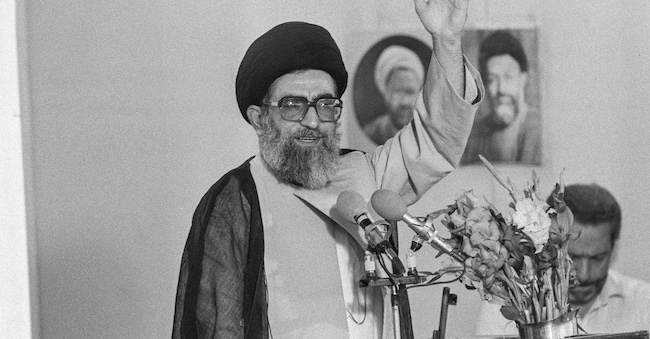
The Supreme Guide of Iran, Ali Khamenei, was reportedly killed in the raids conducted by Israel and the United States on Tehran that razed his residence, as confirmed by Channel 12 and the New York Times. 'The Times of Israel' reports that the body would be recovered shortly after Israeli Prime Minister Benjamin Netnayahu said there were "many signs" that "Khamenei is dead".
Given his age and health problems, several times in the past there had been reports - which turned out to be fake - that Khamenei was hospitalised, sometimes on the verge of death, or fuelling speculation about his successor. According to CIA assessments, a radical figure linked to the Pasdaran will take his place.
Khomeini's student
Born on 19 April 1939 in Mashad, a holy city for Shiites, Khamenei began his education in a 'maktab', the then primary schools. The second son of Hojatoleslam Javad Khamenei then attended the seminary in Mashad, where he attended lectures by the great Ayatollah Milani. The young Khamenei left Iran at the age of 18 to make a pilgrimage to Najaf, an Iraqi city that played an important role in the Supreme Guide's life. The following year he moved to Qom, the 'Vatican' of the Shia, where until 1964 he followed the teachings of some of the most famous ayatollahs of the time, including Ayatollah Borujerdi and Ruhollah Khomeini, the founder of the Islamic Republic. "As far as political and revolutionary ideas and Islamic jurisprudence are concerned, I am certainly a disciple of Imam Khomeini," said Khamenei, who also joined the ranks of revolutionaries opposing the Shah's regime and its pro-American policies in the early 1960s. His 'marriage' to the Khomeinist cause cost him a night in jail in May 1963, when the leader of the revolution entrusted him with the mission of carrying a secret message to Ayatollah Milani. A month later he was again arrested and imprisoned for anti-government activities.
The Hostage Crisis
During those years, Khamenei remained in close contact with Khomeini, at that time in exile first in Iraq and then in France, of whom he became a trusted advisor. Immediately after the latter's return to Tehran in 1979, he was appointed a member of the Council of the Revolution. After its dissolution, he became Deputy Minister of Defence and Khomeini's personal representative in the Supreme Defence Council. For a short time, he commanded the Guardians of the Revolution. A hawk in foreign policy, he was one of the key negotiators in the so-called hostage crisis. One of the founding members of the Islamic Republican Party (IRP), in 1981, while he was giving a speech in a Tehran mosque, a bomb exploded, causing him to lose the use of his right arm. The attack was later claimed by the People's Mojahedin. In that year he was elected deputy and then president, a position he held for two terms in a row until 1989, when on Khomeini's death he was elected Rahbar by the Assembly of Experts, taking advantage of the rupture between the founder of the Islamic Republic and the one who appeared to be the natural candidate for his succession, Ayatollah Montazeri. In reality, Khamenei did not have the qualifications to hold the office. The Supreme Guide, in fact, had to be recognised as 'marja-e taqlid', i.e. a source of imitation. But faced with the vacuum created by Khomeini's death, the Constitution was amended to appoint a new Rahbar. Overnight he was also 'promoted' from hojatoleslam to ayatollah.
contrary to relaxation
Under his leadership, Iran faced very difficult times. The first obstacle for the Supreme Guide was the double mandate of President Mohammad Khatami, a reformist pushing for détente with the West, a line that Khamenei saw as smoke and mirrors. Rahbar basically succeeded in derailing the Khatami presidency by blocking many of his reforms aimed at opening up the country both socially and politically. It was however with his successor, the ultra-conservative Mahmoud Ahmadinejad, considered by many to be his protégé, that the Islamic Republic was on the verge of collapse. In fact, the disputed re-election of the former mayor of Tehran in 2009 brought the country to the brink of chaos, with thousands of protesters killed in the Green Wave repression. Faced with the most serious street demonstrations since the revolution, Khamenei used an iron fist.

