
Ukraine: Meloni criticises the Franco-German axis, calling for an authoritative EU envoy to lead the negotiations. She launches an attack on Vannacci, accusing him of voting with the left
The Prime Minister criticises the E3 initiative (France, Germany and the UK) alongside Zelensky: ‘Fewer redundant meetings’. The attack on Vannacci and the clash with the M5S
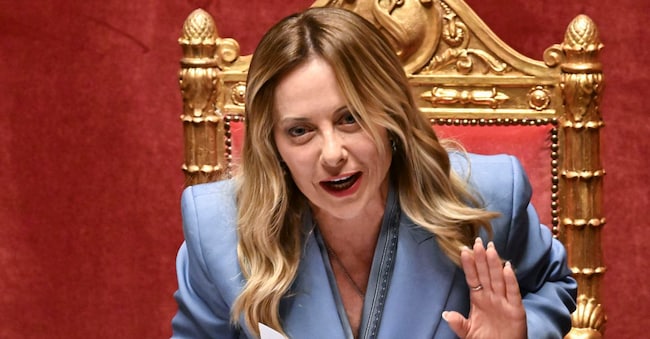
Key points
- The E3 attack: variable formats are ineffective
- “We need an authoritative EU representative”
- Lebanon: aiming for the disarmament of Hezbollah and Israel’s withdrawal
- Trade: a call to the EU to strengthen trade defence instruments
- “Broad” partnerships: from NATO to Japan, India and Korea
- EU budget: CAP and Cohesion Policy remain untouched. And progress on the digital tax
Before arriving at Montecitorio to deliver her statement ahead of the European Council on 18–19 June, Giorgia Meloni paid tribute to the historic secretary of the Italian Communist Party, Enrico Berlinguer, on the anniversary of his death. On the one hand, there is the ‘respectful’ remembrance of ‘a figure who represented a point of reference for the Italian left and one of the key figures in the political history of the Republic’; on the other, however, there is the memory of the gesture by Giorgio Almirante, the leader of the Social Movement, “who wished to pay his respects at the coffin of his political opponent. A sign of human and institutional respect that still today evokes the value of political debate rooted in ideals yet respectful of people. Because one can engage in politics according to different, even diametrically opposed, visions without necessarily demonising one’s opponent’. And because ‘strong ideas do not fear debate’.
Words that ring out like a warning in the Chamber as the Prime Minister enters at 9 am, seated between her deputies Antonio Tajani and Matteo Salvini, fully aware that another round of debate with the opposition awaits her – a foretaste of the election campaign to come. On the agenda are the hottest topics in international current affairs, from Ukraine to the conflict in Iran, but also the challenges of European competitiveness and energy security, common defence, and the new Multiannual Financial Framework for the EU 2028–2034. All this at a time of transition for the Italian government and for the Prime Minister herself, caught between the distinctions with Europe and the complicated attempt to mend fences with Donald Trump following the attacks on the Prime Minister.
The attack on Vannacci
As always, it is in her reply that the Prime Minister really gets going, firing off barbs. The first, a new development, is directed at General Roberto Vannacci, leader of Futuro Nazionale, who is undermining the government coalition from the right. To FN MP Emanuele Pozzolo, known for the New Year’s Eve shooting incident, she reminds him that “no fewer than six times you have voted against a vote of confidence in this government, together with your colleagues Schlein, Conte, Renzi and the rest”. “The true right,” she adds, referring to Vannacci’s comments last night as a guest on Lilli Gruber’s programme on La7, “is never of any use to the left.”
The clash with the M5S
The toughest exchange came with the Five Star Movement. Francesco Silvestri criticised her for not standing up to Donald Trump after the referendum defeat, but for having “simply put on some knee pads to be more comfortable”. The Prime Minister bristles: “It bothers you that the first woman came from the right because you weren’t capable of putting her forward. I’ve never worn knee pads.” Then, as she leaves the Chamber of Deputies to head to the Senate, she hisses at the reporters: “They’re always working for us...”
Ukraine: stance remains unchanged – support for Kyiv, but a long-term vision is needed
The premise regarding the war in Ukraine is clear: Italy’s stance remains unchanged; ‘supporting Kyiv and maintaining pressure on Moscow still represent, in our view, the only practical way to create conditions that might compel the start of a serious round of negotiations’. Yes, therefore, to the 20th package of sanctions and a firm condemnation of Russia’s repeated attacks on the civilian population “as well as the ultimatums issued to Kyiv over repeated violations of European Union and NATO airspace, which have even involved civilian targets in Romania – unacceptable behaviour that Italia has condemned and continues to condemn firmly”. But there is a ‘but’. The Prime Minister makes this clear: “Firmness alone is no longer enough if it is not accompanied by a long-term vision. Firmness must not turn into blindness.”


