Ahead of the G7 and NATO summits

ECFR survey: Europe divided over Ukraine’s accession to the EU and military spending

The European Council on Foreign Relations survey: Portugal, Spain, Sweden, the Netherlands and Italia are among the countries most in favour

From our correspondent Beda Romano
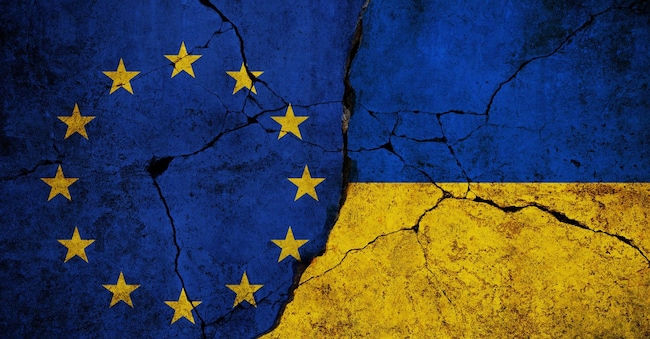
Le bandiere dell'Unione Europea e dell'Ucraina affiancate, con texture screpolate, a simboleggiare tensioni, relazioni fragili Alamy Stock Photo

3' min read

Translated by AI
Versione italiana

3' min read

Translated by AI
Versione italiana

BRUSSELS – At a time when the European Union is seeking to accelerate the process of eastward enlargement, a poll published today, Wednesday 10 June, highlights the caution felt by many Europeans regarding the idea of admitting Ukraine. In the run-up to the G7 and NATO summits, the study confirms a sharp decline in European trust in the United States, whilst Italia is the only country where a majority of respondents are opposed to an increase in military spending.

The survey

A survey by the European Council on Foreign Relations (ECFR) reveals doubts about the advisability of enlarging the Union – a summit in Montenegro last week demonstrated the EU-27’s desire to press ahead on this front –. 32% are in favour of the idea of ‘creating a new and broader European Union, extending eastwards (for example, by including Ukraine)’. Opponents account for 30%. Among the most supportive countries are Portugal, Spain, Sweden, the Netherlands and Italia.

Loading...

Hungary takes a different view (47% consider it a bad idea, compared with 15% who think it is a good idea), as do Bulgaria (46% versus 19%), Austria (42% against 24%) and Germany (37% against 28%). Even in Estonia – one of Ukraine’s staunchest supporters – public opinion is against the country’s accession ‘in the current context’ (37% consider EU enlargement eastwards a bad idea, whilst 32% think it would be a good idea).

Confidence in the US as an ally is waning

The ECFR survey also reveals that just 11% of those polled believe that the United States is still ‘an ally’. The opinion poll was conducted in Estonia, the United Kingdom, Italia, France, Germany, Spain, Bulgaria, Switzerland, Hungary, Poland, Denmark and Portugal. In all these countries, a majority of those surveyed do not expect America to come to their aid in times of need.

IL SONDAGGIO

In questo momento supporteresti o ti opporresti allo sviluppo di un deterrente nucleare europeo che non faccia affidamento sugli Usa? Differenza % tra le risposte “supporterei” e “mi opporrei”

Loading...

This scepticism towards Washington follows the announcements regarding the annexation of Greenland, and the attacks against Venezuela and Iran, as well as the Trump administration’s contradictory signals regarding the withdrawal of troops from Europe. The majority of respondents in all countries covered by the ECFR survey (with the exception of Bulgaria) expressed the belief that ‘at least some European countries’ would come to their aid if they were attacked.

Crosetto: "Disimpegno Usa? Europa dovrà riprendere in mano propria sicurezza"

There is a growing desire for greater military autonomy

Also in light of the survey, the European Council on Foreign Relations notes that ‘various right-wing and Eurosceptic parties, including Giorgia Meloni’s Fratelli d’Italia, Geert Wilders’ PVV, Chega, the Sweden Democrats and Marine Le Pen’s Rassemblement National, are convinced that their European neighbours would provide support to their own country in the event of a crisis’. Against this backdrop, there is a growing desire for Europe to assume greater autonomy in the military sphere.

Ue, Crosetto: penso a una difesa continentale europea, non a 27

Majority in Italia oppose increase in military spending

Italia is the only country among those surveyed where a majority of people are opposed to an increase in military spending (58%). More generally, according to the ECFR survey, 47% of those interviewed support the idea of shared debt to finance defence investment – the figure in Germany is surprisingly high: 45%. The proportion of people opposed in Germany is 38%, compared with 35% at European level.

The data paint a unique picture of Italia, a country that does not wish to increase military spending and that relies on assistance from its partners, should the need arise. Arturo Varvelli, director of the ECFR in Rome, comments: ‘Historically, Italia’s political decisions have been based more on short-term interests than on values. The country struggles immensely to grasp the times. The mass media, the political class, and perhaps also the presence of an ageing population, which finds it difficult to grasp the rapid changes of this historical moment, are to blame.”

Finally, in almost all the countries surveyed, the majority of respondents believe that their country should reduce its strategic dependence on US military supplies. Among those most in favour of ‘Buy European’ are Denmark (75%), the Netherlands (72%), Sweden (70%), Portugal (69%), France (66%), Spain (62%), Estonia and Poland (60% each). Opinion is, however, very divided on the issue in Germany, Hungary and, once again, Italia.

Copyright reserved ©
Loading...

Brand connect

Loading...

Newsletter

Notizie e approfondimenti sugli avvenimenti politici, economici e finanziari.

Iscriviti