Market

Uk, price growth slows in the run-up to the election

However, the market shows resilience with stable values

3' min read

3' min read

"The general election has led to some caution in the market, with some first-time buyers choosing to wait and see how events unfold over the next two weeks before firming up plans." These are the words of Frances McDonald, research director at Savills, whose latest analysis of the UK market shows an all round resilient residential sector in the pre-election period.

In spite of this, however, price growth has come to a temporary halt. 'Given the shorter-than-expected pre-election period, buyer demand will have a better chance of picking up in the autumn, when the situation will be better defined,' McDonald continues.

Loading...

Actually, the figure for the previous month is slightly up: according to the Nationwide lending institution, prices were up 0.2% in June compared to May. By contrast, growth would be 1.5 per cent compared to June last year. In any case, the surge shows a halt, so much so that compared to the peak two years ago, the current prices recorded by Nationwide are about 3 per cent lower. 'In recent years,' said Robert Gardner, Nationwide's chief economist, 'earnings growth has been much stronger than house price growth, but it has not been sufficient to offset the impact of rising mortgage rates.

The opposition Labour Party, which has a strong lead in opinion polls - so much so that the question mark of this election seems to be not who will win but how they will win - has promised to relax planning rules in the hope of stimulating construction and making homes more affordable. A Reuters poll of housing market analysts showed that property prices in Britain are expected to rise by 1.8 per cent in 2024 as rising wages would boost demand.

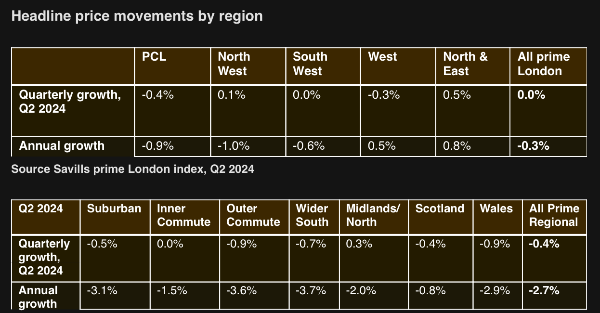
In London meanwhile, prices in the centre have fallen slightly, at least according to Savills' analysis. We are talking about a variance of -0.4 per cent in the second quarter and -0.9 per cent for the year, which represents an average drop in value of just £20,000 for a property worth £5m over the past three months.
"The impact of the changes to the foreigners' tax is likely to be most felt in central London, where those affected are considering their options. But it is important to remember that most buyers in central London do not have non-dom status. Demand from domestic and international buyers continues to be strong, especially given the value offered in a historical context, as well as the increasing stability of the mortgage market, with some lenders having started to lower rates early.

"Furthermore," the researcher adds, "there is no evidence to suggest that we will see a wave of stock coming to market, as many of those affected by the changes to the no-demand regime are likely to retain their base in the capital. However, this is likely to act as a drag on demand and the pace of recovery, with the expectation that value will continue to rise as the proposals become law."

In other primary London markets, values remained stable, with prices essentially flat both year-on-year (-0.1%) and quarter-on-quarter (0.1%). Values were largely supported by strong demand for family homes, a relatively stable mortgage market and limited availability, particularly in locations such as Fulham, Putney and Victoria Park, where several high-value transactions have occurred in the past two weeks.

Outside London, prices fell marginally in the quarter, by -0.4 per cent, bringing the annual decline in value to -2.7 per cent. These are the markets that experienced the greatest growth during the 2020 and 2021 mini-boom in the housing market. Again, some buyers shelved plans pending the announcement of an interest rate cut and, in some cases, clarity on future tuition fees. "However, despite lower demand, there have been enough committed buyers to keep the market moving," MacDonald notes.

In all regions, urban markets are overtaking surrounding rural areas, while pre-pandemic trends continue.

First-rate values in cities (-1.7% year-on-year) and towns (-2.2%) decreased less significantly than in villages (-2.9%) and other rural locations (-3.2%).

"Labour's plans to introduce VAT on public school fees could filter more demand towards state and grammar school systems which, in turn, could increase house price premiums that we already know are evident around high performing state schools."

Copyright reserved ©
Loading...

Brand connect

Loading...

Newsletter RealEstate+

La newsletter premium dedicata al mondo del mercato immobiliare con inchieste esclusive, notizie, analisi ed approfondimenti

Abbonati