War in Ukraine

Heavy Russian bombardment of Kharkiv. Further EU sanctions against Moscow

The 27 member states emphasise that, ‘until there is a just and lasting peace in Ukraine, Russia’s participation in international sporting and cultural events should not be normalised’, according to the leaders’ conclusions.

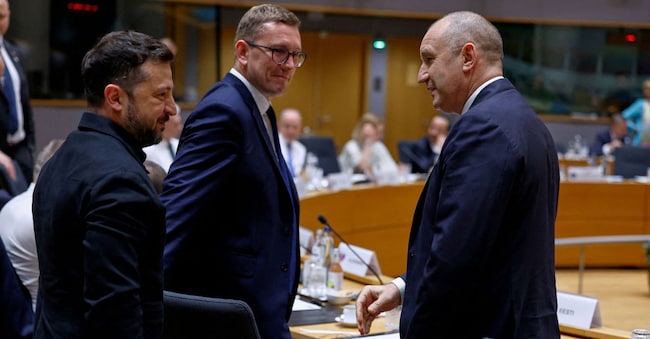
Il presidente ucraino Volodymyr Zelenskiy parla con il primo ministro bulgaro Rumen Radev accanto al primo ministro finlandese Petteri Orpo durante una tavola rotonda al vertice dell'UE a Bruxelles, in Belgio, il 18 giugno 2026. Geert Vanden Wijngaert/Pool via REUTERS/Foto d'archivio REUTERS

3' min read

Translated by AI
Versione italiana

3' min read

Translated by AI
Versione italiana

Whilst European leaders are gathered in Brussels for the European Council meeting, where, amongst other things, they discussed the enlargement process in Kyiv and their role in any potential negotiations with Moscow, Russian bombardments continue on the ground, having targeted the city of Kharkiv last night. Russian forces launched several glide bombs, damaging dozens of homes and injuring at least six people. This was reported by local authorities, according to the Kyiv Independent.

The mayor of Kharkiv, Ihor Terekhov, wrote on Telegram that the attack struck the city’s Kholodnohirskyi district. The Ukrainian Air Force had issued an air raid alert for the dropping of glide bombs at around 3.30 am local time. According to Terekhov, more than 40 homes were damaged in the attack and at least six people were injured.

Loading...

Kharkiv, due to its proximity to the front line, is regularly targeted by Russian attacks and has suffered several significant raids over the past week. On 15 June, a Russian ‘double-tap’ attack killed four rescue workers and injured six others after they had arrived at the site of a previous bombardment. The day before, the Kharkiv Art Museum had been struck by a drone, causing a major fire and injuring four people, including a one-month-old baby.

The new attack on Kharkiv comes a day after what is described as Ukraine’s largest drone attack on Moscow since the start of the full-scale Russian invasion, which caused damage to the oil refinery in Moscow.

Meanwhile, in Brussels last night, the leaders of the 27 European Union countries unanimously adopted the conclusions of the summit on Ukraine and decided to extend the sectoral sanctions against Russia for 12 months, according to the spokesperson for the President of the European Council, Antonio Costa.

This is the first time that the extension of sanctions – which is usually decided on a six-monthly basis – has been applied for a year. In any case, this is a political endorsement. The formal decision, in fact, rests with the ministerial configurations of the EU Council.

Also on the agenda of the EU Council is the conundrum of who should negotiate with Russia, with many leaders putting forward EU Council President Costa as a candidate, whilst the 27 member states stress that, ‘until there is a just and lasting peace in Ukraine, Russia’s participation in international sporting and cultural events should not be normalised’, as stated in the leaders’ conclusions. As regards the accession process, the leaders have removed the time-bound reference that committed the Union to opening the subsequent negotiation clusters ‘as soon as possible’. In the final text, the EU-27 merely state that the Council “looks forward to the opening of the other chapters, in line with the merit-based approach”, thereby putting the brakes on pressure to accelerate Kyiv’s European integration process. Hungarian Prime Minister Péter Magyar claimed credit for the outcome. “On my initiative, the clause referring to the acceleration of accession was removed from the text at the last minute. It wasn’t easy,” he wrote on X.

Ukrainian President Volodymyr Zelensky has issued an ultimatum to Belarusian President Alexander Lukashenko, giving him one week to dismantle the relay stations used to guide drone attacks. Zelensky claimed that devices are operating on Belarusian territory which help guide Russian drones towards targets in Ukraine, and called on Minsk to remove them. Otherwise, he warned, Ukraine itself will take action.

“When Mr Lukashenko says he does not want to be drawn into the war, he should be honest, at least with his own people, because it is not he who might be drawn into the war – it is his entire country that could be drawn in, dragged into it by Russia. From the very first days of this war, children and adults have been killed: missiles have come from Belarus, from his country. And so he even rang up and apologised, saying he had no control over it, that Russia was operating on his territory. And, of course, I don’t believe it, but he has already said so,” Zelenskyy stated at a joint press conference with the President of Honduras, Nasry Asfura, in Kyiv today.

Copyright reserved ©
Loading...

Brand connect

Loading...

Newsletter

Notizie e approfondimenti sugli avvenimenti politici, economici e finanziari.

Iscriviti