Noto Surveys

Ukraine, Palestine, Iran, Greenland: how Europeans feel at risk

For these four scenarios, there is a unanimous perception of danger among the Italians, French, British, Germans and Danes. On the island's fate, the idea of direct intervention re-emerges. Fears for the economic consequences of conflicts

by Serena Uccello

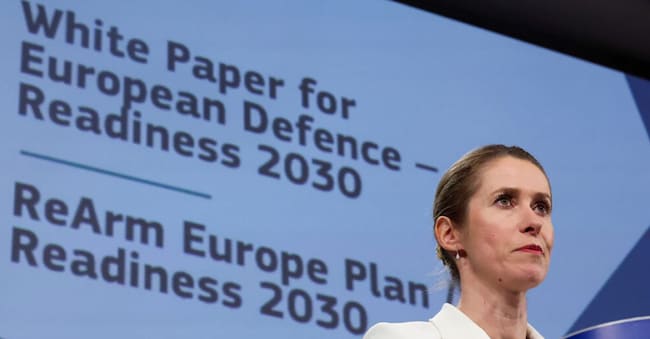
Rearm Europe plan. Kaja Kallas, alto rappresentante per la politica estera dell’Unione presenta il Libro bianco della difesa Ue. (REUTERS/Yves Herman)

4' min read

Translated by AI
Versione italiana

4' min read

Translated by AI
Versione italiana

Right or left, whatever the colour of the government in office in one's own country, there is one perception that unites Europeans, at least those interviewed by Noto Sondaggi for Il Sole 24 Ore on Monday. Italians, French, Germans, British and Danes are fairly unanimously concerned that the Russia-Ukraine war, the Israel-Palestine war and the Greenlandic crisis represent a real danger for their country. A shared pressure that tightens or loosens the grip to varying degrees depending on the territories and conflict. It is above all the war in the Ukraine that frightens Italians (67%), French (66%) and Danes (63%) in equal measure, while it impacts Germans (72%) and British (73%) more.

Iran and the Israeli-Palestinian War

Also felt, although mostly the economic aspect, is what is happening in these hours in Iran. A military intervention by the United States is, in fact, a cause for apprehension due to the consequences on national economies for 51% of Italians, 53% of the British, 43% of the French, 42% of the Danish, and 39% of the Germans. In this specific case, it is interesting to note how the percentage of those who "do not have a clear idea" coincides fairly closely with that of those who "have no fears": 28 and 21% of Italians, 31 and 26% of French, 26 and 35 of Germans, 22 and 25 of British, 27 and 31 of Danes.

Loading...

Massively present in the political news and more generally in the debate among analysts, the Israeli-Palestinian conflict is the one that agitates the least (53% of Italians, 48% of the French, 37 of the Germans, 49 of the British); even in the case of Denmark it does not agitate at all: 74% of Danes say it is not a dangerous conflict for their country.

History counts and kilometres count, the proportions are naturally reversed in the face of the latest crisis in chronological order, namely the statements by the American president Donald Trump on the United States' interest in Greenland. 73% of the Danes, 61% of the British, 59% of the Italians, 55% of the French and finally 47% of the Germans are concerned.

In any case, these three fronts are seen as somehow very 'europacentric'. This is especially evident with regard to the war between the Israelis and Palestinians and the Greenlandic crisis. Both scenarios are not considered dangerous for the world: the percentages range from a low of 6% to a high of 31. And this peak of 31% is understandably expressed by the Danes.

IL SONDAGGIO

Loading...

Fonte: Noto Sondaggi

The war in Ukraine

The fear of a global danger is, on the other hand, there in the case of the war in Ukraine, here the fear touches 68 per cent of Germans, 56 per cent of the French, to 47 per cent of Italians (English at 52 per cent, Danish at 50 per cent). This widespread feeling of alertness strongly urges people to place themselveson positions of neutrality even in the case of Ukraine, which is judged as the nearest danger. The Germans, for example, although among the most alarmed, when asked about a possible involvement of their country have no doubts: 63% say no, followed by the Italians (55), the French and British (44) and finally the Danes (39). The percentages increase in the case of Israel: 72% of the Germans do not want to be involved, 65% of the British, 62% of the Danes, 61 of the Italians, 58 of the French.

The Greenland Node

While they drop noticeably when it comes to Greenland. And if it goes without saying that only one in 10 Danes would remain neutral, it is nevertheless less obvious the interventionism of the French: 56% of them opt for a French involvement (could the recent visit to the Elysée Palace by the Danish Prime Minister, Mette Frederiksen, and the Prime Minister of Greenland, Jens-Frederik Nielsen, have counted?). As well as the British (55%), perhaps given the hypothesis that is beginning to circulate of a return to the EU for the United Kingdom; more 'distant' are the Italians (39%) and Germans (40%).

Putting these responses against the light, a picture emerges that is perhaps not immediate but clear. Paradoxically (given that the tension is currently all diplomatic) it is the Greenlandic crisis that is judged to be the most 'European'. It is true that with regard to Ukraine and the Middle East the perceived fear is linked to the economic consequences (85% of Italians, 87 of the French, 90 of the Germans, 85 of the British and 81 of the Danes fear the economic impact) more than to a military offensive - and this is confirmed by the neutrality figure. But when it comes to the island's fate, old spectres seem to re-emerge, to the point of questioning the pacifist principle on which post-World War II Europe was born. An apprehension that has a direct effect on two crucial questions: does the United States still remain an ally of Europe? And in the management of these crises, what identity does Europe discover for itself? Well, on the first issue the axis that still seems to resist is the Anglo-American one. The US is a reliable partner for one Englishman in two, and if the Germans still believe in it (48%), the French are a little less convinced (44), the Italians are in doubt (38), and the Danes are not at all sure (22). Incidentally, the Italians (46%), if we exclude the Danes (59%), are the most confident in Europe that the US is an ally that considers above all its own interests.

L’europeismo

As for the question of pro-Europeanism, despite everything the crises are not agreeing with the most extreme advocates of disintegration. The share of those who fear it is indeed a minority, ranging from being nothing in Denmark (5%), to being little more than nothing in Germany (14%), to being very small in Italy and France (19%). What deserves reasoning is certainly the relevant percentage in all countries of those who register divisions, but also a specific case: the set of answers of the British who seem to be moving towards an overcoming of the Brexit. Because not only do barely 10% of the British believe in fragmentation, but if we add up those who now consider Europe more united (35%) with those who do not see any change (18%), those who see it divided (37%) are decidedly outnumbered (53%).

Copyright reserved ©
Loading...

Brand connect

Loading...

Newsletter

Notizie e approfondimenti sugli avvenimenti politici, economici e finanziari.

Iscriviti