Arctic

Media: 'Trump considers payments to Greenlanders'. Vance to Europeans: 'Take him seriously'

Although the amount and method of payment are not yet clear, some administration officials have estimated figures ranging from $10,000 to $100,000 per person.

Aggiornato l’8 gennaio 2026 alle ore 20:42

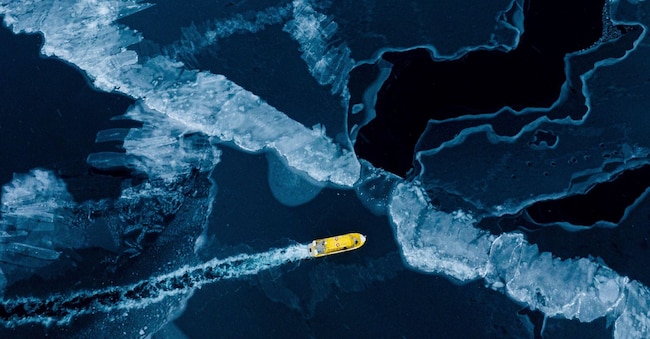
Una barca naviga attraverso un’insenatura ghiacciata al largo di Nuuk, in Groenlandia (AP Photo/Evgeniy Maloletka, File)

7' min read

Translated by AI
Versione italiana

7' min read

Translated by AI
Versione italiana

According to Reuters,the United States has discussed the possibility of making lump-sum payments to the inhabitants of Greenland to convince them to secede from Denmark and potentially join the United States. Although the amount and method of payment are not yet clear, some administration officials have estimated figures ranging from $10,000 to $100,000 per person.

vice-President JD Vance immediately addressed the Europeans: 'What I say to European leaders is: take what Donald Trump says seriously'. Vice President JD Vance said this in response to a question on Greenland. Vance also mentioned that Secretary of State Marco Rubio is expected to meet with the leaders of Denmark and Greenland next week.

Loading...

Trump: having ownership of Greenland is very important

For the US president 'owning' Greenland is 'very important', as he reiterated in an interview with the New York Times. Asked why he needed to own the island, the tycoon said: 'I think it's psychologically necessary for success. I think ownership gives you something that you can't get with a simple lease. Property offers elements that you cannot get by simply signing a document'.

It was already clear yesterday that theTrump administration was studying a proposal to purchase Greenland, a proposal that will be submitted next week to the representatives of Denmark by US Secretary of State Marco Rubio. A hypothesis that would privilege the diplomatic solution to the tensions that are mounting between the two sides of the Atlantic but that in itself does not exclude, if negotiations fail, the use of force. "I would like to emphasise that the US takeover of Greenland is not a new idea," White House spokeswoman Karoline Leavitt said at a press conference today. "It is something that presidents since the 1800s have called beneficial to American national security. The president has been very open and clear with all of you and the world in his belief that it is in the best interests of the United States to deter Russian and Chinese aggression in the Arctic region. And that is why he and his national security team are currently discussing what a potential buyout might look like."

"I know," Leavitt added, "that past presidents have often ruled out" the possibility of using force for these things, "and they've been very transparent in conveying their foreign policy strategy to the rest of the world but that's not something this president does. All options are always on the table for President Trump as he assesses what is in the best interests of the United States. I'll just say that the president's first option has always been diplomacy".

And yet, as the New York Times recalled today, an old agreement, signed in 1951 by Denmark and the United States, would already allow the US to increase the American military presence on the island, making it unnecessary to either buy Greenland from Denmark or conquer it by force. Under the pact, in fact, the US would be able to 'build, install, maintain and operate' military bases throughout Greenland, 'house personnel' and 'control the landings, take-offs, anchorages, moorings, movements and operations of ships, aircraft and vessels', the newspaper writes. "The United States has a free hand in Greenland, it can practically do whatever it wants, said Mikkel RungeOlesen, a researcher at the Danish Institute for International Studies in Copenhagen. Indeed, the path to purchase would be even more complicated: Greenland does not want to be bought by anyone, especially the United States. And Denmark does not have the authority to sell it, Olesen explained. Greenlanders can currently hold a referendum on independence, and a poll last year found that 85 per cent of residents oppose the idea of an American takeover. For the avoidance of doubt, Greenland's Prime Minister, Jens-Frederik Nielsen, has repeatedly scoffed at the idea of being bought out, stating last week that 'our country is not for sale'.

The suspicion that Trump is actually more interested in the island's critical raw materials than in strategic security also does not hold water. According to all analysts, the US would not need to take possession of the island to get them: the Greenlanders have said they are willing to do business with practically anyone.

Even the reason given by Trump about Chinese and Russian aggression in the Arctic appears unfounded, suggests Askanews. It is true that Greenland occupies a relevant geographical position in the Arctic and is often mentioned in Chinese strategic documents as a potential hub of the 'Polar Silk Road', however, on a practical level, the role of the island remains entirely marginal, at least for Beijing: the available data do not indicate a significant Chinese maritime presence around the island, nor a systematic use of its waters as a trade corridor. Russia, on the other hand, does not seem to be able to put much of a strain on a superpower like the United States, as was seen today in the case of the oil tanker 'Marinera', which was boarded and seized by the US Coast Guard for violations of the Venezuelan oil embargo.

France: 'We have started working to react'

EU member states, French Foreign Minister Jean-Noël Barrot said today, are ready to "react" against any intimidation by the United States against Greenland. "Whatever the form of intimidation and whatever its origin, we have started working at the Quai d'Orsay to prepare to react, to respond and not to respond alone. This work will culminate in the coming days' in a plan that will be shared with France's main partners, the transalpine diplomat added. 'Faced with these signs of intimidation, we want to act, but we must act together with our European partners,' continued Barrot, who today held a meeting with his German and Polish counterparts. And even an extreme right-winger like Nigel Farage, leader of the British Reform UK party, said that using force to wrest Greenland from Denmark would be 'outrageous'.

Just yesterday, American intentions had provoked an immediate reaction in Europe. With a joint statement, France, Germany, Italy, Poland, Spain, the United Kingdom and Denmark reaffirmed that the future of Greenland must be decided exclusively by its people and by Copenhagen. A principle also reaffirmed by the President of the European Commission Ursula von der Leyen, who recalled the primacy of international law over force.

The text of the joint declaration circulated by the European leaders also states: 'We must respect the principles of the UN charter, including sovereignty, territorial integrity and the inviolability of borders'.

Greenland, European leaders: 'Belongs to its people, security NATO priority'

"The security of the Arctic remains a key priority for Europe and is fundamental to international and transatlantic security. NATO has made it clear that the Arctic region is a priority and the European allies are intensifying their efforts," reads the joint statement.

And again: 'We and many other allies have increased our presence, activities and investments in order to maintain the security of the Arctic and deter adversaries. The Kingdom of Denmark, including Greenland is part of NATO. Security in the Arctic must therefore be ensured collectively, in cooperation with NATO allies, including the United States, by upholding the principles of the UN Charter, including sovereignty, territorial integrity and inviolability of borders. These are universal principles and we will not stop defending them. The United States is an essential partner in this effort, as an ally of NATO and through the 1951 defence agreement between the Kingdom of Denmark and the United States. Greenland belongs to its people. It is up to Denmark and Greenland, and them alone, to decide on matters that concern Denmark and Greenland'.

Greenland and Denmark ask to meet Rubio

Greenland and Denmark have requested a meeting with US Secretary of State Marco Rubio. This was announced by the Greenlandic government. Denmark's foreign minister, Lars Løkke Rasmussen, said the meeting with Washington's diplomatic chief would serve to "clear up some misunderstandings". "The time has come to make contact in order to get a meeting with our American counterparts," he said following a new round of comments from the United States regarding their claims on Greenland, explaining that he had made the request yesterday.

Groenlandia, Wadephul : "Sarà difesa dalla NATO"

Denmark strengthens its military presence in Greenland

The Danish Defence Minister Troels Lund Poulsen, meanwhile, announced his country's intention to 'strengthen the military presence in Greenland. But we will also have a larger NATO presence, with more exercises'. This was reported by the national news agency Ritzau. The minister went on to point out that Denmark, and thus also Greenland, are members of the Nato defence alliance with the United States. "I would like to emphasise that Greenland is part of the Danish Commonwealth.I am not aware of anyone internationally questioning this," he added

Difesa, terre rare e rotte artiche: perche' la Groenlandia e' nelle mire di Trump

Media: US plan for an association agreement with Greenland

Meanwhile, media sources report that the United States would be working on an association agreement with Greenland that would exclude Denmark. This is one of the hypotheses put on the table by the Trump administration, according to the British weekly Economist, as opposed to a formal annexation. It would be a political and military arrangement to allow Washington to more freely deploy troops and expand its military infrastructure.

Von der Leyen: cooperation, not confrontation

The European Union was born out of conflict and the will to overcome it through cooperation and law, principles that apply not only to Europe but also to the Greenland issue. This was stated by the President of the European Commission, Ursula von der Leyen, speaking at the opening ceremony of the Cypriot Presidency of the Council of the European Union.

In his speech, von der Leyen recalled the origins of European integration, emphasising the political and symbolic significance of the EU project. "The European Union itself was born out of conflict. Our Union is not perfect, but it is a promise: that cooperation is stronger than confrontation, that law is stronger than force,' he said. 'Principles,' he continued, 'that apply not only to our European Union, but likewise to Greenland.

Copyright reserved ©
Loading...

Brand connect

Loading...

Newsletter

Notizie e approfondimenti sugli avvenimenti politici, economici e finanziari.

Iscriviti