Art

Ukrainian Modernism at the Royal Academy

The exhibition 'In the eye of the storm: Modernism in Ukraine 1900-1930' can be visited in London until 13 October
by Nicol Degli Innocenti

2' min read

2' min read

The title of the Royal Academy's exhibition dedicated to Ukrainian art could not be more apt: In the eye of the storm. It refers to both the past and the present.

In war-torn Ukraine, to escape Russian bombing that could have destroyed the National Art Museum in Kiev, the 65 paintings that are now on display in London were packed up two years ago and loaded onto trucks bound for Poland and safety.

Loading...

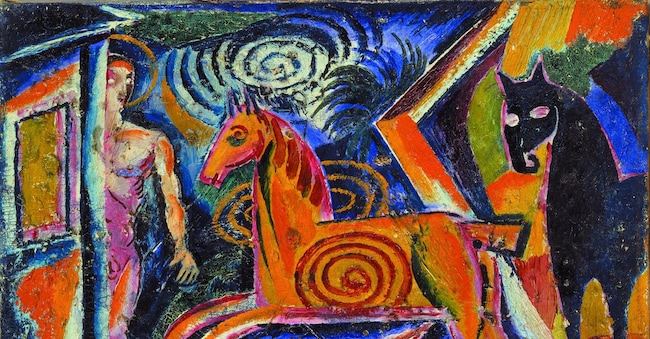
The paintings reflect the storms of a century ago: they are works created in the first thirty years of the 20th century, a tumultuous period of collapsing empires, world war, revolution in Russia, violence and occupation.

From this dramatic context - Ukraine's independence was short-lived, from 1918 to 1922, the year of Soviet occupation - dynamic and bold, innovative and experimental artists emerged. The brilliance and intensity of the colours seem to be a hymn to life, a creative challenge to counteract the reality of an increasingly darkened world.

Ukrainian artists are the product of their country's troubled history, and of cultures and traditions that are rich because they were born from the fusion of Ukrainian, Russian, Jewish and Polish peoples. Sonia Stern Delaunay was born in Odessa to Jewish parents, Kazimir Malevich was born in Kiev to Polish parents, Davyd Burliuk was born in Russia to a Ukrainian father and Belarusian mother.

They drew inspiration from artistic movements elsewhere in Europe, from futurism to cubism to constructivism to suprematism, but adapted and modified them in the light of Ukrainian folk art and traditions.

La Royal Academy alla riscoperta del Modernismo ucraino

Photogallery8 foto

Theatre

The room dedicated to theatre demonstrates this: the protagonist is Alexandra Exter, a painter and set designer, who after having studied art in Paris had founded a studio in Kiev, creating her own style influenced by Cubism and Futurism but with a uniquely Ukrainian sensibility, and mentoring a new generation of painters and set designers.

"Ukrainianisation"

.

In 1923, the 'Ukrainianisation' strategy decided by the Soviet authorities granted a degree of artistic and cultural autonomy, and for a few years there was a flourishing of artistic experimentation, led by Mykhailo Boychuk, in an attempt to create a new cultural identity that could merge Russian and Ukrainian elements.

The last room dedicated to the 'last generation' takes us back to tragedy: Soviet oppression and the Stalinist purges that stifled independent art groups in the 1930s. Soviet Realism was the only official style and no experimentation was allowed. Those who did not fit in were done away with: hundreds of artists like Boychuk, Vasily Sedliar and Ivan Padalka were branded 'bourgeois nationalists' and executed, many others were sentenced to hard labour, their works destroyed.

The era of Ukrainian Modernism was over. In the decades that followed, their works were amalgamated under the generic, all-encompassing and reductive term 'Russian avant-garde'. This exhibition aims to correct this 'historical oversight' by remembering and celebrating the artists who defied a thousand adversities to create a Ukrainian national artistic identity.

In the eye of the storm: Modernism in Ukraine 1900-1930, until 13 October 2024, Royal Academy, London

Copyright reserved ©
Loading...

Brand connect

Loading...

Newsletter

Notizie e approfondimenti sugli avvenimenti politici, economici e finanziari.

Iscriviti