War in Europe

Trump: Ukraine and Russia have agreed not to target energy infrastructure

A train carrying European diplomats and former British Prime Minister Boris Johnson may have been the real target of a Russian attack that struck another train on the border with Poland

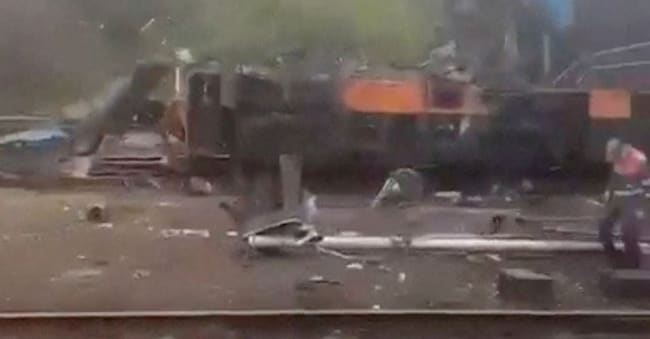
Rottami di un treno passeggeri dopo un attacco con drone russo, nel contesto dell’offensiva della Russia contro l’Ucraina, a Rymachi, nella regione di Volyn, Ucraina, 13 settembre 2026, in un fermo immagine tratto da un video pubblicato sui social media. SOCIAL MEDIA/via REUTERS.

5' min read

Translated by AI
Versione italiana

5' min read

Translated by AI
Versione italiana

“Ukraine has agreed not to target Russian energy infrastructure. Russia has agreed to do the same! The rise in global petrol prices is mainly caused by the war between Russia and Ukraine, not by Iran.” This is what Donald Trump writes on Truth.

According to Ukrainian Railways, the train carrying European diplomats and former British Prime Minister Boris Johnson, which was travelling from Ukraine to Poland, may have been the real target of a Russian attack that struck the convoy that departed later.

Loading...

The train had set off just before the one struck by a Russian drone on the Polish border, and was stopped but not evacuated. “‘It is highly likely that the target of this Russian drone could also have been the diplomatic train, which left the station earlier than scheduled as part of the real-time revision of train timetables, made necessary by the constant threat of Russian attacks,’ the railway company stated.

“I have no idea what twisted logic leads (Vladimir) Putin to blow up a locomotive on the Polish border, but it is the sort of senseless attack that Ukrainians endure every day,” commented Boris Johnson on social media. “When will we give the Ukrainians the air defence systems they need?” said the former British Conservative leader, who was in office when the Russian invasion began in February 2022.

Ucraina, 1654° giorno di guerra

Photogallery20 foto

Tusk: ‘The escalation of Russian actions is becoming a reality’

The Polish Prime Minister Donald Tusk also commented on the matter. “The escalation of Russian actions is becoming a reality, and examples of this are emerging ever closer to our border,” he stated during an emergency briefing with the security services, which was convened following the Russian attack on the train near the Polish border. This was reported by the Pap news agency. “The attacks carried out overnight indicate that the Russians are prepared to deploy more dangerous equipment than that used so far, specifically jet-powered drones,” said Tusk. “What we know and can foresee is that the coming weeks and months will be characterised by a significant intensification of activity on Russia’s part and, unfortunately, we cannot rule out that this escalation may also extend to our territory.”

Rutte: ‘Putin’s attack on the train shows his desperation’

“Yesterday’s attack on a passenger train in Ukraine shows just how desperate Putin has become,” Mark Rutte said at a press conference today. “He believes he can prevent us from supporting Ukraine and undermine our unity. He is mistaken,” the NATO Secretary-General added. “Our response is to step up our support for Ukraine, so that it has what it needs to defend itself”, said the NATO Secretary-General during a joint press briefing with the Slovenian Prime Minister Janez Jansa.

Tajani: ‘Russian attacks on the Polish border are a provocation; we will not be intimidated’

Yesterday’s Russian attack on a train in Ukraine near the border with Poland “is yet another signal from Russia saying: ‘Be careful, don’t help Ukraine too much’”. This was stated by the Foreign Minister, Antonio Tajani, on 24 Mattino on Radio 24. “Russia is certainly sending signals, carrying out provocations and testing the West’s reactions,” added Tajani, who believes that “in this case, we must always stand firm” because “Russia cannot continue with this aggression”, but “without losing” the capacity “for mediation and dialogue”. “We certainly will not be intimidated, but we are advocates of strong peace efforts and we hope that talks can take place between Putin and Zelensky, perhaps with American mediation – or indeed mediation by India or China would also be welcome,” added the minister.

As for the possibility of Moscow attacking Europe, the minister stated: ‘There is a great deal of tension, but I believe that no one intends to go to war. Nor do I believe that Russia has any intention of waging war, because it is well aware that it would lose against the West. Russia would be defeated, so I do not think it is in Russia’s interests to go to war,’ added Tajani, who believes that European countries must ‘continue to work for peace’.

Trump: ‘I asked Zelensky not to target Russian refineries’

Meanwhile, the war on the ground continues. Ukrainian forces have struck the Russian city of Sochi, causing fires and explosions in the urban area, as appears to be shown in some videos filmed by eyewitnesses. This is reported by the Kyiv Independent. According to reports from Ukrainian monitoring channels Exilenova+ and Supernova+, a massive drone attack targeted several sites in the Black Sea resort town – situated in Russia’s Krasnodar region – between 650 and 700 kilometres from the Ukrainian border. Footage captured by Sochi residents shows explosions lighting up the night sky and at least one large fire raging in the city. The mayor of Sochi, Anatoly Pakhomov, has confirmed that Russian air defence systems have been activated.

On the subject of Ukrainian attacks on Russian territory, the US President Donald Trump, speaking to journalists, stated: ‘The problem I have with Ukraine and Russia is that much of the diesel comes from Russia, and this is what is causing a huge increase in imports, whilst Russian facilities are being targeted by Ukraine. I have asked President Zelensky not to target diesel facilities and refineries.” Trump was also asked whether Kyiv would be granted authorisation for the Patriot systems, and the US president clarified that a ‘less sophisticated’ version of the missile systems is under discussion.

Loading...

Moscow: Rosatom chief discusses safety at the Zaporizhzhia power station with Grossi

Alexei Likhachev, the chief executive of the Russian state atomic energy agency Rosatom, met today in Vienna with the Director General of the IAEA, Rafael Grossi, with whom he discussed the recent Ukrainian attacks on tankers transporting fuel to the Zaporizhzhia nuclear power station. This was reported in a statement from Rosatom. The power station, located in the Ukrainian region of the same name, is controlled and operated by the Russians. ‘Diesel supplies are essential for the nuclear safety of the power station,’ Likhachev emphasised, according to Rosatom’s press office. ‘Rafael Grossi said he was ready to assess the options available to the Agency to provide assistance in carrying out these operations,’ the statement reads.

Earlier, the CEO of Rosatom reported that on 11 September the Ukrainian armed forces had attacked tankers carrying diesel to the power station – which had been running on backup generators since the end of August – resulting in the deaths of two Russian servicemen. Subsequently, in an interview with TASS, the plant’s director, Yuri Chernichuk, clarified that ‘IAEA experts present at the Zaporizhzhia nuclear power station can clearly see that it is the Ukrainian army that is launching attacks against the site and its satellite town, Energodar, particularly since the escalation of the situation last spring, but in its reports, the Agency has not yet identified the armed forces of Kyiv as the source of the attacks”.

Over the last four and a half months, according to data provided by Rosatom, Ukraine has struck the Zaporizhzhia power station and the neighbouring town of Energodar more than 750 times with drones and artillery. “Kiev is waging a systematic campaign against civilians and staff at the power station. Since the escalation began, 20 people have been killed, including 9 power station employees, and over 100 have been injured,” the statement reads.

Zelensky: working to produce anti-Shahed drones

Meanwhile, Volodymyr Zelensky, together with the Minister of Defence Yevhenii Khmara and the Commander-in-Chief of the Ukrainian Armed Forces Mykhailo Drapatyi, discussed the need to produce new interceptor drones capable of countering Russian Shaheds. ‘Reports on countering Russian Shaheds and on our work with manufacturers on a new generation of interceptor drones, designed to defend us against jet-powered Shaheds. Solutions exist and testing is already underway. We are accelerating all processes. Ukraine needs an operational defence solution, available in sufficient quantities and with the necessary effectiveness. Together with Defence Minister Yevhenii Khmara and Commander-in-Chief of the Ukrainian Armed Forces Mykhailo Drapatyi, we discussed the steps that could lead to results more quickly. The financial basis for this work has been secured,” Zelenskyy wrote on X.

Copyright reserved ©
Loading...

Brand connect

Loading...

Newsletter

Notizie e approfondimenti sugli avvenimenti politici, economici e finanziari.

Iscriviti