
Under the railway yards 10,000 Greek tombs. It is Himera, the largest necropolis in Sicily
During the works for the construction of the Palermo-Catania railway line, the FS group uncovered important archaeological sites together with finds and burials that were returned to the citizens in an exhibition inaugurated in the presence of Minister Giuli

4' min read
Key points
4' min read
A treasure hidden under the railway construction sites: more than 10,000 tombs dating back to 400 B.C., as well as objects and artefacts of all kinds dating back to Greek settlements in Sicily that have been brought to light and returned to the public, who can now visit them free of charge. The doubling of the Fiumetorto-Ogliastrillo railway line, part of the expansion of the Palermo-Messina line, was not only a work of modernisation of mobility: it turned into one of the most extraordinary opportunities for archaeological research ever in Sicily.
The excavations
.During the excavation operations, entrusted by the FS Group to Rete Ferroviaria Italiana with the technical-scientific support of Italferr, an area of extraordinary historical value emerged: the necropolis of the Greek city of Himera, founded in 648 B.C. by Greek colonists on the coastal plain of Buonfornello. A site already known to archaeologists, but which had never before yielded such an extensive and well-preserved heritage. The numbers speak for themselves: more than 10,000 burials came to light between 2008 and 2011, in an unprecedented archaeological site in terms of size and continuity, financed entirely by the FS Group. A multidisciplinary team of archaeologists, anthropologists, designers, restorers and technicians worked in the field for over two years, documenting, restoring and cataloguing every single find. The result is now a huge digital archive of images, surveys, data and drawings: a unique database for the study of Greek funerary culture between the Archaic and Classical periods.
The exhibition
.To celebrate this discovery, the exhibition 'Himera from the high cliffs. Un viaggio nella necropoli svelata dal raddoppio ferroviario' ('Himera from the high cliffs. A journey through the necropolis unveiled by the railway doubling'), hosted until 10 November in the spaces of Palermo Centrale station, in the Sala Reale (Royal Hall) and the adjacent hall, made available free of charge by GS Retail. The exhibition - conceived by Archeolog Ets, the cultural association of Gruppo Fs - is organised in cooperation with the Archaeological Park of Himera, Solunto and Iato and the Superintendency of Cultural Heritage of Palermo. On display is a selection of the more than 20,000 finds: urns, jewellery, weapons, everyday objects, human and animal remains. These include the tombs of soldiers and citizens who fell in the bloody destruction of the colony by the Carthaginians in 409 BC, an event that marked the end of the city. Archaeologists have also found the remains of horses used in battle and numerous weapons, testifying to those battles that made Himera a key junction in the ancient history of Sicily.
Himera: the Greek colony theatre of great battles
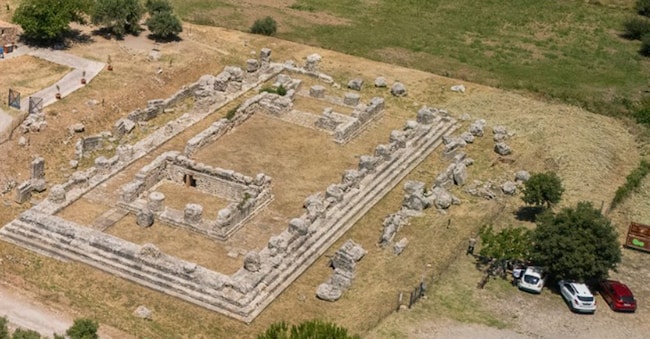
Founded in 648 B.C. by Greek colonists, Himera was the scene of major historical events, including the battles of 480 and 409 B.C., which were destined to deeply mark the history of ancient Sicily. In particular, the Carthaginian victory of 409 B.C. decreed the end of the Greek colony. Of these epic battles, the excavations at Himera have yielded exceptional documentation with the discovery of the tombs of the soldiers, horses and citizens who died in the massacre of 409 BC and the weapons used in the battles. The identification of the site of the colony dates back to 1573 when the humanist Claudio Mario Arezzo indicated the remains, on the hills above the coastal plain of Buonfornello, as the ancient colony of Himera. It was only between 1927 and 1929 that archaeological investigations began with the excavation of the eastern necropolis and the Doric temple of Victory. From 1962 to the present day, excavations, continued thanks to the efforts of the Superintendency of Palermo and the Universities of Palermo and Berne, have made it possible to establish the limits of the city, bringing to light large portions of the settlement and a large extra-urban 'port' district, the large sanctuary of Athena and sections of the fortifications; extensive areas of the necropolis have also been explored.
The finds unearthed
.Between 2008 and 2011, more than 10,000 burials were unearthed, with scientific results of enormous importance for our knowledge of the Greek funerary sphere of the Archaic and Classical periods. The archaeological site, entirely financed by the FS Group and under the scientific direction of the Superintendency of Cultural and Environmental Heritage of Palermo, involved a team of dozens of archaeologists, anthropologists, draughtsmen, restorers, labourers and topographical technicians, all of whom were present in the field consecutively for over two years. As a result, it was possible to create a complete documentation of the archaeological finds, initiate field restorations, catalogue all the finds, and create a large archive of drawings and photos in digital media, which today constitute an enormous source of data for the study of one of the largest necropolises in Greece from the Archaic-Classical period.


