
Underwater infrastructure, Fincantieri's protection system launched
Christened Deep, it works with drones and is installed in La Spezia, in the Navy's Naval Support and Experimentation Centre

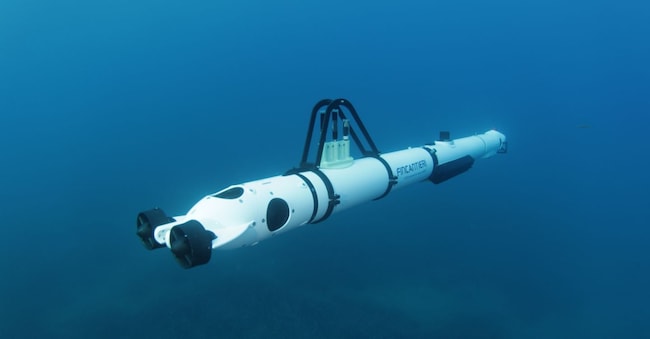
The first Fincantieri-designed system for the protection, development and maintenance of critical underwater infrastructures, as well as for the monitoring and protection of the marine environment has been launched: it is called Deep and is defined as a 'system of systems', with the characteristic of being modular, scalable (i.e. able to sustain increases and decreases in workloads) and cyber-secure. It has been installed, for demonstration purposes, at the Italian Navy's Naval Support and Experimentation Centre (CSSN) in La Spezia, and was officially presented today.
To effectively protect infrastructures such as submarine pipelines, electrical and telecommunication cables (but if installed in more restricted environments, it can perform the same functions in ports and offshore installations), Deep integrates four key components: firstly, an acoustic barrier (Early Warning System) that acts as an alarm system and is able to detect the presence of intruders in the monitored volume of water and track their position. The Ews is based on hydrophone fibre-optic sensors and can be installed up to 100 kilometres away from the asset to be protected.
The second key component is a team of autonomous underwater drones (Auv) for detecting anomalies and potential threats and for mapping the seabed and infrastructure. The vehicles are equipped with acoustic, optical and environmental sensors, as well as real-time computing capabilities. Then there is the command and control software (Underwater management system - Ums) that integrates and merges the data collected by the sensors and drones, allowing for rapid overall management of the solution. Finally, an artificial intelligence-based data analysis and recognition system allows for accurate image processing and recognition of features on the seabed. In essence, the drones are equipped with advanced Ai-based algorithms that allow for accurate image processing and automatic target recognition.
Deep, Fincantieri's engineers explain, 'exploits both the company's advanced technologies and those of a national chain of SMEs and universities, offering a tailor-made solution for civil and defence needs. Its architecture is based on resilience, modularity and security (safety & cyber), ensuring operational continuity and adaptability even in hostile environments and under complex threat conditions'.
Thanks to its modular design, Deep can also be integrated with autonomous surface vehicles such as the Sand (Unmanned surface vehicle by Ids, a subsidiary of Fincantieri) and advanced anti-drone sensors, such as Omega360 (produced by Fincantieri), thus extending surveillance and protection to non-submarine areas.


