Discrimination

Unicef: 122 million girls excluded from education worldwide

Unicef reveals alarming data on the lack of access to education for millions of girls worldwide.

by Rosanna Magnano

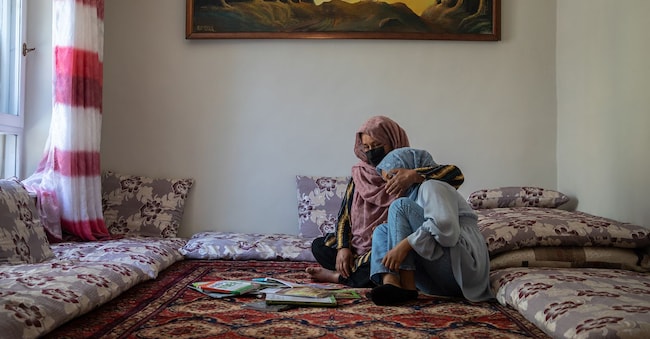
L'8 giugno 2024, Lateefa*, 42 anni, conforta la figlia Zainab* che piange e non va a scuola da tre anni. Lateefa ha cinque figli, due maschi e tre femmine.  "Avevo molti sogni, proprio come mia figlia, ma non sono riuscita a vederli realizzati. La nostra famiglia è fuggita dall'Afghanistan dopo la presa di potere dei Talebani nel 1996 e io ho dovuto lasciare la mia scuola quando frequentavo la prima media".  "Zainab piangeva spesso ed è diventata molto depressa da quando non va più a scuola. Cerchiamo di confortarla mandandola a frequentare un corso di inglese e di sostenerla il più possibile".  "Sono molto preoccupata per il suo benessere. Si sente molto sola a non vedere i suoi amici".  "Credo che sia molto importante che le ragazze ricevano un'istruzione. Ho fatto esperienza di una vita senza istruzione. È molto difficile. Non posso nemmeno aiutare i miei figli a studiare e questo mi ferisce profondamente".  *I nomi sono stati cambiati. (© UNICEF/UNI590567/Amin Meerzad)

3' min read

Translated by AI
Versione italiana

3' min read

Translated by AI
Versione italiana

There are 122 million girls worldwide who do not attend school. And girls between the ages of 15 and 19 are twice as likely as boys not to be included in school, work or training activities. In fragile contexts this figure rises to 90 per cent more likely not to attend school than girls in stable contexts. In the same age group, one in four girls in a relationship has experienced violence from her partner. One in five young women between the ages of 20 and 24 was married as a child. And in fragile contexts child marriage rates are almost double the global average. These are the figures compiled by Unicef on the occasion of the International Day of the Girl Child, which is celebrated on 11 October.

The risk of abuse, discrimination, early marriage and maternal mortality increase in contexts of crisis and conflict. "Despite the progress made in the last 30 years," explains Nicola Graziano, Unicef Italy President, "in the lives of girls and adolescent girls, their rights continue to be violated in many parts of the world. Celebrated every year on 11 October, the Day is a key global moment to celebrate girls around the world, amplify their voices, their actions and their leadership".

Loading...

Some progress has been made globally. The percentages quoted by Unicef have improved over the last decades. Girls and adolescents out of high school have fallen from 49% in 2020 to 30% in 2023. Girls aged 15-24 excluded from education, training or employment have fallen from 33% in 2005 to 28% in 2023. Early marriages have also fallen from 25% in 1998 to 19% in 2023.

One of the watersheds - thirty years ago - was the 4th World Conference on Women in Beijing, an event that in 1995 represented a historic turning point in the fight for gender equality, giving rise to the Beijing Platform for Action, with its twelve strategic goals to promote the rights of women, girls and children worldwide.

These include ensuring equal access to training and education, improving access to health care, preventing and eliminating all forms of violence, promoting economic empowerment and equality at work.

Where do we stand in Italy? On the occasion of the International Day of the Girl Child, Unicef Italy inaugurated the Unicef Interview Workshop. In this first edition - "We, girls of today" - dedicated to the 30th anniversary of the Fourth World Conference on Women in Beijing, Unicef takes stock of the progress made with the contribution of Linda Laura Sabbadini, former central director of ISTAT and a reference point for the dissemination of gender data in Italy.

Women and Science still far behind. In terms of education, in our country girls continue to be underrepresented in STEM disciplines (science, technology, engineering and mathematics): only 16.8% of female graduates choose scientific or technological subjects, compared to 37% of men (ISTAT Annual Report, 2025) and the school route also varies according to the country of origin: 66.6% of Italian girls choose high school, while among foreign girls the share drops to 49.4%. On the contrary, in vocational institutes, they are overrepresented: 20.8% compared to 13.9% of Italian girls (Ministry of Education and Merit, ''Pupils with non-Italian citizenship''). A sign, underlines ISTAT, that socio-economic and cultural factors still strongly influence access to educational opportunities.

On the labour market, the gap persists. In 1995, the female employment rate stood at 38.2%, while the male rate was 67%.

(Istat database 1995 "Historical series"). Today, women work more - reaching 53.3 per cent - but the gap remains wide compared to the employment rate of men at 71.1 per cent (Istat Annual Report, 2025). The gender gap still stands at almost 18 percentage points. Yet, thirty years ago, women were already outperforming men in diplomas and degrees. Today, despite this educational advantage, 38.1 per cent of young female graduates are employed in jobs that are under-qualified compared to their qualifications.

Gender-based violence remains an emergency. Despite legislative advances - from the ratification of the Istanbul Convention (2013), to Code Red (2019), to the introduction of the anti-violence number 1522 (2024). A recent survey by the Department of Public Security reveals an ambivalent picture: while 95% of young people consider it essential to talk about gender-based violence, worrying signs are emerging. 66% of girls report having been pressured by their partner on how to dress, while almost half of boys consider it normal to check their partner's social profiles (Analysis of questionnaires - Young people and gender-based violence, 2024). Cultural change is underway, but it is still not enough.

Copyright reserved ©

Brand connect

Loading...

Newsletter

Notizie e approfondimenti sugli avvenimenti politici, economici e finanziari.

Iscriviti