
United League-Russia, what's in the now renegade cooperation agreement
The understanding, signed in March 2017, stipulated that the parties would consult and exchange 'information on current issues, international relations, exchange of experiences in the sphere of youth policies, economic development'.

3' min read
Key points
3' min read
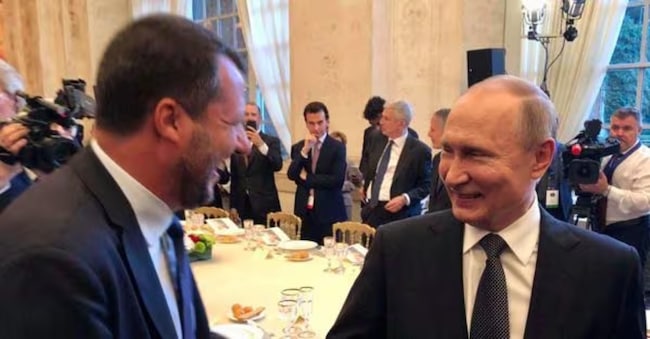
Between today and tomorrow the motion of no-confidence of the oppositions to the minister Matteo Salvini, which concerns the League's relations with United Russia, the party of Vladimir Putin, arrives in the Chamber of Deputies. Motion tabled by Azione (and signed by the leaders of Pd, M5s and Avs) after the Carroccio secretary's statements following the death in prison of Russian dissident Aleksei Navalny ("Clarity is needed. But the doctors, the judges do it, we don't do it'), lacking an explicit condemnation of the Russian president. The League's note in which the Carroccio argued yesterday that 'after the invasion of Ukraine, the purely political collaboration intentions of 2017 between the League and United Russia no longer have any value' was not enough to convince Carlo Calenda's party to withdraw the motion. To do so, the latter demanded written proof of the termination of the agreement. Action group leader in the Chamber of Deputies Matteo Richetti reiterated that "that agreement contains an automatic renewal clause" and that Salvini's ambiguities on Russia are far from clear".
The Origins of the Agreement
.But how did the understanding between the League and United Russia come about and what does it contain? The first piece dates backto October 2014 when the two parties agreed on the preparation of a programmatic agreement of cooperation between the two political camps. Those were the days when the League was siding against the (mild) sanctions on Russia following the annexation of Crimea. 'The agreement with United Russia is another important piece of a European alliance between parties that share the same identity ideas and I am sure that cooperation between Russia and Europe will resume with vigour also thanks to these transnational programmatic agreements,' Salvini declared at the time.
Agreement signed in Moscow in 2017
The actual signing of the 'cooperation and collaboration' agreement dates back to 6 March 2017. The document was signed at the headquarters of the Russian ruling party's Executive Committee by the Carroccio secretary, Matteo Salvini, and the deputy secretary general of United Russia's Council for International Relations, Serghiei Zhelezniak. The agreement stipulated that the parties would consult and exchange 'information on current issues, international relations, exchange of experiences in the sphere of youth policies, economic development'. There would be - the document reads - 'regular exchanges of party delegations at various levels', 'bilateral and multilateral seminars, conferences and round tables on the most topical issues of Russian-Italian reactions'. Salvini emphasised at the time that it was the first agreement 'so detailed and of this level' that the Carroccio signed with a foreign party: 'Not even with the Front National did we formalise it like this' was the final comment on a five-year agreement, which would, however, provide for tacit renewal in the absence of explicit communication by the parties. And since there is no record of the protocol being terminated, it would be renewed on 6 March 2022, when Putin had already invaded Ukraine (24 February 2022).
In 2018 the cooperation agreement between the League's 'youth' and United Russia
.Not enough. A year and a half later, in November 2018, it was the youth wing of the League that signed a cooperation agreement with the United Young Guard of Russia. The news was reported by Tass citing representatives of the Carroccio. A delegation of young Lega members headed by MP Andrea Crippa went to Moscow, the news agency reported. 'Our interaction,' reads the statement from the youth branch of the League, 'is based on the common cultural values we share, such as maintaining European identity and traditions in the face of globalisation. Russia represents one of the pillars of the defence of traditional, Christian and family values in Europe'. The organisation of the trip was helped by the Lombardy-Russia cultural association led by Gianluca Savoini, who was in charge of relations between the League and the Russian Federation at the time.


