The ‘Deportation Project’ investigation

United States: more than 25,000 migrants deported to third countries

The Trump administration has signed agreements with 35 developing countries to deport migrants, investing more than 400 million dollars.


 AP Photo/Jacquelyn Martin

3' min read

Translated by AI
Versione italiana

3' min read

Translated by AI
Versione italiana

Getting on a plane knowing you are leaving your home, but without knowing where you are going. And with no chance of returning. This is the story that unites more than 25,000 people, who also have in common the fact that they are immigrants to the United States.

The ‘Deportation Project’ investigation, carried out by twenty-four news organisations and coordinated by the Paris-based organisation ‘Forbidden Stories’, reveals that Washington is said to have entered into private agreements with 35 developing countries to take in migrants who cannot be legally repatriated to their country of origin. Since President Donald Trump took office in January 2025, just over $400 million has reportedly been allocated to manage these transfers. This money is said to have been paid both directly to the receiving states and to UN agencies.

Loading...

The geography and volume of transfers

The figures and information describing this phenomenon are being kept confidential by the Trump administration. Nevertheless, it has been possible to piece together the routes and the scale of the transfers thanks to the work of NGOs such as Refugees International and Human Rights First. The latter have set up a website to track the agreements entered into with third countries, as well as the number and nationalities of people deported each month.

According to the data collected, as at 31 August 2026, at least 25,447 people had already been deported from the United States. Of these, around 20,000 were transported by bus to neighbouring Mexico. The remainder were put on flights bound for countries in Africa – Ghana, Equatorial Guinea and the Central African Republic, which took in the largest numbers – as well as to Central America – with Guatemala, Costa Rica and Honduras leading the way – and to the Caribbean, Central Asia and Eastern Europe.
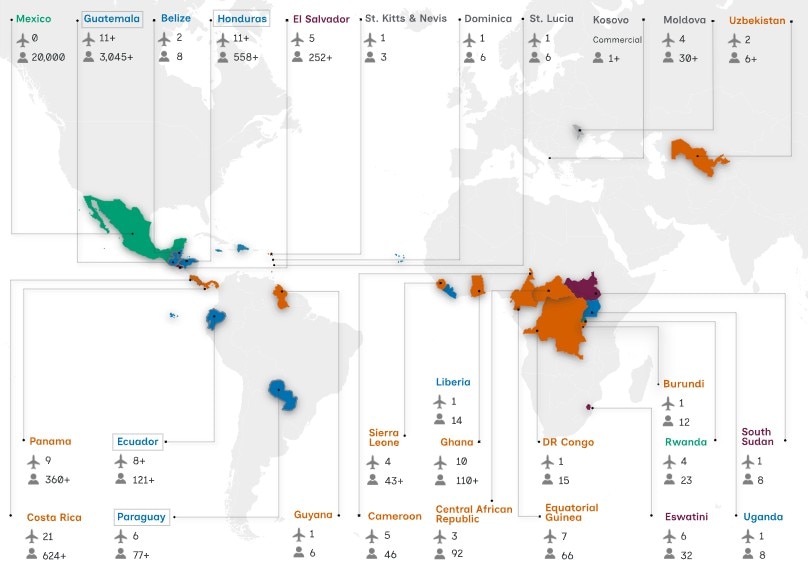
In all these destinations, the vast majority of migrants have neither family nor acquaintances. Furthermore, they are often subsequently returned to their country of origin, where their freedom and their lives are at risk.

Mappa degli spostamenti, tracciata nell’ultimo anno dalle Ong Human rights first e Refugees International

As the ‘Deportation Project’ investigation highlights, the figures for the transfers are likely to be an underestimate, given that they only take into account flights that journalists have been able to verify independently.

The British newspaper *The Guardian*, one of the publications that took part in the investigation, states that the frequency of deportation flights is increasing: following an initial surge during the first few months of Trump’s second term, the number of deportations rose again in August, when a record number of sixteen flights departed for thirteen different countries.

The legal aspects of remigration

Whilst the Trump administration cites the removal of criminals from the United States as the rationale for its remigration policies, the ‘Deportation Project’ has gathered the stories of people who are far from being defined as criminals: there is the nurse originally from Sierra Leone, the only one able to look after her parents in the US; there is the gay man who fled Ghana because he was persecuted by his own family; there is the Iranian dissident; and there are many others.

Loading...

Human rights lawyers have described the agreements with third countries as part of a ‘show of force’ by Washington, aimed at deterring migrants and asylum seekers from entering the country. The operation is being carried out by the Office of Remigration, a new section set up within the US State Department’s Bureau of Population, Refugees and Migration. The government agency is reportedly exploiting a loophole in US law, under which it is illegal to return people to their countries of origin where they risk persecution. The law, therefore, does not address the option of sending migrants to third countries.

But a US federal court of appeal did just that last Friday, 18 September: it ruled that deportations to third countries are unlawful, because the notice periods are insufficient and do not allow those affected to legally challenge the decision to be transferred to another country. The US Government, for its part, has ninety days to lodge an appeal. “The policy of deportation to third countries continues,” said James Percival, General Counsel at the Department of Homeland Security.

Copyright reserved ©
Loading...

Brand connect

Loading...

Newsletter

Notizie e approfondimenti sugli avvenimenti politici, economici e finanziari.

Iscriviti