
Unitree set for a record-breaking IPO: Beijing launches a super robot and takes on Musk
Enormous demand for the group that produces a humanoid with exceptional physical and computational capabilities. The listing in Shanghai will be a test case for AI on the stock market

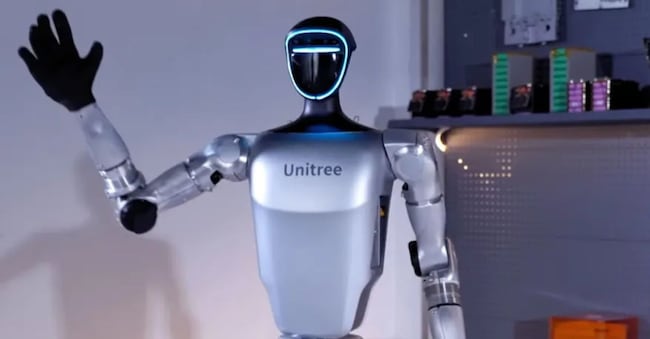
The best humanoid robot from the Chinese company Unitree, nicknamed “Superman”, reaches a top speed of over 45 kilometres per hour and can jump more than two metres in height from a standing start. With a few more improvements, it could, in the near future, break two iconic athletics records: Usain Bolt’s 9.58 seconds in the 100 metres (Berlin 2009) and the 2 metres 45 centimetres jumped by Javier Sotomayor in Salamanca in 1993. Back then, the idea of a robot with such agility, speed, intelligence, computing power (it can house up to three Nvidia AI modules) and a base price of around 16,000 dollars would have been pure utopia.
Today, however, Unitree Robotics is a company poised to list on the Shanghai Stock Exchange and to set – here too – a series of records. Starting with its debut performance: on Tuesday, crypto futures linked to the Chinese group were soaring, suggesting a valuation more than four times that set for the IPO, i.e. over $40 billion. This means that the share price, starting at 150 yuan, could rise above 600. These figures are in line with those already circulating last week: retail demand that exceeded the supply of more than 8,000 times (the probability of being allocated shares is 0.018 per cent – practically a lottery) and traders already queuing up to buy the shares ahead of the official listing at a 170 per cent premium. In short, figures never seen before, although – it must be said – in terms of scale, the gap with the other landmark listing of 2026, SpaceX, remains and will remain vast.
The reasons behind the ‘humanoid’ craze
How can one explain such a frenzy surrounding the first IPO of humanoid robots in mainland China? Moreover, this comes at a pivotal moment, globally, for the tech sector in general and artificial intelligence in particular, with industry insiders seeking signs (and confirmation) that the system remains sound, against a backdrop of high valuations and increasingly ambitious bets on future revenues. First and foremost, Unitree has the advantage that it is already generating profits, is of significant size and has the capacity to scale: in 2025, it generated revenue of 1.7 billion yuan (252 million dollars), more than four times that of the previous year, with a gross margin of around 60 per cent. And unlike Optimus – developed by Musk’s Tesla and focused on other priorities – it is already marketing its own models.
Furthermore, Unitree is a story riding the wave of the delayed AI rally in China: since the start of the year, the Star 50 technology index – on which the humanoid robot group will be listed – has risen by nearly 30 per cent. Proof of this is that the shares have not only appealed to small savers – who are used to seeing robots dance and practise martial arts on the Lunar New Year’s Eve show (the equivalent of the Super Bowl in terms of audience figures) – but also to major institutional investors in China, including Tencent and even hedge funds linked to the founder of DeepSeek, Liang Wenfeng. Not to mention – and this is no minor point – a touch of patriotic pride, given that Unitree’s robots are the symbol of Beijing’s technological propaganda.
Limx Dynamics is also aiming for an IPO
This combination of factors has not only paved the way for a record-breaking listing for Unitree, but is also prompting other groups in the sector to consider going public. Among these – as reported yesterday – is LimX Dynamics, which is said to have quietly begun preparations for an IPO in Hong Kong. The Shenzhen-based company manufactures humanoid robots for domestic, industrial and research use, as well as for commercial settings, and counts tech giants Alibaba and JD among its backers.


