
Record debut for Unitree in Shanghai: Chinese ‘super robots’ close up 460 per cent
In the first trading session, the group that produces a humanoid with exceptional physical and computational capabilities has soared: it is now valued at 50 billion dollars

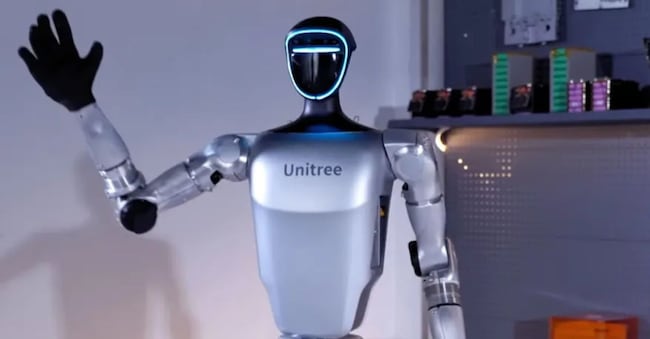
A debut to remember for Unitree on the Shanghai Stock Exchange. Shares in the Chinese start-up, which manufactures humanoid robots, initially soared by as much as 629 per cent compared with the IPO price on their first day of trading on the Chinese market, reaching 1,100 yuan per share. The company’s market capitalisation thus reached approximately 445 billion yuan, equivalent to 66 billion dollars. The share price then retreated slightly, settling at around 460 per cent above the IPO price, at 845 yuan, giving it a market value of 50 billion dollars.
The best humanoid robot from Unitree, named ‘Superman’, reaches a top speed of over 45 kilometres per hour and can jump more than two metres in height from a standing start. With a few more improvements, it could, in the near future, break two iconic athletics records: Usain Bolt’s 9.58 seconds in the 100 metres (Berlin 2009) and the 2 metres 45 centimetres jumped by Javier Sotomayor in Salamanca in 1993. Back then, the idea of a robot with such agility, speed, intelligence, computing power (it can accommodate up to three Nvidia AI modules) and a base price of around 16,000 dollars would have been pure utopia.
Today, however, it is a reality, as are the record prices achieved during the first trading session in Shanghai. After all, as early as Tuesday 18 August, crypto futures linked to the Chinese group were soaring, suggesting a valuation more than four times that set for the IPO – and therefore over $40 billion. And judging by the share price performance, they had even been pessimistic, given that Unitree is already worth 50 billion.
These figures are in line with those that were already circulating last week: retail demand exceeded supply of more than 8,000 times (the probability of being allocated shares was 0.018 per cent – practically a lottery) and traders already ready to buy the shares ahead of the official listing at a 170 per cent premium – in hindsight, a bargain given the 500 per cent rise. In short, unprecedented figures, although – it must be said – in terms of scale, the gap with the other landmark listing of 2026, SpaceX, remains and will remain vast.
The reasons behind the ‘humanoid’ craze
How can we explain such a frenzy surrounding the first IPO of humanoid robots in mainland China? Moreover, this comes at a pivotal moment, globally, for the tech sector in general and artificial intelligence in particular, with industry insiders seeking signs (and confirmation) that the system is holding up, against a backdrop of high valuations and increasingly ambitious bets on future revenues. First and foremost, Unitree has the advantage that it is already generating profits, is of significant size and has the capacity to scale: in 2025, it generated revenue of 1.7 billion yuan (252 million dollars), more than four times that of the previous year, with a gross margin of around 60 per cent. And unlike Optimus – developed by Musk’s Tesla and focused on other priorities – it is already marketing its own models.


