The Trump era

Unprecedented facts in the US and institutions do not react

Never has a president so shamelessly stepped outside the perimeter of his role, without any serious resistance from traditional countervailing powers, public or private

by Carlo Melzi d'Eril - Giulio Enea Vigevani

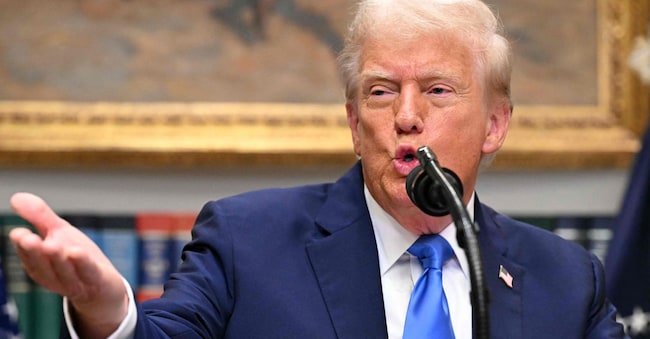
Il Presidente degli Stati Uniti Donald Trump parla di autismo nella Sala Roosevelt della Casa Bianca a Washington il 22 settembre 2025. (Foto di Saul Loeb / AFP)

3' min read

3' min read

Unprecedented things are happening in the United States. Never, at least since the days of McCarthyism, had political power trampled underfoot in such a short space of time and with such arrogance individual and collective rights that were considered untouchable, because they were the common heritage of the whole of society. And never had a president so shamelessly stepped outside the perimeter of his role, without any serious resistance from the traditional countervailing powers, public or private.

In particular, we are stunned by the daily erosion of the spaces of free information in what, perhaps only in our imagination, was considered the home of free speech. We cannot quell a question that spontaneously comes to our lips: how was this possible? Why don't the antibodies seem to be working?

Loading...

In the USA, administrative authorities, which have always been jealous of their autonomy, seem to have become the armed arm of political power. The case of the FCC, the independent government agency that regulates communications, is emblematic: it lent itself to ventilating the possibility of revoking the licence of a television network if it did not fire an anchorman who had shown hostility to the president.

But it is another fact that seems even more worrying: in the face of the president's ukase, whether they are manifestations of his political line or personal interests matters little, the large private institutions have not shown the capacity to react that one might have expected.

Everyone, from web giants to the most prestigious universities, from the most influential law firms to traditional media companies, with rare exceptions at risk of martyrdom, have readily bowed to every wish, accompanied by often explicit threats.

As for the 'free press', it is largely owned by tycoons who do not want to sacrifice their main interests in defending the freedom of journalists. So they would rather silence those who oppose power than risk losing government favours. And who knows what will become of the journalist who was silenced and called 'hateful' at a recent press conference.

And all this certainly for short-term economic gain, but perhaps also for some condescension towards a system with clear authoritarian traits, quite different from the one in which all these 'institutions' were born and have prospered. In short, a betrayal of the ruling classes not dissimilar to that which contributed in no small measure to the collapse of the European democracies a century ago.

Is this the wind of history? In other words, can something similar happen in Italy?

Of course, the tendencies to limit dissent and control the media are not only American, and there are also elements of concern here. The European Union's 2025 rights report highlights government interference in RAI, the intermingling of publishing, economic power and political power (this is the case of Angelucci, publisher of many right-wing newspapers, parliamentarian and important health care entrepreneur), the weakness of editorial offices and journalists, often paid starvation wages.

On the other hand, the Italian institutions that protect freedom of speech, from the Constitutional Court, to the ordinary judiciary, to the regulatory authorities, have hitherto been solid embankments against the overflowing of political power. And new antibodies come from Europe: the entry into force last August of the regulation on media freedom imposes a common minimum standard to guarantee the rights of journalists and editorial independence, transparency and pluralism of the media.

There is also a provision that takes on a peculiar significance in the Italian context: European legislation states, with a clarity never seen before, that only independent public services freed from government control can guarantee plural and quality information. Thus, it lays down a series of obligations concerning the appointment and dismissal of directors and the sources of financing of RAI, which the Italian Parliament does not seem to want to adopt for the time being, but which appear significant in order to understand which 'wind of history' our rulers want to be guided by.

Copyright reserved ©
Loading...

Brand connect

Loading...

Newsletter

Notizie e approfondimenti sugli avvenimenti politici, economici e finanziari.

Iscriviti