The gap between cities and suburbs

Urban gaps at the top, income gap widens in big cities

Income gaps are flanked by social gaps

by Marta Casadei and Michela Finizio
5' min read

5' min read

Just under 28 thousand euro in the centre and about 22 thousand in the suburbs. The average income declared by Italians living in the 14 metropolitan city capitals is 1.3 times higher than that of the inhabitants of the other belt municipalities, which make up the hinterland. The gap between cities and suburbs runs across the whole country, but is more marked in the metropolitan areas. On average, in the other capital cities, income stands at 26 thousand euro, against the 22 thousand euro of taxpayers in the provinces, with a ratio of 1.18. In practice, in the heart of the large urban poles, values are 27% higher than those declared in the 'out-of-town' areas, compared to a gap that stops at 18% in the rest of the country.

Increasingly unequal metropolis

Income inequalities are on the rise in Italy, and this has also been certified by Istat. In March, in its latest report on 'Living conditions and household incomes', the institute classified Italians into five groups, from the lowest to the highest equivalent income (the first quintile includes the 20% with the lowest incomes, the last quintile the 20% with the highest incomes): in 2023, the income of the former was 5.5 times lower than the income of the latter. A summary measure of inequality, worsening compared to 2022 (when the ratio between the two 'extremes' was 5.3).

Loading...

I NUMERI NELLE CITTÀ METROPOLITANE

I divari nel reddito medio complessivo dichiarato (anno di imposta 2019- 2023)

Loading...

In the 14 metropolitan areas, moreover, the gaps are widening, as ISTAT also emphasised in its thematic report on 'Fair and Sustainable Welfare' last November. Around 21.3 million inhabitants, or 36.2% of the population, live here. Characterised by high population density and strong economic and social interaction, large cities are home to inequalities that manifest themselves in several areas: income, access to services and quality of life.

The gap between centre and periphery

.

Income gaps, in particular, are found between the most central areas and the suburbs, but also between neighbourhoods within the same city. The gap emerges from an analysis of municipal and sub-municipal data on 2024 declarations (which photograph the 2023 tax year), published by the Ministry of Finance. The highest income gap is recorded in Reggio Calabria, where those who live in the centre declare an income 1.46 higher than those who live in the suburbs: 22,903 euro against 15,642 euro (the lowest figure among metropolitan cities). Right behind, in income inequality between the urban centre and the hinterland, Milan (1.43), Palermo and Rome (both 1.42) stand out.

The capital of Lombardy, in particular, shows the highest average income (40,521 in the city in 2023) and the greatest distance to that of the suburbs (28,380 euro), presenting the most marked inequality even among the districts within the same city (in the 'richest' district, the declared total average value is close to 95,000 euro).

Milan is also the only metropolitan area in which, extending the analysis to the period between 2019 and 2023, this income gap widened slightly, with an increase in such incomes of 13.9 per cent in the centre and 11.7 per cent in the suburbs.

Rome, on the other hand, recorded an average income of 31,360 euro in the city in 2023 and 22,148 euro in the other municipalities of the metropolitan area. The latter figure is also lower than that of Bologna (26,645 euro in the city), Genoa (25,697), Florence (25,124), Turin (25,191) and Venice (24,336 euro).

The differences between neighbourhoods

.

The Mef's numbers speak for themselves: in the metropolitan area of Lombardy's capital city there is a Cap (Cap 20145, which includes several areas: from De Angeli to San Siro, all in the western area) where the average declared income in 2023 exceeds 94 thousand euro. On the other hand, in the area identified by Cap 20157 (which includes Quarto Oggiaro, as well as the Gallaratese neighbourhood), the average income exceeds 20 thousand euros by a small margin. Between the two portions of the city (it is not even a metropolitan area: the areas fall within the boundaries of the municipality) there is therefore an income difference of about five times. The same is true for Rome, where the lowest declared income is 17,317 euro (in Cap 00119) while the highest is over 77,500 (in Cap 00197) and therefore almost 4.5 times higher. Income inequality is also very high in Palermo where the lowest incomes are concentrated in the area identified by Cap 90137 and reach the threshold of 9,000 euro while the highest ones, declared by those living in the areas codified by Cap 90144, exceed 37,200 euro. The ratio, even here, is almost five times.

I QUARTIERI

Loading...

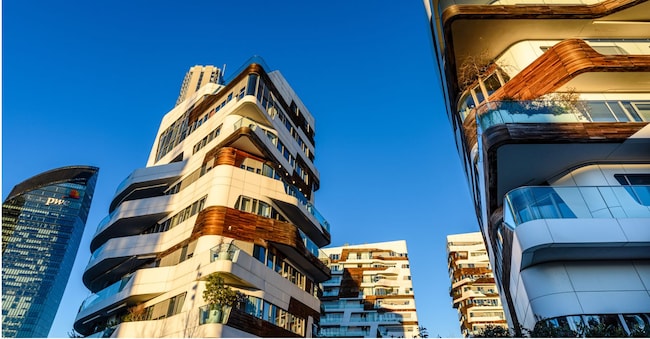
Wealth, in practice, in large metropolitan areas is all concentrated in a few neighbourhoods, in stark contrast to areas whose postcodes differ only by a few digits and which tell an entirely different story. On the one hand, the skyscrapers of Citylife in Milan, home to millionaire footballers and influencers, or the stately palaces of Parioli, strongholds of the Roman upper middle class. Or the villas of Corso Picco, inhabited by football professionals stationed in Turin (including, among the richest ever, Cristiano Ronaldo). On the other hand, Quarto Oggiaro, which is only a few kilometres away from the Three Towers of Milan; Ostia Antica and Bagnoletto, which are also geographically distant from Parioli, or Barriera di Milano, a large working-class neighbourhood on the outskirts of Turin.

I LIVELLI DI ISTRUZIONE

Laureati o dottori di ricerca ogni 100 abitanti

Loading...

Social divides

.

The differences risk causing irremediable fractures in the urban skeleton, in the absence of a systemic policy. Don Marco Pagniello, director general of Caritas Italy, is convinced of this: 'Cities have a higher rate of serious marginality, also due to the presence of certain places such as stations or large spaces such as the suburbs, abandoned buildings'. The situation, according to Pagnello, 'must be tackled in its complexity, with a multidimensional and multifactorial approach that takes into account different issues: housing, care and services'.

Income gaps are accompanied by social gaps. In this case too, ISTAT analyses confirm this: for example, the standardised mortality rate for dementias and diseases of the nervous system (65+) for 2019, 2020 and 2021 is lower in the metropolitan municipalities than in the other municipalities of the metropolitan city; in 2021 in Florence there was a 28% excess of mortality in the hinterland (32.4 deaths per 10,000 inhabitants) compared to the capital (25.4 per 10,000). Finally, the distance is also found in education levels: on average, in the metropolitan cities, the rate of university graduates or PhDs per 100 inhabitants is 2.1 times higher than in the hinterland. In Catania this ratio is even 4.9 times, with a rate of 12.8 per cent in the city compared to 2.6 per cent in the other municipalities of the urban belt.

Copyright reserved ©
Loading...

Brand connect

Loading...

Newsletter

Notizie e approfondimenti sugli avvenimenti politici, economici e finanziari.

Iscriviti